

Software expenditure rarely becomes excessive through one major purchasing decision. More often, it accumulates gradually. A department adds a subscription to solve an immediate problem, another team purchases a similar application, and existing contracts renew with additional licences that are no longer required. Over time, organisations can end up paying for overlapping functionality, unused entitlements and premium features that deliver limited operational value.
The challenge is to reduce this expenditure without disrupting the systems employees depend on. Enterprise software sourcing cost optimization provides a structured way to examine software demand, supplier pricing, contract terms and actual usage before making purchasing decisions. It helps organisations distinguish between genuine savings opportunities and reductions that could create greater costs through lost productivity, service disruption or replacement requirements.
Start with the Software Estate, Not the Renewal Quote
Renewals are often treated as isolated commercial events. A supplier sends a proposal, procurement reviews the increase and negotiations begin. However, the most useful questions should be asked before the renewal reaches the negotiation stage.
Does the organisation still need every product included in the agreement? Are employees using the licence tiers assigned to them? Does another platform already provide similar functionality? Have business requirements changed since the original contract was signed?
A consolidated software inventory can help answer these questions. It should connect contract information with licence assignments, user activity, application ownership and renewal dates. Without this visibility, procurement teams may negotiate discounts on products the organisation should be reducing or discontinuing altogether.
The inventory should also distinguish between business-critical applications and tools that can be consolidated. A lightly used application may still support an important regulatory or operational process. Usage data is an important starting point, but it should not be treated as the sole basis for removing access.
Five Areas Where Software Costs Can Be Reconsidered
- Licence allocation and utilisation. Organisations should compare purchased entitlements with active usage. Inactive accounts, duplicate assignments and licences retained after employee departures can create avoidable expenditure. Reclaiming these entitlements before buying additional capacity is often a practical first step.
- Product overlap. Different departments may purchase tools with similar capabilities, particularly in collaboration, document management, analytics, project management and cybersecurity. Consolidation may reduce subscriptions and simplify administration, provided the selected platform meets the needs of all affected teams.
- Licence tier selection. Premium editions are not always necessary for every employee. Some users may require advanced analytics or administrative controls, while others need only basic access. Assigning licence tiers according to role and usage can improve cost efficiency without removing essential functionality.
- Contract structure and renewal conditions. Minimum purchase commitments, automatic renewals, price escalation clauses and inflexible user quantities can restrict an organisation’s ability to manage demand. Procurement teams should examine whether contracts allow adjustments as the workforce and technology environment change.
- Support and maintenance arrangements. Organisations should review whether their support packages reflect actual operational requirements. Premium support may be essential for business-critical applications, but the same service level may not be necessary for every product.
How to Protect Capability While Reducing Spend
Cost optimisation becomes risky when it is driven by a savings target without sufficient consideration of operational impact. Removing a subscription may appear straightforward until employees lose access to a workflow, integration or data source that has no immediate replacement.
A more reliable approach is to classify applications according to business criticality, functionality and usage. Procurement should work with IT owners and business users to identify which products can be rationalised, which require renegotiation and which should remain unchanged.
Where consolidation is being considered, organisations should test the proposed replacement against real workflows. The assessment should cover integration requirements, data migration, user experience, security controls and support availability. Migration costs and employee training should be included in the business case rather than treated as incidental expenses.
Supplier negotiations should also extend beyond headline discounts. Organisations can seek improved price protection, flexible licence quantities, transparent renewal terms and clearer treatment of additional users or modules. A lower unit price is useful, but contractual flexibility can be just as important when future demand is uncertain.
Building a Sustainable Software Sourcing Model
One-time licence clean-ups can deliver immediate benefits, but savings may gradually disappear if purchasing practices remain unchanged. Organisations need clearer ownership of software categories, approval processes for new subscriptions and regular reviews of usage and contract performance.
A centralised renewal calendar can help procurement teams identify upcoming commitments early enough to assess alternatives. Standardised software request procedures can also prevent departments from independently purchasing products that duplicate existing capabilities.
The aim is not to eliminate every overlapping application. Different business functions may have legitimate reasons for using specialist tools. The objective is to ensure that every subscription has a clear purpose, an accountable owner and a commercial arrangement that reflects its value.
How Nexdigm Supports Software Sourcing Cost Optimization
Nexdigm supports organisations through software market research, supplier benchmarking, procurement analysis and commercial intelligence. Its research can help clients assess software alternatives, compare licensing structures, identify supplier pricing opportunities and evaluate the commercial implications of consolidation. This provides procurement teams with a stronger basis for reducing expenditure while protecting business-critical capabilities.
Software Sourcing Cost Optimization Roadmap
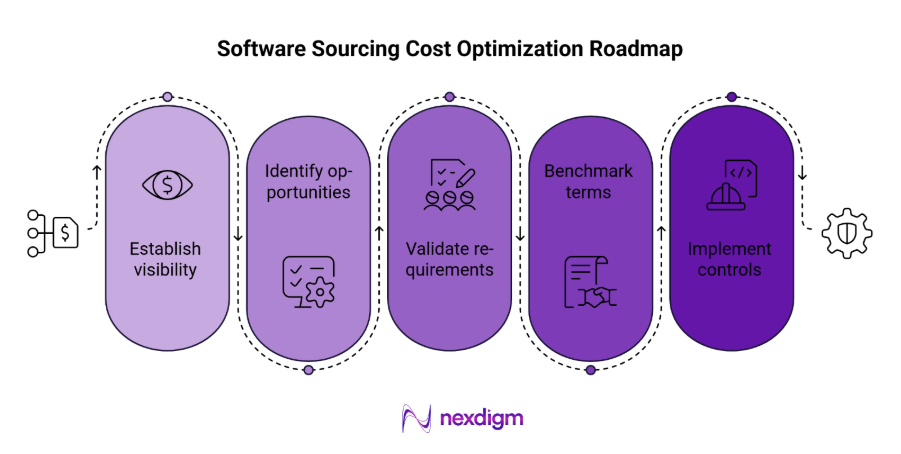
- Establish expenditure visibility: Consolidate software contracts, licence quantities, suppliers, renewal dates and usage information.
- Identify rationalisation opportunities: Examine inactive licences, duplicate subscriptions, unnecessary premium tiers and overlapping functionality.
- Validate operational requirements: Confirm business criticality, integration dependencies, security requirements and user needs.
- Benchmark commercial terms: Compare supplier pricing, licence metrics, discounts, renewal provisions and alternative products.
- Implement ongoing controls: Establish software ownership, renewal reviews, purchasing approvals and regular utilisation monitoring.
Nexdigm’s Case Study: Rationalising Enterprise Software Expenditure
Nexdigm reviewed 18 software agreements across seven departments, identified 23 underutilised licence categories and benchmarked renewal terms across 11 suppliers. The analysis prioritised six contracts for rationalisation and commercial renegotiation.
To take the next step, simply visit our Request a Consultation page and share your requirements with us.
Harsh Mittal
+91-8422857704