

Enterprise software decisions influence how organisations manage finance, procurement, human resources, operations, customer relationships and internal reporting. These platforms often become embedded in daily business processes, connecting departments and supporting decisions across the organisation. Selecting a vendor is therefore not simply a technology purchase. It is a long-term commitment involving implementation, integration, licensing, user adoption and ongoing support.
The market offers a wide range of enterprise software providers, from vendors specialising in individual business functions to those offering integrated suites. Their capabilities can overlap, but differences in functionality, architecture and commercial models can have significant implications for buyers.
A structured enterprise software vendor analysis helps organisations understand the supplier landscape, compare product capabilities and identify vendors that align with both operational requirements and technology strategy.
The Real Problem: Finding Software That Fits the Business
Many enterprise software procurement exercises begin with a list of well-known vendors. This can narrow the search too early and create a bias towards platforms that may be more extensive, expensive or complex than the organisation actually requires.
A better starting point is the business process.
Consider an organisation reviewing its finance systems. Its requirements may include automated reconciliation, reporting, compliance, budgeting and integration with procurement platforms. Another business may prioritise inventory management, production planning and supplier coordination.
The software selection process should establish which processes need to improve, where existing systems create friction and what the proposed platform must deliver.
This is particularly important when comparing integrated enterprise suites with specialised applications. A single platform may simplify integration, while specialised tools may provide stronger functionality for specific workflows.
Mapping the Enterprise Software Market
Enterprise software spans several functional categories, each with its own supplier landscape.
- Enterprise resource planning (ERP) platforms connect functions such as finance, procurement, inventory, manufacturing and supply chain management. Buyers should assess process coverage, reporting capabilities, customisation and integration requirements.
- Human capital management (HCM) software supports recruitment, payroll, workforce planning, performance management and employee administration. Evaluation should consider local regulatory requirements, employee experience and integration with finance systems.
- Customer relationship management (CRM) platforms manage sales pipelines, customer information, marketing activities and service interactions. Their suitability depends on workflow requirements, automation and reporting.
- Business intelligence and analytics solutions help organisations consolidate data, create dashboards and support management decisions. Data connectivity, governance and analytical functionality are important comparison criteria.
- Procurement and supply chain software supports sourcing, supplier management, purchase orders, inventory visibility and logistics coordination. Buyers should examine supplier onboarding, approval workflows, contract management and integration with existing enterprise systems.
Evaluating Vendors Against Business Requirements
A software platform should be judged on whether it can support the processes that matter to the buyer, rather than on the number of features included in its product catalogue.
A useful vendor assessment examines five dimensions:
- Functional coverage: Does the software support the required workflows without excessive customisation?
- Technical compatibility: Can it integrate with existing applications, databases and infrastructure?
- Scalability: Can the platform accommodate additional users, business units, locations and transaction volumes?
- User experience: Is the interface accessible and practical for the people expected to use it?
- Implementation and support: Does the vendor offer suitable deployment assistance, training, maintenance and issue resolution?
Implementation complexity deserves particular attention. A platform may meet every functional requirement but demand extensive process redesign, data migration or specialist support. These factors influence both the project budget and the time required to realise value.
Comparing Licensing and Total Cost of Ownership
Enterprise software pricing can include subscriptions, user licences, modules, implementation fees, integrations, customisation, maintenance and support.
The pricing structure may also change according to the number of users, transaction volumes, storage requirements or selected functionality. Procurement teams should identify which features are included in the base package and which require additional licences.
Total cost of ownership should account for the full software lifecycle:
- Initial licensing or subscription expenditure.
- Implementation, configuration and data migration.
- Integration with existing systems.
- User training and change management.
- Ongoing support, upgrades and maintenance.
- Contract renewal, expansion and exit requirements.
This is particularly important when comparing cloud-based software with on-premises solutions. Their cost structures differ, and a direct comparison of subscription fees with initial licence prices can be misleading.
When Is an Integrated Suite Better Than a Specialist Platform?
The answer depends on the organisation’s process complexity and technology environment.
An integrated suite can reduce the number of vendors and simplify data exchange between departments. However, it may include features that the organisation does not need or may offer less depth in certain specialised workflows.
Specialist platforms can provide stronger functionality for individual business processes, but they may increase integration requirements and create additional supplier relationships.
Procurement teams should compare both approaches against the organisation’s actual needs, implementation capacity and long-term technology roadmap.
Enterprise Software Vendor Fit Assessment Framework
A strong vendor selection process should produce more than a feature comparison. It should establish which platform is operationally suitable and commercially sustainable.
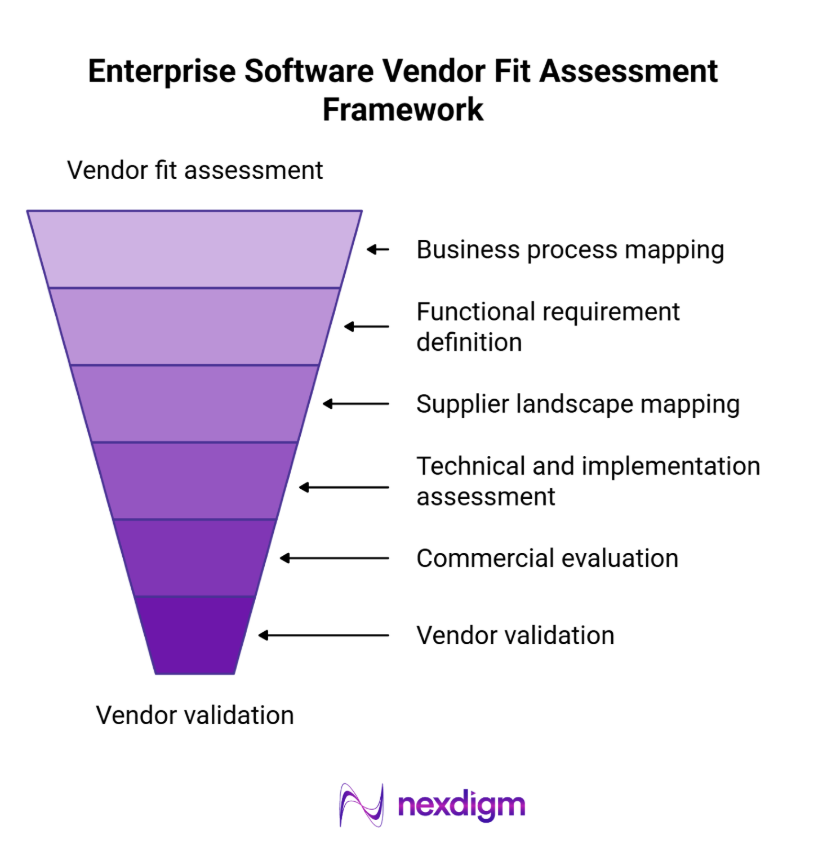
- Business process mapping: Document existing workflows, inefficiencies, control requirements and desired improvements.
- Functional requirement definition: Translate business needs into mandatory capabilities and desirable features.
- Supplier landscape mapping: Identify integrated suites and specialist vendors relevant to each software category.
- Technical and implementation assessment: Compare architecture, integration, scalability, migration requirements and deployment complexity.
- Commercial evaluation: Examine licensing, subscriptions, implementation, support, renewal and exit costs.
- Vendor validation: Use demonstrations, reference checks and scenario-based testing to confirm supplier suitability.
Nexdigm can support enterprise buyers through software market research, vendor intelligence, competitive benchmarking and commercial assessment. These services help organisations identify relevant suppliers, compare technology offerings and develop procurement strategies aligned with business processes and investment priorities.
Nexdigm’s Case Study: Evaluating Enterprise Software Alternatives
Nexdigm assessed 15 enterprise software vendors across 5 functional categories, comparing capabilities, integration, scalability and pricing. The research identified 6 capability gaps, shortlisted 4 vendors and established 9 evaluation criteria for technology procurement decisions.
To take the next step, simply visit our Request a Consultation page and share your requirements with us.
Harsh Mittal
+91-8422857704