

Enterprise technology pricing intelligence helps organizations navigate complex multi-vendor markets by comparing software, cloud, infrastructure, licensing, support, and service costs across vendors and contract structures. Enterprise technology pricing intelligence combines pricing analysis with benchmark data, discount ranges, implementation costs, and negotiation levers to improve commercial decisions.
By identifying price disparities, hidden cost drivers, and achievable market rates, businesses can strengthen procurement leverage, optimize technology spend, reduce overpayment, improve budget predictability, and establish more competitive, value-aligned agreements across enterprise technology portfolios while supporting scalable technology investment governance.
Recent 2026 benchmark data shows enterprise software discounts averaging 28% to 41% off list prices across major vendors, demonstrating how pricing intelligence can improve sourcing decisions, reduce overpayment, and strengthen commercial outcomes across complex multi-vendor technology environments.
Enterprise Technology Pricing Analysis for Multi-Vendor Cost Benchmarking
Enterprise technology pricing analysis compares vendor rates, licensing structures, cloud economics, service costs, and contract terms to improve cost transparency, strengthen negotiations, reduce overpayment, and optimize technology investments. Major dimensions of analysis are:
- Licensing Analysis: Per-user, consumption-based, enterprise-wide, concurrent, and tiered licensing structures are normalized to reveal true cost differences across vendors and prevent misleading headline price comparisons.
- Discount Analysis Potential: Published prices, negotiated discounts, volume incentives, renewal concessions, and benchmark ranges are compared to identify achievable savings and strengthen enterprise procurement negotiation positions.
- Cloud Consumption Estimation: Compute, storage, data transfer, reserved capacity, support, and usage growth are evaluated to determine whether cloud pricing structures remain economically efficient across competing providers.
- Contract Commitment Exposure: Minimum spends, multi-year commitments, auto-renewals, termination rights, and volume obligations are assessed to identify contractual structures that may increase long-term technology cost exposure.
Nexdigm’s Support for Market-Aligned Enterprise Technology Pricing
Nexdigm supports market-aligned enterprise technology pricing through pricing analysis, enterprise technology pricing intelligence, multi-vendor cost benchmarking, software licensing analysis, cloud cost optimization, and contract benchmarking. By evaluating vendor rates, discounts, usage, renewal terms, implementation costs, and service structures, Nexdigm helps businesses reduce overpayment, strengthen negotiations, improve procurement efficiency, enhance budget predictability, and establish competitive technology agreements aligned with market benchmarks.
Nexdigm’s Data-Led Roadmap for Technology Pricing to Navigate Multi-Vendor Markets
Nexdigm’s data-led roadmap combines pricing analysis, vendor intelligence, cost benchmarking, and procurement analytics to optimize technology spending, strengthen negotiations, improve cost visibility, and support data-driven investment decisions. Some important features of the roadmap model, helping businesses grow are:
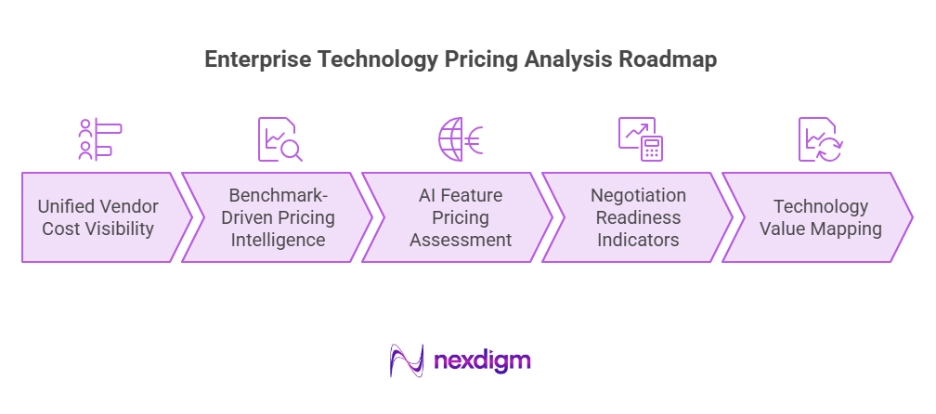
- Unified Vendor Cost Visibility: The roadmap consolidates software, cloud, infrastructure, support, and implementation costs into a single analytical view, helping businesses understand total technology spending across complex multi-vendor environments.
- Benchmark-Driven Pricing Intelligence: Market rates, negotiated discounts, renewal trends, and vendor pricing structures are compared continuously, enabling businesses to identify overpayment risks and strengthen procurement positions.
- Negotiation Readiness Indicators: Benchmark gaps, contract timing, vendor dependency, usage patterns, and discount history are converted into actionable negotiation signals that strengthen procurement planning before commercial discussions begin.
- Technology Value Mapping: Spend is connected with business usage, operational impact, scalability, productivity, and strategic importance to distinguish high-value technology investments from lower-return cost commitments.
- AI Feature Pricing Assessment: AI-enabled capabilities, embedded copilots, automation features, and usage-based charges are evaluated separately to determine whether emerging technology premiums deliver sufficient incremental business value.
Nexdigm’s Case
Nexdigm supported an enterprise with technology pricing analysis, multi-vendor benchmarking, and spend optimization across software and cloud portfolios. The initiative reduced technology spend, improved negotiated discounts by 18%, and lowered unused-license costs by 21%, strengthening procurement efficiency and investment value.
To take the next step, simply visit our Request a Consultation page and share your requirements with us.
Harsh Mittal
+91-8422857704