

Enterprise resource planning is shifting from traditional systems of record toward cloud-based, connected, and increasingly intelligent platforms. Enterprises now expect ERP to support automation, real-time visibility, predictive analytics, and AI-assisted decision-making.
Recent industry data highlights the scale of this transition. IDC forecasts worldwide spending on AI-centric systems will exceed $630 billion by 2028, while Gartner projects that 50% of enterprise applications will have embedded AI assistants by 2027, up from less than 10% in 2024.
For ERP vendors, enterprise software providers, investors, private-equity firms, CIOs, CFOs, system integrators, and digital-transformation leaders, the critical questions are changing: Where is ERP demand moving? Which industries are accelerating cloud migration? Which AI capabilities are customers willing to pay for?
An ERP software market assessment helps organizations answer these questions by evaluating market demand, cloud adoption, AI readiness, customer requirements, competitive dynamics, pricing, industry opportunity, and commercial potential.
Why ERP Demand Is Changing
ERP remains mission-critical for modern enterprises, but expectations are evolving beyond process standardization and system integration. Organizations increasingly seek ERP platforms that support agility, automation, intelligence, and scalable growth across the following areas:
- Cloud Migration: Organizations are increasingly replacing legacy on-premise ERP systems with scalable cloud-based platforms that offer flexibility, lower infrastructure requirements, faster upgrades, and improved accessibility.
- AI Integration: Enterprises are embedding AI across finance, procurement, planning, and analytics functions to improve forecasting accuracy, automate decision-making, and unlock greater business value.
- Automation: Businesses expect ERP platforms to reduce manual effort by automating repetitive workflows, streamlining operations, improving process efficiency, and enabling workforce productivity gains.
- Real-Time Intelligence: Organizations increasingly demand real-time operational visibility, predictive insights, and advanced analytics capabilities that support faster, data-driven decisions across business functions.
Together, trends across these areas are reshaping ERP demand by creating new opportunities for growth and innovation across the ERP ecosystem.
Navigating the Next Phase of ERP Growth
As ERP demand becomes increasingly shaped by cloud adoption, AI integration, automation, and analytics, organizations need more than market data to make informed decisions.
Nexdigm’s expertise in ERP Software Market Assessment provides a comprehensive view of customer demand, competitive intensity, technology differentiation, and value creation potential, enabling stakeholders to make confident growth and investment decisions.
The Need of Structured ERP Market Assessment
As ERP markets evolve, growth opportunities are becoming increasingly dependent on cloud adoption, AI capabilities, customer requirements, and competitive differentiation. A structured ERP market assessment helps stakeholders move beyond broad market trends to evaluate where demand is accelerating and how technology shifts may influence future market dynamics.
By providing a comprehensive understanding of market attractiveness, customer demand, competitive intensity, and value creation opportunities, Nexdigm’s assessment supports informed strategic, investment, and expansion decisions.
Nexdigm’s ERP Software Market Assessment
As ERP markets evolve with cloud adoption, AI integration, and changing enterprise requirements, organizations need a multidimensional view of market potential. Nexdigm’s ERP Software Market Assessment evaluates several areas that influence long-term growth and competitiveness. These are:
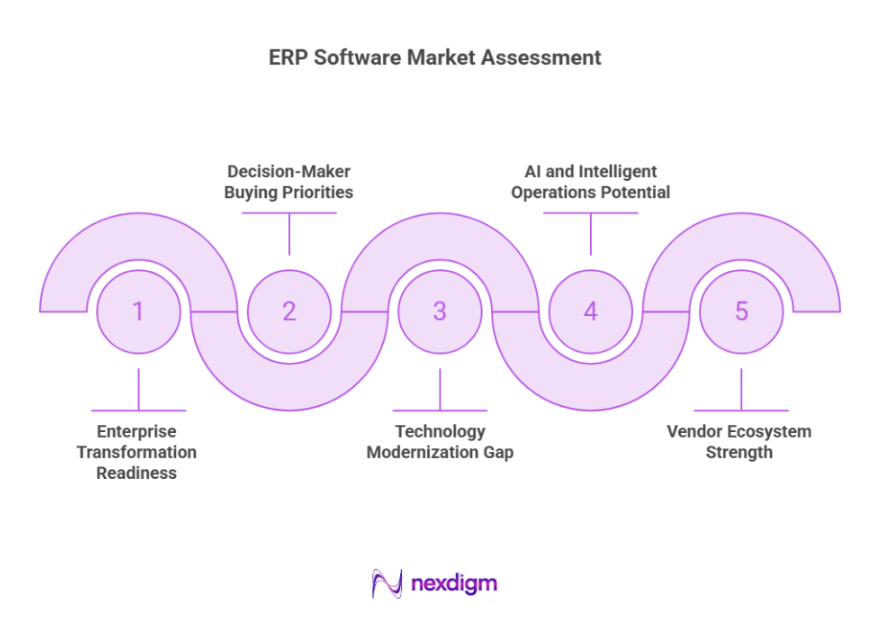
- Enterprise Transformation Readiness: Assesses the extent to which organizations are investing in digital transformation, process modernization, cloud migration, and operational efficiency initiatives that drive ERP adoption.
- Decision-Maker Buying Priorities: Evaluates how CIOs, CFOs, and business leaders prioritize functionality, scalability, analytics, automation, implementation speed, and total cost of ownership during ERP selection.
- Technology Modernization Gap: Identifies legacy system limitations, upgrade requirements, technical debt, and modernization pressures that create demand for next-generation ERP solutions.
- AI and Intelligent Operations Potential: Analyzes demand for AI-enabled forecasting, workflow automation, predictive analytics, and decision intelligence capabilities that enhance enterprise productivity and performance.
- Vendor Ecosystem Strength: Assesses implementation partners, integration capabilities, third-party applications, marketplace ecosystems, and customer support networks that influence ERP adoption decisions.
By examining transformation readiness, Nexdigm’s ERP Market Assessment provides a comprehensive view of market attractiveness and long-term value creation potential.
Business Applications of Nexdigm’s ERP Market Assessment
Nexdigm’s Assessment evaluates demand across finance, procurement, supply chain, manufacturing, human resources, customer operations, and other areas to provide ERP applications to the businesses by conducting:
- Business Function Adoption Analysis: Assessment across different business functions to prioritize ERP investments, technology upgrades, automation capabilities, and AI-enabled tools based on operational requirements.
- Mission-Critical Process Mapping: Identifying business processes where ERP solutions deliver the greatest operational impact, efficiency improvements, compliance benefits, and strategic value.
- Industry Application Assessment: Analysis of ERP application requirements across industries such as manufacturing, retail, healthcare, BFSI, and technology to identify sector-specific opportunities.
- Workflow Modernization Potential: Evaluation of opportunities to improve process efficiency through cloud-native applications, automation, AI-driven workflows, and integrated enterprise operations.
By evaluating ERP applications across these areas, Nexdigm helps stakeholders identify high-growth use cases, investment priorities, and sustainable opportunities within the evolving ERP ecosystem.
Nexdigm’s Case
A global enterprise software provider engaged with Nexdigm to assess cloud ERP demand across manufacturing, retail, and services. The study identified six high-growth segments, shortlisted 14 priority opportunities, and improved market-entry decision confidence by 22%, supporting sharper product positioning, customer targeting, investment allocation, and regional expansion planning.
To take the next step, simply visit our Request a Consultation page and share your requirements with us.
Harsh Mittal
+91-8422857704