

An Enterprise Resource Planning (ERP) system can determine how effectively an organisation manages its finances, procurement, inventory, production, workforce and supply chain. When these functions operate through disconnected applications, businesses often face duplicated data, inconsistent reporting and manual processes that slow down decision-making. An ERP platform is expected to bring these activities together, but selecting the right supplier is a substantial investment involving technology, process redesign and long-term vendor dependence.
The market includes global enterprise software providers, mid-market ERP specialists and vendors serving specific industries. Their platforms may offer similar core modules but differ significantly in implementation complexity, integration, functionality and pricing. A structured ERP system supplier benchmarking exercise helps buyers identify which providers can support their operating model and deliver value beyond the initial software deployment.
ERP Adoption Reflects the Shift Towards Connected Operations
ERP systems remain one of the most widely adopted categories of enterprise business software. Eurostat reported that 46.45% of EU enterprises used ERP software in 2025. Adoption reached 88.71% among large enterprises, compared with 41.08% among small enterprises.
The difference reflects the complexity of managing multiple departments, locations and operating processes as businesses grow. Larger organisations often require integrated systems to coordinate financial reporting, procurement, production planning, inventory and distribution. Smaller businesses may have more focused requirements, making implementation cost and ease of use particularly important.
For software suppliers, this creates demand across different market segments. For procurement teams, it makes vendor segmentation essential: an ERP platform designed for a multinational manufacturer may not be appropriate for a growing services business.
Where ERP Platforms Differ
An ERP comparison should begin with the functions that the organisation needs to integrate. Finance is usually a central requirement, but the depth of financial capabilities varies. Buyers should examine general ledger management, accounts payable and receivable, budgeting, consolidation, taxation, audit trails and reporting.
Operational functionality can be just as important. Manufacturing businesses may need production planning, quality management and shop-floor integration. Retailers may prioritise inventory visibility, order management and demand planning. Service organisations may require project accounting, resource allocation and billing.
Supply chain capabilities deserve separate attention. Procurement workflows, supplier records, purchase approvals, inventory management and logistics coordination can determine whether the platform improves operational control or simply replaces existing software.
The comparison should also distinguish between native functionality and features delivered through third-party applications or additional modules. A broad product catalogue does not necessarily mean every capability is included in the base ERP package.
Integration Is Where Many ERP Projects Become Difficult
An ERP platform rarely operates in isolation. It may need to connect with CRM systems, warehouse management software, payroll applications, banking platforms, e-commerce systems and business intelligence tools.
Procurement teams should assess the supplier’s integration architecture, APIs, data migration tools, middleware compatibility and support for existing applications. They should also consider how easily information can move between business units and external partners.
Legacy systems create another challenge. Data may be inconsistent, duplicated or stored in formats that require substantial cleansing before migration. The cost of preparing and transferring this information should be included in the sourcing assessment.
A platform that appears less expensive at the licensing stage may require extensive customisation and integration work. This can change the economics of the entire project.
Comparing Deployment, Scalability and Commercial Models
ERP vendors generally offer cloud-based, on-premises or hybrid deployment options. Each has different implications for infrastructure management, security, customisation, maintenance and recurring expenditure.
Cloud ERP can reduce the need for internal infrastructure management, while on-premises deployment may provide greater control over certain technical configurations. Hybrid models can support organisations with existing infrastructure investments or specific data requirements.
Commercial comparisons should cover more than licence prices. Procurement teams should account for:
- User licences, modules and subscription tiers.
- Implementation, configuration and customisation.
- Data migration and integration.
- Training and change management.
- Maintenance, support and future upgrades.
- Contract renewal, expansion and exit costs.
Scalability should also be tested against expected business growth. The platform should accommodate additional users, locations, entities, transactions and reporting requirements without creating disproportionate costs or requiring a major system replacement.
The Supplier Decision Should Reflect the Business Model
The most suitable ERP supplier depends on the organisation’s operating complexity, industry requirements and internal technology capabilities.
A manufacturer may prioritise production planning and inventory control. A distribution business may place greater emphasis on procurement, warehouse integration and order fulfilment. A multinational group may require multi-entity consolidation, multiple currencies, localisation and complex approval structures.
Buyers should also examine the implementation ecosystem. Availability of experienced implementation partners, local support, training resources and industry-specific expertise can influence project timelines and long-term system performance.
ERP System Supplier Benchmarking Framework
A useful ERP comparison should produce a clear view of functional fit, implementation effort and long-term commercial exposure:
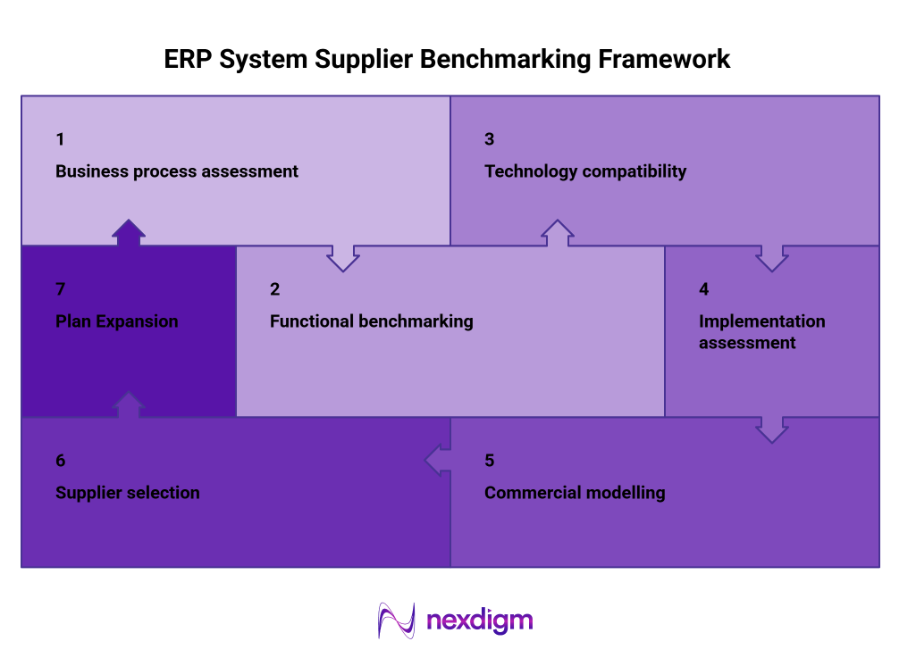
- Business process assessment: Map finance, operations, procurement, inventory and supply chain workflows that require integration.
- Functional benchmarking: Compare native modules, industry-specific capabilities, reporting and workflow configuration.
- Technology compatibility: Evaluate APIs, data migration, integration architecture, deployment and legacy system support.
- Implementation assessment: Examine project complexity, partner availability, customisation and change management requirements.
- Commercial modelling: Compare licensing, subscriptions, implementation, support, upgrades and exit costs.
- Supplier selection: Rank vendors against business priorities, scalability and the organisation’s ability to implement and maintain the platform.
Nexdigm can support ERP sourcing through enterprise software market research, supplier benchmarking, commercial analysis and vendor capability assessment. This helps organisations understand the competitive landscape, compare platform economics and identify suppliers aligned with their operational and technology requirements.
Nexdigm’s Case Study: Benchmarking ERP Platforms Across Enterprise Functions
Nexdigm assessed 14 ERP providers across 5 functional areas, comparing finance, operations, supply chain, integration and scalability. The research identified a 20% variation in comparable implementation and licensing costs, shortlisted 4 vendors and established 9 selection benchmarks.
To take the next step, simply visit our Request a Consultation page and share your requirements with us.
Harsh Mittal
+91-8422857704