

Electric vehicles (EVs) have become a central part of the global mobility conversation. Automakers are expanding their electric portfolios, governments are introducing supportive regulations, and consumers are showing growing interest in sustainable transportation.
A comprehensive EV adoption market assessment reveals that no single factor is responsible for market growth. Instead, EV adoption is being shaped by the combined influence of cost economics, charging accessibility, policy support, and consumer readiness. Understanding the relative importance of these drivers is critical for manufacturers, investors, policymakers, and mobility stakeholders seeking to capture opportunities in the evolving EV ecosystem.
Assessing the Core Drivers of EV Market Growth
While EV adoption continues to accelerate globally, growth is not driven by a single factor. Instead, consumer purchasing decisions and market development are influenced by a combination of economic, technological, regulatory, and behavioral considerations.
To understand what is really driving EV adoption, it is important to examine the factors that most directly influence market growth: cost, charging access, policy support, and consumer readiness.
Cost an Important EV Adoption Factor
For many consumers, financial considerations remain the starting point of the purchase journey. Vehicle buyers increasingly evaluate:
- Total cost of ownership (TCO)
- Fuel savings
- Maintenance expenses
- Financing options
- Long-term operating costs
As battery technology advances and production scales improve, the economics of EV ownership continue to become more attractive. However, affordability remains a key consideration influencing purchase decisions and adoption rates. At Nexdigm, market evaluations increasingly indicate that organizations should focus on pricing. Businesses entering or expanding in the EV sector should analyze:
- Lifetime Customer Savings: Understanding long-term value creation helps improve conversion rates.
- Charging Cost Trends: Regional electricity pricing can significantly influence adoption behavior.
- Fleet Economics: Commercial buyers often prioritize operating efficiency over vehicle acquisition costs.
- Residual Value Expectations: Consumer confidence is strengthened when resale prospects remain attractive.
From a Nexdigm perspective, companies that effectively communicate pricing value are better positioned to drive adoption.
Charging Access Shaping Consumer Confidence
Even when consumers recognize the economic benefits of EVs, infrastructure availability often determines whether interest converts into a purchase. Questions commonly asked by buyers include:
- Where will I charge my vehicle?
- How long will charging take?
- Is charging available near my home?
- Are charging stations reliable?
These concerns directly affect consumer confidence. As public and private charging networks expand, adoption barriers gradually diminish. However, infrastructure maturity remains uneven across regions. This means charging access is not simply a technical issue. It is a trust-building mechanism.
Nexdigm suggests that charging accessibility should be assessed through customer experience metrics rather than installation numbers alone. Organizations should focus on:
- Network Reliability: Consumers value dependable charging experiences more than charger density alone.
- Strategic Location Planning: Optimal charger placement influences utilization rates and user satisfaction.
- Urban Accessibility: High-density cities require innovative charging models to accommodate apartment dwellers and shared parking environments.
- Ecosystem Partnerships: Collaboration among utilities, infrastructure providers, automotive companies, and local authorities can accelerate infrastructure effectiveness.
Policy Accelerating Market Growth
Government support remains one of the most influential catalysts for EV adoption. Policy measures commonly include:
- Purchase incentives
- Tax benefits
- Registration fee reductions
- Charging infrastructure investments
- Local manufacturing incentives
These initiatives help bridge affordability gaps and stimulate early adoption. However, as markets mature, policy effectiveness increasingly depends on stability and predictability rather than incentive magnitude alone. Businesses and consumers alike seek long-term clarity.
At Nexdigm, policy analysis forms an essential part of market-entry and expansion strategies. Organizations should continuously monitor:
- Incentive Structures: Changes in subsidies can directly influence purchasing behavior.
- Manufacturing Policies: Localization initiatives can reshape supply chain investments.
- Sustainability Regulations: Environmental compliance increasingly impacts business decisions.
- Infrastructure Development Programs: Public-sector investments often create significant market opportunities.
A forward-looking EV adoption market assessment must therefore incorporate both current regulations and anticipated policy evolution to help business stay updated with the policies and regulations.
Consumer Readiness Determining Sustainable Growth
The most underestimated factor in EV adoption is consumer readiness. Market success depends not only on vehicle availability but also on consumer confidence. Modern buyers today evaluate:
- Technology familiarity
- Battery reliability
- Range expectations
- Brand credibility
- Service network support
Early adopters often accepted certain limitations in exchange for innovation. Mainstream consumers typically require greater assurance. As a result, consumer education remains a vital component of adoption strategies. Nexdigm’s consumer readiness approach highlights a shift in the EV customer profile. The next growth phase is expected to be driven by:
- Urban Professionals: Seeking practical, cost-efficient mobility solutions.
- Family Buyers: Prioritizing reliability, safety, and convenience.
- Corporate Fleets: Focused on sustainability goals and operating cost reduction.
- Value-Conscious Consumers: Evaluating EVs through a financial lens rather than an environmental one alone.
Understanding these segments enables organizations to develop targeted growth strategies rather than generalized marketing campaigns.
What Is Really Driving EV Adoption?
The strongest driver today is the growing economic attractiveness of EV ownership, supported by improving charging access and favorable policy environments. However, long-term market expansion will ultimately depend on consumer readiness and confidence. In other words:
Cost initiates interest. Infrastructure enables adoption. Policy accelerates growth. Consumer readiness sustains the market. This interconnected framework explains why some regions experience rapid adoption while others continue to face barriers.
Comparing the Four Adoption Drivers
When viewed through a market expansion lens, EV adoption is shaped by multiple interconnected factors rather than a single growth driver. Understanding how each factor influences consumer behavior and investment decisions provides a clearer picture of overall market readiness:
- Cost: Creates initial interest and purchase consideration by influencing affordability, ownership economics, and the overall financial attractiveness of EV adoption.
- Charging Access: Removes practical barriers to ownership by improving convenience, reducing range anxiety, and supporting everyday vehicle usability.
- Policy: Accelerates adoption and investment through incentives, regulatory support, infrastructure development programs, and long-term market confidence.
- Consumer Readiness: Determines long-term acceptance by reflecting awareness, trust, willingness to adopt new technologies, and changing mobility preferences.
The most successful markets are those where all four factors progress together. From Nexdigm’s perspective, assessing the balance between these drivers is essential for developing effective EV growth strategies. Markets that demonstrate strength across all four dimensions are typically better positioned for sustainable and scalable adoption.
Nexdigm Framework for Evaluating EV Adoption Potential
For organizations evaluating opportunities within the EV ecosystem, Nexdigm recommends a four-dimensional assessment model. This framework helps stakeholders move beyond headline adoption figures and evaluate the factors that influence long-term market attractiveness and growth potential:
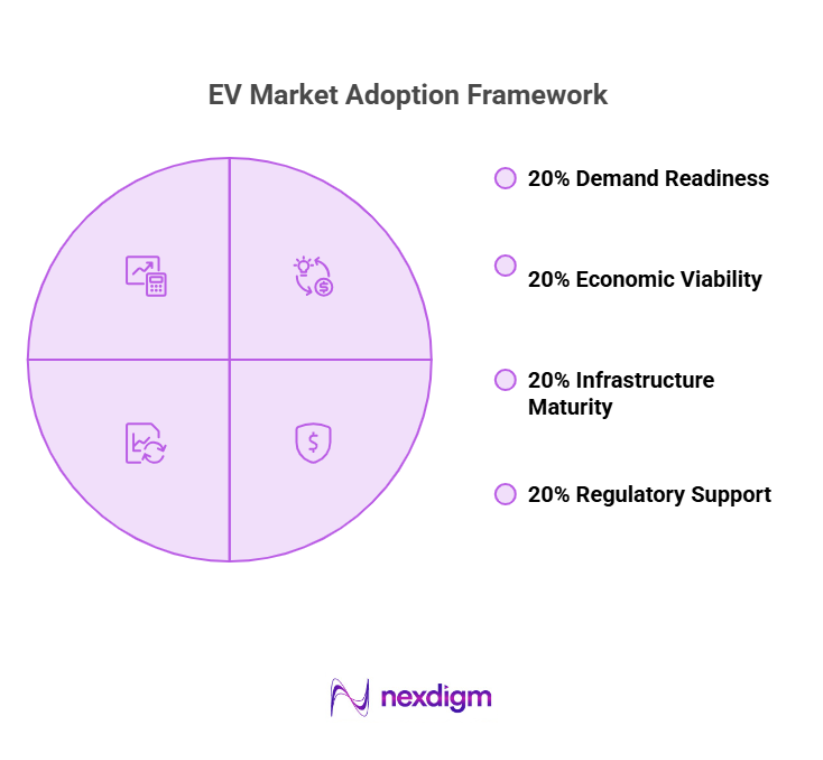
- Demand Readiness: Assesses consumer awareness, purchase intent, adoption trends, and market demand to determine the likelihood of sustained EV uptake.
- Economic Viability: Evaluates affordability, total cost of ownership, financing accessibility, and operating economics to understand long-term commercial feasibility.
- Infrastructure Maturity: Examines the availability, accessibility, and scalability of charging networks required to support widespread EV adoption.
- Regulatory Support: Reviews government policies, incentives, emissions regulations, and industry initiatives that encourage investment and accelerate market development.
By evaluating these four dimensions together, Nexdigm helps organizations identify high-potential markets, assess investment readiness, and develop strategies that support sustainable growth within the rapidly evolving EV ecosystem.
Nexdigm’s Case
Nexdigm supported an automotive player in assessing EV adoption drivers as sales expanded 66% YoY and charging infrastructure crossed 52,000 stations. The analysis prioritized ownership cost, accessibility, incentives, and consumer readiness, enabling targeted market actions and improving ecosystem maturity.
To take the next step, simply visit our Request a Consultation page and share your requirements with us.
Harsh Mittal
+91-8422857704