

EV adoption pricing strategy is increasingly critical in markets driven by government incentives and rapid infrastructure growth. Automotive brands rely on structured pricing analysis to align electric vehicle pricing with subsidies, charging network expansion, and consumer affordability thresholds.
By evaluating competitor pricing, battery cost impact, and total cost of ownership, EV adoption pricing strategy enables manufacturers to optimize market entry and scale demand. This approach supports data-driven EV pricing decisions, improves penetration rates, and strengthens competitiveness in fast-evolving electric mobility ecosystems.
EV adoption pricing strategies can increase purchase intent by 10–16%, improve affordability perception, and reduce pricing resistance in incentive-heavy markets. With expanding charging networks and policy support, structured EV pricing analysis supports faster transition to electric mobility ecosystems.
EV Adoption Pricing Analysis for Incentive-Driven Electric Vehicle Markets
EV Adoption Pricing Analysis enables automotive brands to optimize pricing strategies by aligning EV price benchmarking, competitor intelligence, and government incentives with consumer affordability patterns. Its key elements include:
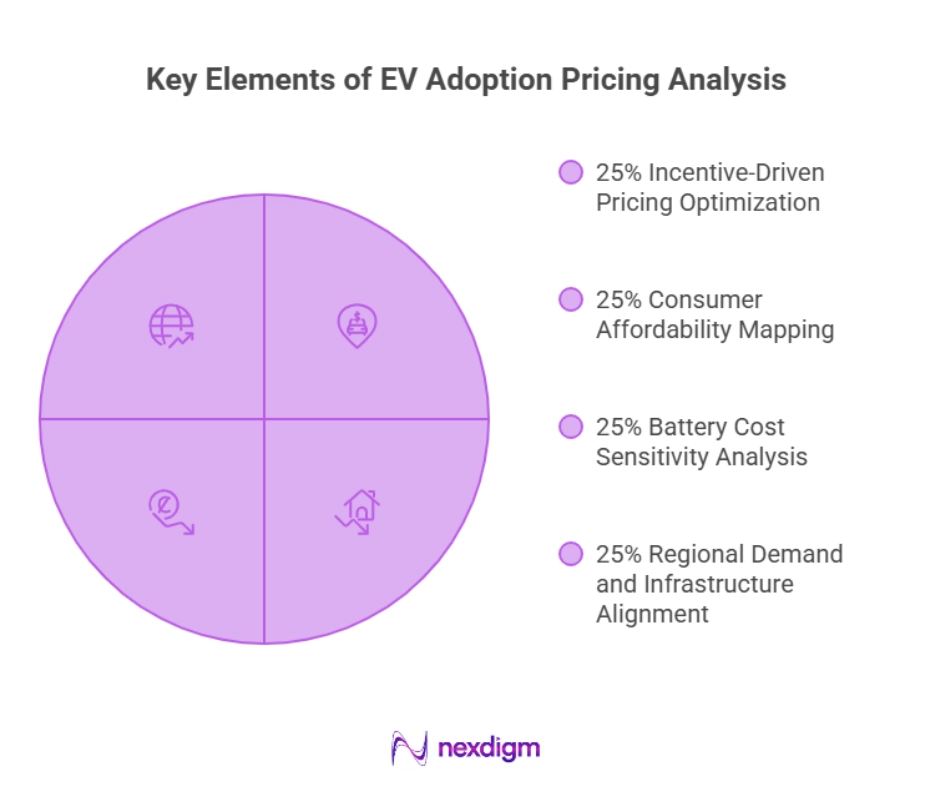
- Incentive-Driven Pricing Optimization: Evaluation of subsidies, tax credits, and rebates to align EV pricing with government-supported adoption frameworks.
- Consumer Affordability Mapping: Assessing buyer income levels and price sensitivity to improve accessibility and reduce adoption barriers.
- Battery Cost Sensitivity Analysis: Examination of how fluctuations in battery pricing impact overall EV affordability and pricing structure decisions.
- Regional Demand and Infrastructure Alignment: Aligning pricing strategies with charging infrastructure availability and regional adoption maturity.
Nexdigm’s Strategic Support for EV Pricing and Adoption Planning
Nexdigm’s Strategic Support for automotive companies design effective electric vehicle pricing strategies aligned with EV price benchmarking, incentive structures, and market demand trends. By integrating EV pricing analysis, battery cost insights, and total cost of ownership evaluation, Nexdigm enables data-driven decisions that improve affordability, strengthen EV adoption rates, and enhance competitive positioning across evolving electric mobility markets.
Nexdigm’s Integrated EV Pricing Analytics Framework for Market Expansion
Nexdigm’s Integrated EV Pricing Framework for Market Expansion enables automotive brands to develop data-driven electric vehicle pricing strategies by combining EV price benchmarking, competitor intelligence, and battery cost analysis. Its key elements include:
- Geopolitical and Policy Impact Pricing Review: Assessing how regulations, tariffs, and policy shifts influence EV pricing across markets.
- Subscription and Alternative Ownership Modeling: Evaluation of leasing, subscription, and pay-per-use models to expand accessibility and reduce upfront cost barriers.
- Brand Perception and Price Correlation Study: Examination of how EV pricing influences brand equity, premium perception, and consumer trust.
- Competitive Reaction Pricing Simulation: Model competitor responses to pricing changes to improve strategic resilience.
- Market Penetration Pricing Strategy Design: Supporting aggressive pricing approaches to accelerate EV adoption in early-stage markets.
- Data-Led Margin Optimization: Balancing cost structures and pricing strategies to maximize profitability across EV portfolios.
Nexdigm’s Case
Nexdigm assisted an EV SUV Manufacturer to enhance pricing precision using EV price benchmarking and competitor intelligence. The initiative resulted in a 19% increase in sales volume, improvement in pricing accuracy, 11% growth in market penetration, 9% reduction in discount leakage, and faster pricing cycle execution, strengthening overall market competitiveness.
To take the next step, simply visit our Request a Consultation page and share your requirements with us.
Harsh Mittal
+91-8422857704