

EV battery costs are becoming an increasingly important procurement consideration as electric-vehicle adoption expands. The IEA reports that global electric car sales exceeded 17 million in 2024, with more than 20% of new cars sold worldwide being electric. Battery prices also continued to decline, with average lithium-ion battery pack prices falling by 8% in 2025.
China remains the largest battery manufacturing hub, accounting for more than 80% of global battery cell production capacity. Battery costs also vary significantly by chemistry: LFP packs were around 40% cheaper per kWh than NMC packs in 2025, highlighting how technology choices can directly influence procurement economics.
For automakers, EV battery cost benchmarking procurement research can therefore help explain why battery prices differ across suppliers, technologies, and regions and where procurement teams can identify opportunities to improve cost competitiveness.
Battery Cost Depends on More Than Materials
Battery procurement costs reflect several connected factors rather than a single price point. Material prices matter, but chemistry, manufacturing scale, production efficiency, supplier location, logistics, and commercial arrangements can also influence the final cost. Understanding these differences can help procurement teams determine whether a cost gap is driven by market conditions, supplier efficiency, technology choices, or commercial terms.
What Shapes the Battery Procurement Costs
A straightforward cost review can focus on three areas:
- Materials: Lithium, nickel, cobalt, graphite, and other battery inputs can influence cell costs as commodity prices and supply conditions change.
- Technology & Scale: Battery chemistry, cell design, manufacturing efficiency, production volume, and plant utilization can affect the cost of producing each unit.
- Commercial Conditions: Supplier pricing, logistics, contracts, volume commitments, duties, and payment terms can change the final delivered procurement cost.
Looking at these factors together gives procurement teams a clearer understanding of what is actually driving battery cost differences.
How Nexdigm Brings Clarity to EV Battery Cost Benchmarking
Battery pricing can look straightforward on the surface, but differences between suppliers often reflect several underlying factors. Nexdigm can help procurement teams make these differences easier to interpret:
- Build a Comparable Cost View: Normalize supplier and regional cost information so differences can be assessed on a more consistent basis.
- Connect Cost With Context: Interpret battery prices alongside chemistry, production scale, location, capacity, material exposure, and supplier positioning.
- Highlight Meaningful Variations: Identify where cost differences are significant enough to warrant further supplier discussions, sourcing reviews, or technology evaluation.
- Support Better Procurement Conversations: Give teams a clearer evidence base for discussing pricing, cost structures, volume expectations, and long-term supply arrangements.
This enables EV battery cost benchmarking procurement research to provide a clearer picture of why battery costs differ and what those differences mean for procurement decisions.
Nexdigm’s Strategic View of Battery Sourcing Economics
Understanding battery cost differences is only the first step. Nexdigm can help procurement teams place those differences within broader sourcing decisions, particularly where cost, technology, and supply considerations intersect by:
- Comparing Sourcing Scenarios: Examining how different suppliers, regions, production models, and battery chemistries could affect overall procurement economics.
- Balancing Cost and Supply: Considering whether lower-cost options also provide adequate capacity, geographic coverage, quality, and supply continuity.
- Evaluating Future Economics: Considering how changes in material prices, production scale, technology adoption, and regional manufacturing could influence future battery costs.
- Supporting Sourcing Priorities: Translating cost findings into clearer priorities for supplier selection, localization, negotiation, diversification, or longer-term sourcing arrangements.
This gives procurement teams a broader perspective on EV battery cost benchmarking procurement research, connecting cost intelligence with the sourcing decisions that shape battery economics over time.
Nexdigm’s EV Battery Cost Benchmarking Assessment
Experts at Nexdigm structure EV battery cost benchmarking procurement research as a step-by-step assessment. This involves the following steps:
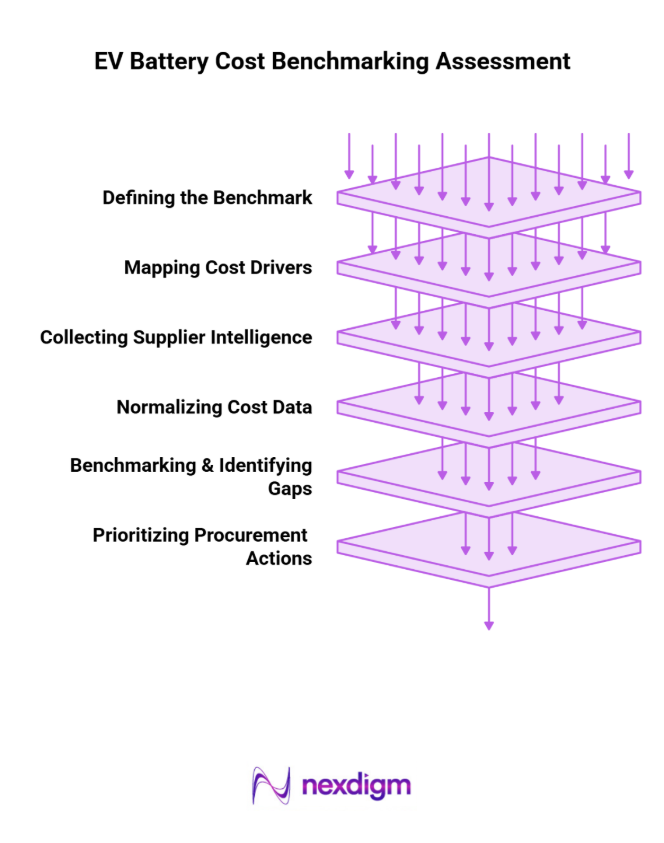
- Defining the Benchmark: Establishing chemistry, cell format, geography, production volume, performance requirements, and relevant cost parameters.
- Mapping Cost Drivers: Breaking down material, manufacturing, technology, logistics, and commercial components contributing to battery cost.
- Collecting Supplier Intelligence: Gathering comparable information on supplier pricing, capacity, production scale, technology, location, and commercial terms.
- Normalizing Cost Data: Adjusting for differences in specifications, volumes, production regions, chemistry, and commercial structures to enable meaningful comparisons.
- Benchmarking & Identifying Gaps: Comparing suppliers and sourcing options to identify significant cost variations and understand their underlying causes.
- Prioritizing Procurement Actions: Translating findings into opportunities involving negotiation, supplier selection, localization, technology choices, or sourcing strategy.
The assessment can give procurement teams greater visibility into where battery costs originate, why suppliers differ, and which cost gaps matter most. It can support more informed negotiations, supplier comparisons, technology decisions, and sourcing strategies
Nexdigm’s Case
Nexdigm supported an automaker who benchmarked 36 battery suppliers across four regions and three chemistries. Our experts identified 24% of cost variation linked to material and chemistry differences, while 18% reflected manufacturing and commercial factors. The findings helped procurement prioritize supplier negotiations, chemistry evaluation, and regional sourcing opportunities.
To take the next step, simply visit our Request a Consultation page and share your requirements with us.
Harsh Mittal
+91-8422857704