

The rapid growth of electric vehicles has brought batteries to the forefront of the automotive industry’s transformation. While EV adoption continues to accelerate, the success of the market increasingly depends on the ability of battery manufacturers and suppliers to meet rising demand, control costs, secure raw materials, and advance technology performance.
A comprehensive EV battery market assessment suggests that the future of electrification will be shaped not only by vehicle production volumes but also by developments in cell manufacturing, battery pack economics, supplier capabilities, and next-generation battery technologies. From Nexdigm’s perspective, understanding these dynamics is essential for organizations seeking to identify growth opportunities and strengthen their position within the evolving battery ecosystem.
What Is Driving the EV Battery Market?
The answer lies in four interconnected forces. Together, these factors are influencing investment decisions, reshaping competitive dynamics, and determining how value is created across the battery ecosystem. Understanding their impact is essential for evaluating future growth opportunities and long-term market potential. Then continue with your four drivers.
- Rising cell demand from expanding EV production
- Continuous pressure on battery pack economics
- Intensifying competition among global suppliers
- Rapid technology innovation across battery chemistries
Together, these factors are reshaping the battery landscape and creating new opportunities across the value chain. Nexdigm believes that a forward-looking EV battery market assessment can help businesses best positioned for long-term success.
Assessing Demand Mapping
Battery demand is increasingly becoming a defining challenge for the automotive industry. As automakers expand EV production targets, battery manufacturers face mounting pressure to scale capacity while ensuring supply reliability. Some key demand drivers of the same are:
- Expanding EV Production: Global automotive manufacturers continue to increase investments in electric vehicle platforms.
- Electrification Policies: Governments are strengthening decarbonization initiatives, further accelerating battery demand.
- Commercial Vehicle Adoption: Battery requirements now extend beyond passenger vehicles into buses, logistics fleets, and industrial mobility solutions.
- Energy Storage Integration: Battery manufacturers are also serving growing stationary energy storage markets, creating additional demand pressure.
The result is a highly competitive landscape where capacity planning has become a strategic necessity. At Nexdigm, battery market analysis indicates that demand forecasting is becoming as important as production capability. In such a case. organizations should prioritize:
- Regional Demand Intelligence: Cell demand varies significantly across geographies depending on EV adoption rates and regulatory developments.
- Supply-Demand Gap Analysis: Identifying potential imbalances helps organizations mitigate future supply risks.
- Strategic Capacity Planning: Battery manufacturers must align expansion investments with realistic demand scenarios.
- Customer Diversification: Overreliance on a limited number of automotive customers can increase business vulnerability.
A robust EV battery market assessment should therefore begin with a detailed understanding of future demand patterns rather than current market conditions alone.
Pack Economics
While battery performance remains important, economics increasingly determine market competitiveness. For EV manufacturers, battery packs often represent the largest cost component within the vehicle. As a result, reducing battery costs remains a top industry priority.
Critical Economic Drivers
- Raw material pricing
- Manufacturing efficiency
- Production scale
- Energy density improvements
- Supply chain optimization
Even small cost reductions at the battery level can significantly influence overall vehicle affordability. Nexdigm’s market advisory approach highlights that pack economics should be viewed holistically. Key assessment areas include:
- Material Sourcing Strategy: Organizations must evaluate exposure to lithium, nickel, cobalt, and graphite price fluctuations.
- Localization Opportunities: Regional manufacturing can reduce logistics costs and improve supply chain resilience.
- Operational Efficiency: Automation and process optimization remain essential for maintaining profitability.
- Lifecycle Economics: Battery recycling and second-life applications are becoming increasingly important contributors to long-term value creation.
Supplier Positioning for Strategic Partnerships
The battery ecosystem is becoming increasingly complex and competitive. Established players continue expanding capacity while emerging suppliers seek market share through innovation and specialization. The competitive landscape is shaped by:
- Manufacturing scale
- Technological capabilities
- Geographic presence
- Raw material access
- Customer relationships
As battery demand grows, strategic positioning is becoming a major differentiator. From a Nexdigm standpoint, suppliers can no longer rely solely on production capacity to secure market leadership. The future success of EV Battery Market will increasingly depend on:
- Strategic Partnerships: Long-term agreements with automotive manufacturers can improve revenue visibility and investment planning.
- Vertical Integration: Control over upstream materials can help reduce supply chain risks.
- Sustainability Credentials: Environmental and social governance considerations are playing a larger role in supplier selection.
- Innovation Capabilities: Suppliers capable of supporting next-generation battery technologies will gain competitive advantages.
A modern EV battery market assessment should therefore evaluate supplier positioning through both operational and strategic lenses.
Technology Shifts Reshaping EV Battery Market
Battery technology is evolving rapidly. Manufacturers are actively pursuing solutions that enhance:
- Energy density
- Charging speed
- Safety
- Durability
- Cost efficiency
Several technological shifts are expected to influence market direction. At Nexdigm, technology assessments emphasize balancing innovation with commercial viability. Hence, organizations should evaluate:
- Scalability Potential
- Market Readiness
- Investment Prioritization
Companies that combine technological innovations with strategic foresight are likely to outperform competitors in the long term.
The Nexdigm Framework for EV Battery Market Assessment
As the EV battery ecosystem continues to evolve, stakeholders must look beyond production volumes and short-term demand trends. A comprehensive evaluation of market opportunities requires an understanding of long-term demand potential, cost competitiveness, supplier capabilities, and technology evolution. To support strategic decision-making, Nexdigm recommends assessing opportunities through four key dimensions:
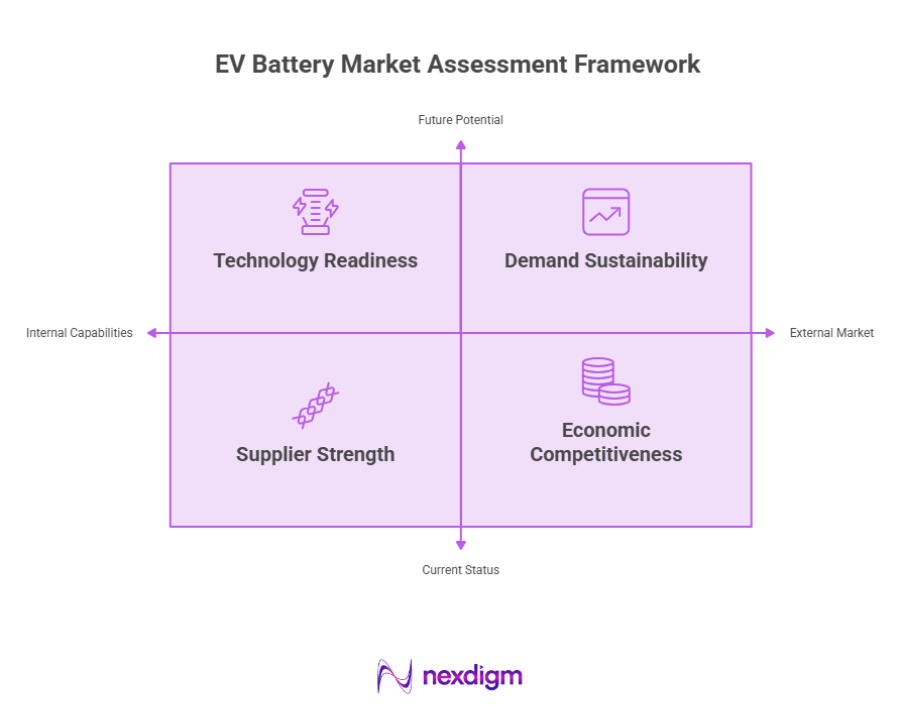
- Demand Sustainability: Evaluates whether battery demand can be sustained over the long term by analyzing EV adoption trends, regulatory support, production forecasts, and market growth patterns.
- Economic Competitiveness: Assesses battery cost structures, pack economics, manufacturing efficiency, and pricing dynamics to determine long-term commercial viability and profitability.
- Supplier Strength: Examines supplier capabilities, production capacity, supply chain resilience, raw material access, and strategic partnerships that influence market competitiveness.
- Technology Readiness: Measures the maturity and scalability of emerging battery technologies, including energy density improvements, charging performance, safety enhancements, and commercialization potential.
Together, these dimensions provide a holistic view of market attractiveness and help organizations identify where future value creation is most likely to occur. This framework helps stakeholders move from reactive decision-making to proactive strategy development.
Nexdigm’s Case
Nexdigm supported an automotive player in assessing India’s EV battery market as pack prices fell to ~$115/kWh and domestic capacity announcements crossed 220 GWh. The study mapped demand, economics, suppliers, and technology shifts, strengthening sourcing priorities and localization decisions.
To take the next step, simply visit our Request a Consultation page and share your requirements with us.
Harsh Mittal
+91-8422857704