

The EV battery supplier landscape is becoming more concentrated even as global demand expands. SNE Research reported 844.2 GWh of global EV battery usage during January–August 2026, up 19.7% year-on-year. CATL led with 39.4%, followed by BYD at 15.1%, while the seven Chinese suppliers in the top 10 accounted for 73.3% of global usage.
Outside China, the market is also expanding rapidly: January–July 2026 EV battery usage reached 316.2 GWh, up 25.8%, with CATL and BYD together holding 44.6%. These figures highlight why EV battery supplier analysis needs to consider more than market share.
Technology, manufacturing scale, geographic footprint, customer diversification, chemistry, cost competitiveness, and supply-chain resilience increasingly determine which suppliers are best positioned for automotive sourcing.
Why Battery Supplier Positioning Matters
Market leadership does not automatically translate into the best sourcing choice for every OEM. Battery suppliers differ in chemistry expertise, manufacturing locations, customer portfolios, technology roadmaps, capacity expansion, and ability to support regional production requirements. OEMs therefore need to evaluate suppliers against their specific platform, volume, localization, cost, and technology needs. A structured comparison can reveal which suppliers offer scale today and which are building capabilities that may support future programs.
Areas OEMs Should Evaluate
A useful supplier comparison should look beyond production volumes and examine the factors that influence long-term sourcing suitability. These are:
- Technology & Chemistry: Assess LFP, NMC, fast-charging, energy-density, cell-format, thermal-management, and next-generation battery capabilities against vehicle requirements.
- Scale & Manufacturing Footprint: Evaluate installed capacity, expansion plans, plant locations, utilization, localization, and ability to support planned OEM volumes reliably.
- Commercial & Supply Position: Compare cost competitiveness, customer diversification, material exposure, geographic dependencies, quality performance, and supply-chain resilience.
Together, these factors provide a stronger basis for determining whether a battery supplier is competitive today and capable of scaling with future automotive programs.
Nexdigm’s Automotive Industry Expertise
Nexdigm brings automotive market and procurement expertise to battery sourcing decisions, combining industry knowledge with supplier intelligence and commercial analysis. Our understanding of evolving EV battery supplier analysis can help OEMs assess supplier positioning across technology, manufacturing scale, market developments, sourcing models, and strategic partnerships.
This industry perspective helps connect battery-market developments with practical procurement priorities, supporting more informed supplier evaluation, sourcing strategy, and long-term automotive program planning.
How Experts of Nexdigm Help OEMs in Battery Supplier Positioning
Battery suppliers can look attractive on individual metrics, but sourcing decisions often depend on how those strengths work together. Nexdigm helps OEMs connect technology, scale, cost, geography, and supplier strategy to:
- Read the Supplier’s Position: Assess where each supplier stands in terms of technology maturity, manufacturing scale, market presence, and customer relationships.
- Understand the Trade-Offs: Examine whether advantages in cost or scale are balanced by factors such as geographic concentration, capacity constraints, or technology dependencies.
- Match Suppliers to Programs: Align supplier strengths with specific OEM priorities, including chemistry requirements, production volumes, localization goals, technology roadmaps, and future platform needs.
This provides OEMs with a more practical view of which battery suppliers are not only strong in the market, but strategically suitable for their sourcing requirements.
What Makes Nexdigm’s Battery Supplier Analysis Different
Nexdigm’s approach goes beyond comparing battery suppliers on market share or production capacity. The analysis connects supplier capabilities with the OEM’s specific sourcing objectives, creating a more decision-oriented view through:
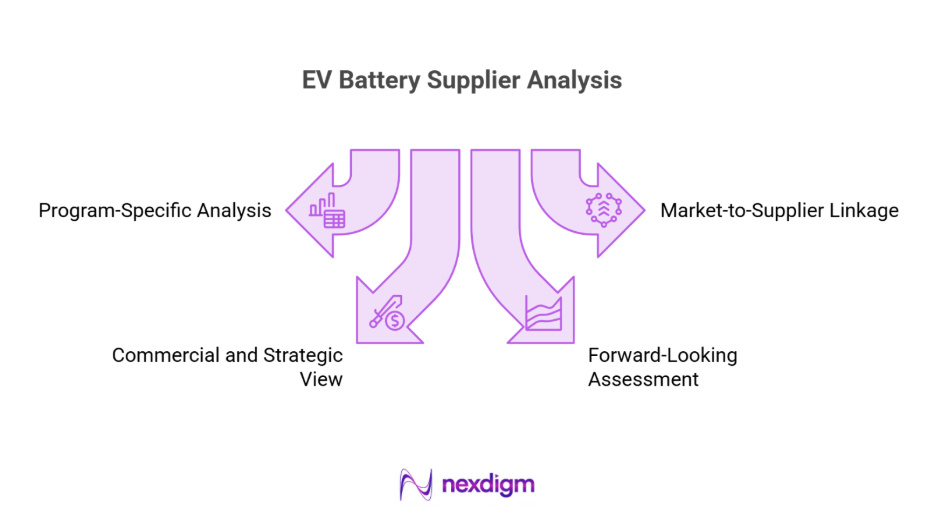
- Program-Specific Analysis: Evaluate suppliers against the OEM’s vehicle platforms, chemistry requirements, volumes, localization priorities, and technology roadmap.
- Market-to-Supplier Linkage: Connect battery-market developments, capacity additions, technology shifts, and regional trends with individual supplier capabilities.
- Commercial and Strategic View: Consider cost competitiveness alongside manufacturing scale, customer relationships, geographic exposure, partnerships, and future growth potential.
- Forward-Looking Assessment: Look beyond current supplier performance to identify investments, capacity expansion, technology developments, and strategic moves that could influence future sourcing.
This approach helps OEMs move beyond who leads the battery market to understand which suppliers are best aligned with their specific sourcing strategy and future requirements.
Nexdigm’s Case
Nexdigm’s EV battery supplier analysis identified 22% of suppliers as strong strategic-fit candidates, while 15% demonstrated technology advantages and 12% showed stronger regional capacity positioning. A further 9% presented elevated concentration exposure. Based on these findings, the OEM prioritized strategic supplier engagement and capacity planning for future EV programs.
To take the next step, simply visit our Request a Consultation page and share your requirements with us.
Harsh Mittal
+91-8422857704