

EV battery compliance is becoming more important as battery production expands and regulations increasingly cover safety, sustainability, traceability, materials, and supplier information. Global EV battery deployment reached 1.2 TWh in 2025, almost 30% higher than in 2024, increasing the importance of consistent standards across a rapidly expanding supply base. LFP batteries also accounted for more than 55% of global EV battery deployment in 2025, showing how quickly battery technologies are evolving.
Regulatory expectations are also becoming more detailed. Under the EU Batteries Regulation, relevant EV batteries placed on the EU market will require a digital Battery Passport from 18 February 2027. The passport framework covers information such as technical characteristics, material composition, performance, sustainability, and circularity. The European Commission’s 2026 guidance brings together 71 data points to support industry preparation.
For automakers, EV battery supplier compliance research services can therefore help determine whether suppliers are meeting applicable requirements and whether their documentation, processes, materials, and data systems are ready for evolving compliance expectations.
Compliance Is Becoming a Supply-Chain Requirement
Battery compliance is no longer limited to checking whether a finished battery meets technical specifications. Requirements can extend across cells, modules, packs, raw materials, manufacturing processes, documentation, and supplier information. This makes supplier compliance a broader procurement consideration, requiring organizations to understand what standards apply, what evidence suppliers can provide, and where gaps may create market-access or sourcing risks.
Compliance Can Vary Across Suppliers and Markets
Meeting battery requirements is not necessarily consistent across every supplier, facility, or market. Differences in manufacturing processes, certifications, documentation practices, material sources, and regulatory exposure can create varying levels of readiness. For automakers, this makes it important to look beyond a supplier’s basic compliance status and understand how consistently its systems and processes can support requirements across products, locations, and changing market expectations.
How Nexdigm Helps Build Battery Compliance Readiness
Compliance requirements can create different levels of readiness across an EV battery supplier base. Nexdigm can help organizations understand where suppliers stand today and what may be required to strengthen their preparedness:
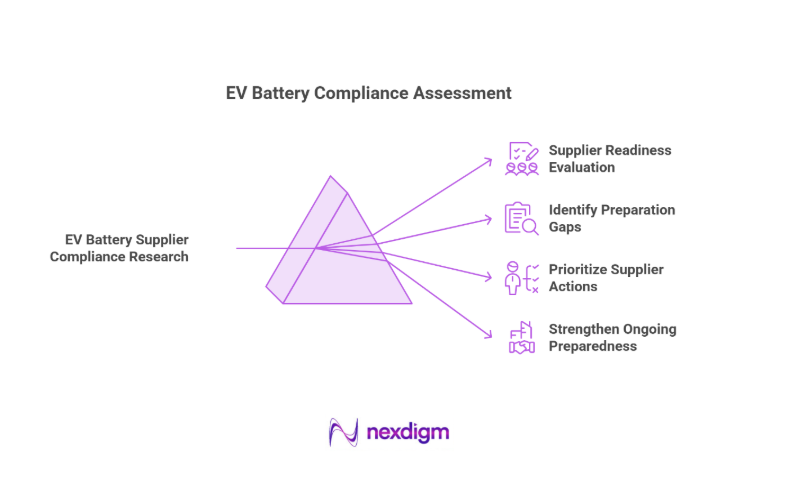
- Establish Supplier Readiness: Evaluate how well suppliers’ current processes, systems, and capabilities align with applicable requirements.
- Identify Preparation Gaps: Highlight areas involving testing, documentation, material information, traceability, or regulatory data that may require attention.
- Prioritize Supplier Actions: Distinguish between gaps that require immediate remediation and those that can be addressed as requirements evolve.
- Strengthen Ongoing Preparedness: Help procurement teams incorporate compliance readiness into supplier monitoring, qualification, and engagement processes.
Through EV battery supplier compliance research services, Nexdigm can help turn compliance requirements into clear supplier-readiness priorities and practical next steps.
Nexdigm’s Role in Turning Compliance Insights into Supplier Action
Nexdigm can help organizations move from identifying compliance gaps to deciding how each supplier should be addressed. Our approach can support:
- Supplier-Level Gap Prioritization: Determine which compliance gaps require immediate attention based on regulatory relevance, product scope, and potential sourcing impact.
- Targeted Remediation: Identify whether suppliers need additional testing, documentation, traceability improvements, process changes, or stronger data capabilities.
- Supplier Engagement: Provide procurement teams with clearer areas for discussion when working with suppliers on compliance improvements and readiness.
- Ongoing Monitoring: Establish a basis for tracking supplier progress as requirements, technologies, and market expectations continue to evolve.
- Compliance Benchmarking: Compare supplier readiness across markets, facilities, products, and compliance dimensions to identify relative strengths and weaknesses.
- Sourcing Decision Support: Incorporate compliance readiness into supplier qualification, sourcing allocation, supplier development, and alternative-source decisions.
Through EV battery supplier compliance research services, Nexdigm can help turn compliance findings into specific supplier actions rather than leaving them as standalone compliance observations.
Nexdigm’s Compliance Insights for Smarter Supplier Choices
Compliance readiness can become an important differentiator when multiple battery suppliers appear comparable on price, technology, or capacity. Nexdigm can help procurement teams incorporate compliance intelligence into supplier decisions by:
- Comparing Readiness Levels: Highlight differences in current compliance status, documentation quality, traceability, and regulatory preparedness.
- Identifying Qualification Risks: Flag suppliers where unresolved compliance gaps could delay qualification, production, or market entry.
- Supporting Supplier Shortlisting: Use compliance readiness alongside commercial and operational factors to strengthen supplier evaluation.
- Informing Supplier Allocation: Consider compliance maturity when determining sourcing volumes, alternative suppliers, and supplier development priorities.
- Preparing for Future Requirements: Identify suppliers that may be better positioned to adapt as battery regulations and reporting expectations evolve.
This enables EV battery supplier compliance research services to contribute directly to supplier selection, qualification, allocation, and long-term sourcing decisions.
Nexdigm’s Case
An automaker evaluated 40 EV battery suppliers across four markets using Nexdigm’s EV battery supplier for compliance research services. The assessment found 22% requiring additional compliance validation, while 17% showed gaps in material traceability or regulatory data readiness. The findings helped procurement prioritize supplier remediation, qualification reviews, and ongoing compliance monitoring.
To take the next step, simply visit our Request a Consultation page and share your requirements with us.
Harsh Mittal
+91-8422857704