

The global EV battery supply chain is expanding rapidly while remaining highly concentrated across a few production hubs. In 2025, global EV battery deployment reached 1.2 TWh, almost 30% higher than in 2024. China accounted for around 60% of global EV battery deployment, while global lithium-ion battery manufacturing capacity exceeded 4 TWh.
China also represented more than 80% of global battery manufacturing capacity and over 80% of battery-cell production. At the same time, EV sales exceeded 20 million vehicles globally in 2025, with one in four new cars sold being electric. These developments make EV battery trade intelligence increasingly important for understanding cell, module, pack, material, supplier, and destination-market movements.
Battery Trade Is Expanding Beyond Finished Cells
EV battery trade increasingly involves a connected chain of cells, modules, packs, active materials, precursors, and manufacturing inputs. While China remains dominant, battery production capacity outside the largest markets grew rapidly in 2025, particularly in Southeast Asia and the United Kingdom. The diversification of manufacturing locations is creating new trade relationships while leaving critical upstream stages highly concentrated.
What Battery Trade Movements Can Reveal
Battery trade patterns can provide practical signals about changing supply chains:
- Changing Supply Hubs: New cell and component capacity can indicate emerging sourcing locations and diversification opportunities.
- Changing Material Dependencies: Concentration in cathode, anode, precursor, or critical-material supply can reveal potential supply-chain exposure.
Together, these signals help businesses understand where battery production is expanding, which suppliers are gaining relevance, and where dependencies may require strategic attention.
Nexdigm’s Industry-Led Expertise in Assessing EV Battery Markets
The EV battery ecosystem is evolving rapidly, with shifting manufacturing footprints, emerging supplier networks, and changing material dependencies reshaping global trade flows. Navigating these developments requires more than trade visibility alone. Nexdigm combines sector expertise, market intelligence, and supply chain analysis to help businesses with:
- Industry-Centric Perspective: Nexdigm evaluates battery trade movements within the broader EV ecosystem, connecting developments across battery manufacturers, automakers, material suppliers, and energy-transition trends.
- End-to-End Value Chain Understanding: From critical minerals and active materials to cells, modules, and battery packs, Nexdigm provides insights across the entire battery supply chain to uncover risks and growth opportunities.
- Strategic Business Focus: By integrating trade intelligence with market, supplier, and competitive analysis, Nexdigm helps businesses support sourcing decisions, investment planning, market expansion, and supply chain resilience.
Nexdigm’s EV Battery Trade Intelligence Capabilities
As the EV ecosystem expands, businesses need visibility into shifting supply networks, manufacturing footprints, and material dependencies. Nexdigm’s EV battery trade intelligence combines trade data, supplier analysis, and market assessment to help organizations identify sourcing opportunities, evaluate risks, track emerging production hubs, and make informed decisions across procurement, investment, expansion, and supply chain strategy.
Nexdigm’s EV Battery Trade Assessment
Experts at Nexdigm structure the assessment across four connected areas to understand the battery value chain from product movement to commercial opportunity. These areas are:
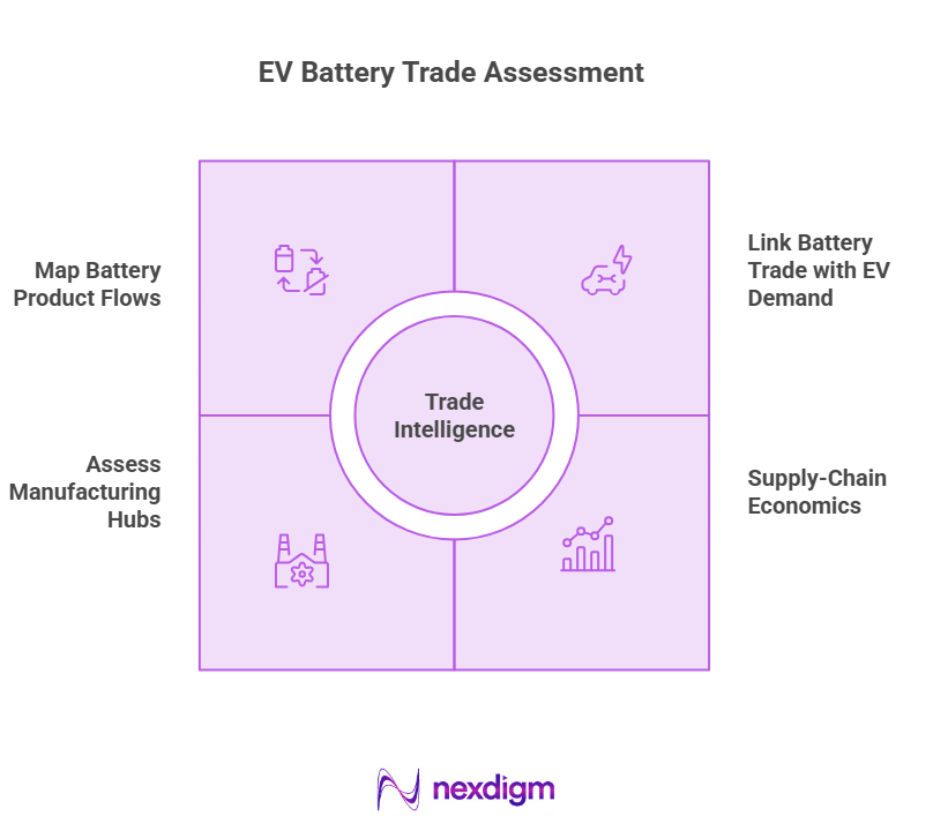
- Map Battery Product Flows: Analyzing cells, modules, packs, cathode and anode materials, precursors, battery components, import-export volumes, trade values, origins, and destinations to identify important trade corridors and product movements.
- Assess Suppliers and Manufacturing Hubs: Mapping battery manufacturers, material producers, OEM-linked suppliers, production locations, capacity, supplier shares, and manufacturing ecosystems to identify established and emerging supply hubs.
- Link Battery Trade with EV Demand: Connecting battery movements with EV production, vehicle sales, model launches, battery demand, local manufacturing plans, and regional adoption to understand the market drivers behind trade flows.
- Evaluate Supply-Chain Economics and Exposure: Assessing pricing, tariffs, logistics, infrastructure, critical-material dependencies, supplier concentration, and alternative sourcing options to identify commercial opportunities and supply-chain vulnerabilities.
This assessment helps businesses distinguish short-term shipment movements from structural changes in battery manufacturing and sourcing networks.
Benefits of Nexdigm’s EV Battery Trade Assessment
By connecting product-level trade data with suppliers, manufacturing capacity, EV demand, pricing, and material dependencies, Nexdigm’s assessment helps businesses:
- Identify Sourcing Alternatives: Compare suppliers, countries, product categories, capacity, and trade routes to identify viable alternatives to concentrated sources.
- Locate Emerging Production Hubs: Assess manufacturing capacity, supplier ecosystems, investments, and export activity to identify new battery-production locations.
- Understand Supply Dependencies: Evaluate geographic and supplier concentration across critical materials, components, and manufacturing stages.
- Support Investment Decisions: Combine demand, supply, trade, infrastructure, and competitive signals to assess potential manufacturing, sourcing, and partnership opportunities.
The assessment helps businesses move from monitoring battery trade flows to identifying actionable opportunities and risks, supporting sourcing, market expansion, supplier development, investment, and long-term EV supply-chain strategy.
Nexdigm’s Case
Nexdigm supported an automotive-sector client by analyzing 6,400+ EV battery and material shipments across 10 markets, covering product categories, 24 supplier countries, and 29 trade corridors. The assessment identified priority battery segments, 7 alternative sourcing markets, and 5 high-potential destination markets, helping the client evaluate supply diversification and expansion opportunities across the EV battery value chain.
To take the next step, simply visit our Request a Consultation page and share your requirements with us.
Harsh Mittal
+91-8422857704