

An EV brand expansion strategy is important as competition intensifies across global electric mobility markets. With more players entering the sector, companies must clearly define their positioning, target customers, pricing approach, product differentiation, and distribution channels. A strong market entry strategy helps EV brands evaluate demand, regulatory requirements, charging infrastructure, local partnerships, and competitive pressures before expansion.
It also supports decisions related to localization, after-sales service, and customer trust-building. By aligning brand identity with market needs and operational capabilities, businesses can improve visibility, reduce entry risks, and capture growth opportunities in the fast-evolving global electric mobility industry.
Global electric car sales crossed 20 million units in 2025, growing 20% from 2024 and reaching around 25% of total car sales. In 2025, sales had already exceeded 17 million units, with more than 20% market share. These figures show rising demand, but also intensifying competition, making a clear EV brand expansion strategy essential for differentiation and growth. This data shows why brand expansion strategy is becoming more important in EV market.
Evaluating Competitive Intensity Across Global EV Markets for Expansion
Evaluating competitive intensity across global EV markets helps companies understand existing players, pricing pressure, product differentiation, market share, customer preferences, and entry barriers before planning expansion.
-
Existing EV Players
Identify established EV brands, local manufacturers, and new entrants competing for customers across target international markets.
-
Market Share Analysis
Assess how sales volumes and customer demand are distributed among leading EV competitors in each market.
-
Pricing Pressure Review
Analyze competitor pricing, discounts, financing schemes, and affordability levels affecting EV purchase decisions.
-
Product Differentiation Study
Compare vehicle range, battery performance, design, technology features, safety standards, and charging compatibility.
Nexdigm’s EV Market Research and Demand Assessment Support
Nexdigm’s EV Market Research and Demand Assessment Support helps businesses understand growth opportunities in electric mobility markets before expansion. It includes analyzing EV adoption trends, customer preferences, market size, charging infrastructure, policy incentives, competitor activity, and demand drivers. These insights help companies assess commercial potential, reduce entry risks, and develop a focused market entry strategy for sustainable EV brand expansion.
Nexdigm’s Risk Assessment for Competitive EV Market Entry
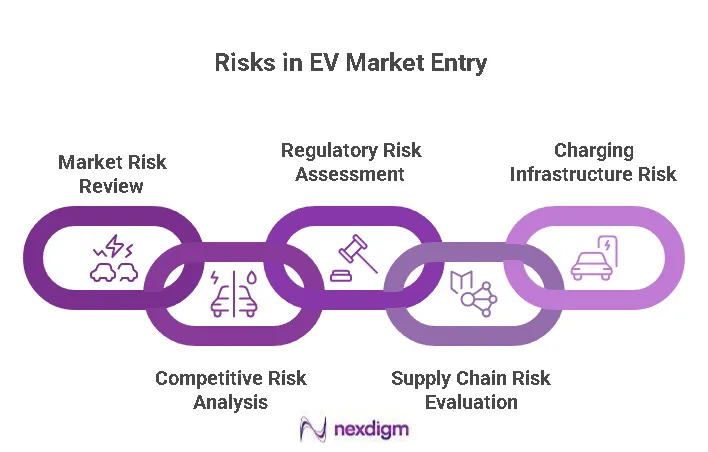
Nexdigm’s Risk Assessment for Competitive EV Market Entry helps businesses identify market, regulatory, pricing, supply chain, infrastructure, and competition-related risks before entering global electric mobility markets:
-
Market Risk Review
Nexdigm assesses demand uncertainty, adoption rates, customer readiness, and growth barriers before EV market entry decisions.
-
Competitive Risk Analysis
Nexdigm evaluates competitor strength, pricing pressure, product differentiation, brand loyalty, and market share concentration.
-
Regulatory Risk Assessment
Nexdigm reviews EV policies, incentives, import rules, localization requirements, and compliance obligations affecting entry feasibility.
-
Supply Chain Risk Evaluation
Nexdigm studies battery sourcing, component availability, logistics costs, vendor reliability, and dependency on critical materials.
-
Charging Infrastructure Risk
Nexdigm assesses charging network gaps, grid readiness, public charging availability, and infrastructure investment requirements.
Nexdigm’s case:
Nexdigm assisted an EV brand to evaluate risks before entering a competitive international market. Nexdigm found that three leading players controlled nearly 58% of EV sales, while average vehicle prices had declined by 9% due to aggressive competition. The assessment also showed that charging infrastructure covered only 64% of key urban zones. Based on these findings, Nexdigm helped the company refine its phased market entry strategy, strengthen dealer planning, and reduce competitive entry risk.
To take the next step, simply visit our Request a Consultation page and share your requirements with us.
Harsh Mittal
+91-8422857704