

The EV charging ecosystem is expanding rapidly alongside vehicle electrification. Global public charging infrastructure exceeded 7 million charging points at the end of 2025, after nearly 1.8 million new points were added during the year, representing growth of more than 33%. China accounted for more than 65% of the global public charging stock, while its fast and ultra-fast charger base grew 40% during 2025.
Charging capabilities are also advancing. The global average public charging speed increased from just over 40 kW in 2024 to nearly 50 kW in 2025, reflecting faster deployment of fast and ultra-fast equipment. This expanding and increasingly diverse ecosystem makes EV charging equipment supplier mapping important for organizations evaluating technology providers, infrastructure partners, and market opportunities.
Understanding the Multiple Layers of the Charging Ecosystem
The charging market is no longer limited to hardware manufacturers. It includes AC charging equipment, DC fast and ultra-fast chargers, charging-network operators, software providers, installation specialists, power-management companies, and infrastructure partners. Each plays a different role in enabling reliable charging deployment.
For OEMs, charge-point operators, utilities, and infrastructure investors, understanding these layers can make supplier identification more targeted and commercially relevant.
Key Factors That Differentiate EV Charging Suppliers
Supplier competitiveness can vary significantly depending on charging application, geography, technology, and deployment scale. A broader assessment can therefore consider:
- Charging Technology: Compare AC, DC fast, and ultra-fast charging portfolios, power ratings, interoperability, connectivity, software, and technology maturity.
- Deployment Capability: Evaluate manufacturing capacity, installation expertise, grid integration, service networks, localization, maintenance capabilities, and geographic reach.
- Market Strength: Assess customer relationships, partnerships, pricing, market presence, expansion plans, and ability to support different charging environments.
These dimensions help organizations distinguish suppliers with broad portfolios from those offering specialized capabilities for residential, commercial, fleet, highway, or high-power charging applications.
Nexdigm’s Approach to Distinguishing EV Charging Suppliers
Nexdigm can help organizations create a structured supplier landscape by combining market intelligence, supplier research, competitive benchmarking, and industry-led analysis. The approach can cover:
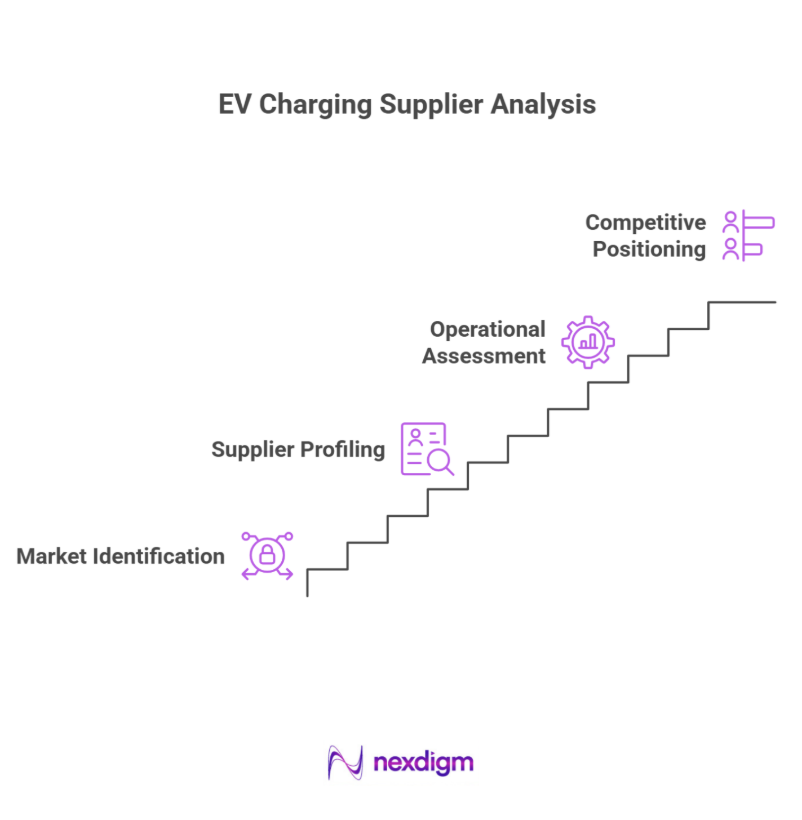
- Market Identification: Mapping AC, DC fast, ultra-fast, hardware, software, infrastructure, and ecosystem providers across selected markets.
- Supplier Profiling: Assessing product portfolios, customers, manufacturing footprint, geographic presence, partnerships, investments, and business focus.
- Operational Assessment: Evaluating capacity, localization, quality systems, installation capabilities, service coverage, and scalability.
- Competitive Positioning: Understanding supplier strengths, market presence, customer segments, strategic priorities, and expansion direction.
This creates a structured view of the market rather than treating all charging equipment providers as a single supplier category.
Nexdigm’s Industry-Led View on Charging Infrastructure
Experts at Nexdigm combine automotive, mobility, and infrastructure knowledge with market intelligence to assess evolving charging ecosystems. Our industry-led view can help organizations understand supplier movements, technology developments, infrastructure requirements, and competitive dynamics while connecting these findings with commercial and strategic priorities across different EV markets.
Assessing Charging Infrastructure Trends through Supplier Mapping
Understanding charging infrastructure trends is only the starting point. The next step is to translate these market developments into a clear view of supplier capabilities, competitive positioning, and potential opportunities. Nexdigm can connect industry-level signals with EV charging equipment supplier mapping, helping organizations understand:
- Evolving Needs: Identify suppliers with advanced AC/DC charging portfolios, scalable capacity, strong interoperability, software capabilities, and technology roadmaps aligned with future requirements.
- Areas Requiring Evaluation: Flag suppliers where gaps exist in manufacturing scale, technology maturity, service coverage, localization, quality, or ability to support larger deployments.
- Opportunities for Action: Highlight suppliers that may warrant deeper technical diligence, commercial negotiations, strategic partnerships, supplier development, or investment based on their capabilities and market positioning.
This helps organizations distinguish who is ready to scale, who requires further validation, and where strategic intervention could create value.
How Nexdigm Supports Charging Infrastructure Decision-Making
Nexdigm can translate supplier and market intelligence into practical inputs for charging infrastructure strategy. Our analysis can help organizations:
- Prioritize Partners: Identify suppliers with the right combination of technology, scale, geographic presence, and deployment capabilities.
- Identify Market Gaps: Highlight underserved charging segments, technology gaps, and supplier capability areas that may create opportunities.
- Evaluate Partnerships: Assess potential technology, infrastructure, and commercial partners based on strategic and operational fit.
- Plan Expansion: Use supplier and market insights to support geographic expansion, localization, and future infrastructure deployment.
- Strengthen Procurement: Benchmark supplier capabilities and positioning to support negotiations, sourcing allocation, and procurement decisions.
By connecting supplier intelligence with infrastructure priorities, Nexdigm can help organizations move from mapping the charging ecosystem to making targeted strategic decisions.
Nexdigm’s Case
An EV infrastructure player assessed 26 charging equipment suppliers across AC, DC fast, and ultra-fast segments using Nexdigm’s supplier mapping approach. The exercise identified 7 priority suppliers, highlighted 10 critical capability gaps, and reduced the evaluation cycle by 30%, enabling faster partner discussions, more focused sourcing, and better-aligned infrastructure deployment planning.
To take the next step, simply visit our Request a Consultation page and share your requirements with us.
Harsh Mittal
+91-8422857704