

The global shift toward electric vehicles is changing how automotive supply chains are built, managed, and scaled. Unlike traditional vehicle components, EV parts depend heavily on battery materials, electronics, software-linked systems, and specialized manufacturing capabilities.
As demand grows, companies entering this space must look beyond production capacity and evaluate supplier reliability, mineral sourcing, technology access, policy support, and regional localization needs. A clear market entry strategy becomes essential to reduce supply risks and capture electrification-led opportunities. An effective EV component supply chain entry strategy helps firms build resilient networks across batteries, motors, semiconductors, charging systems, and power electronics.
EV growth is directly increasing pressure on component supply chains. Electric car sales exceeded 20 million units in 2025, up 20% from 2024, and accounted for 25% of global car sales. Battery demand is also rising, with the global EV battery market valued at USD 61.31 billion in 2024 and projected to reach USD 198.86 billion by 2030 at 22.2% CAGR, strengthening opportunities across EV components and supply networks.
Building a Market Entry Strategy for EV Component Supply Chains in High-Growth Electrification Markets
This heading focuses on helping companies enter fast-growing EV markets by assessing component demand, supplier readiness, localization needs, sourcing risks, policy incentives, and partnerships across the electrification supply chain:
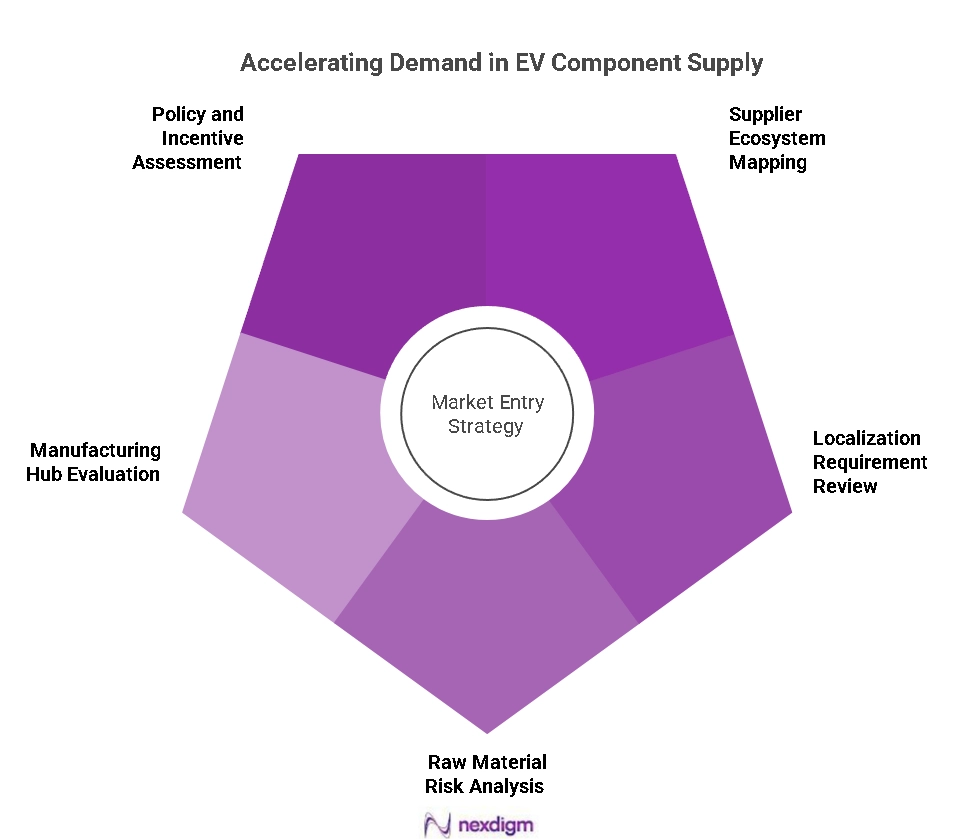
- Supplier Ecosystem Mapping – Identify battery makers, electronics suppliers, semiconductor firms, material providers, and local manufacturers supporting EV component supply chains.
- Localization Requirement Review – Assess local content rules, manufacturing incentives, import duties, assembly requirements, and OEM sourcing expectations before market entry.
- Raw Material Risk Analysis – Review lithium, nickel, cobalt, graphite, copper, and rare earth sourcing risks affecting EV component production.
- Manufacturing Hub Evaluation – Compare industrial clusters, logistics access, energy availability, labor skills, infrastructure, and supplier proximity across potential locations.
- Policy and Incentive Assessment – Analyze EV policies, subsidies, tax benefits, production-linked incentives, and government support for component manufacturing.
Nexdigm’s Advisory on Identifying High-Growth EV Component Markets
Nexdigm’s Advisory on Identifying High-Growth EV Component Markets helps companies evaluate where EV component demand is rising fastest. Nexdigm can assess EV adoption rates, OEM production plans, battery demand, charging infrastructure growth, policy incentives, supplier ecosystems, and localization needs. This enables component manufacturers to prioritize attractive markets, reduce entry risks, and align expansion plans with global electrification demand.
Nexdigm’s Raw Material and Sourcing Risk Assessment for EV Supply Chains
Nexdigm’s raw material and sourcing risk assessment helps companies evaluate lithium, nickel, cobalt, graphite, copper, supplier reliability, price volatility, geopolitical exposure, logistics risks, and alternative sourcing options.
- Supplier Reliability Review – Nexdigm evaluates supplier capacity, delivery consistency, financial strength, quality standards, and long-term sourcing dependability.
- Price Volatility Assessment – Nexdigm tracks raw material price movements, contract risks, inflation exposure, and cost impact on EV component manufacturing.
- Geopolitical Risk Mapping – Nexdigm reviews country-level risks, trade restrictions, export controls, sanctions, and policy changes affecting EV raw material access.
- Alternative Sourcing Options – Nexdigm identifies secondary suppliers, local sourcing opportunities, recycled materials, and substitute inputs to reduce supply dependency.
Nexdigm’s case:
Nexdigm helped an EV component manufacturer assess raw material and sourcing risks before expanding its battery and power electronics supply chain across Asia and Europe. Nexdigm evaluated lithium, nickel, cobalt, graphite, and copper sourcing across 10 supplier markets, reviewed 80+ potential suppliers, and mapped risks linked to price volatility, logistics delays, ESG compliance, and geopolitical exposure.
The assessment helped the company shortlist 25 reliable suppliers, reduce single-source dependency by 35%, and build a diversified sourcing roadmap for EV component expansion.
To take the next step, simply visit our Request a Consultation page and share your requirements with us.
Harsh Mittal
+91-8422857704