

EV ecosystem investments are expanding rapidly across charging networks, battery technologies, and digital mobility infrastructure as electric mobility becomes a major growth area in the automotive industry. Companies are investing in public charging stations, battery manufacturing, recycling systems, fleet electrification platforms, and connected mobility solutions to support wider EV adoption.
A strong EV ecosystem investment entry strategy helps businesses assess infrastructure gaps, customer readiness, regulatory incentives, and partnership opportunities before entering new markets. As part of a market entry strategy, these investments reduce adoption barriers, improve charging convenience, strengthen supply chains, and create long-term value across the electric mobility ecosystem.
Electric car sales exceeded 20 million units in 2025, accounting for about 25% of global car sales. EV battery deployment reached 1.2 TWh in 2025, rising nearly 30% from 2024. Public charging infrastructure also expanded rapidly, with more than 1.3 million public charging points added globally in 2024, a rise of over 30%. These trends support investment in charging, batteries, and digital mobility infrastructure.
Digital Mobility Infrastructure Planning for EV Market Growth
Digital Mobility Infrastructure Planning for EV Market Growth supports EV adoption by developing connected platforms, charging apps, payment systems, fleet tools, data analytics, and user-friendly digital services for efficient mobility operations:
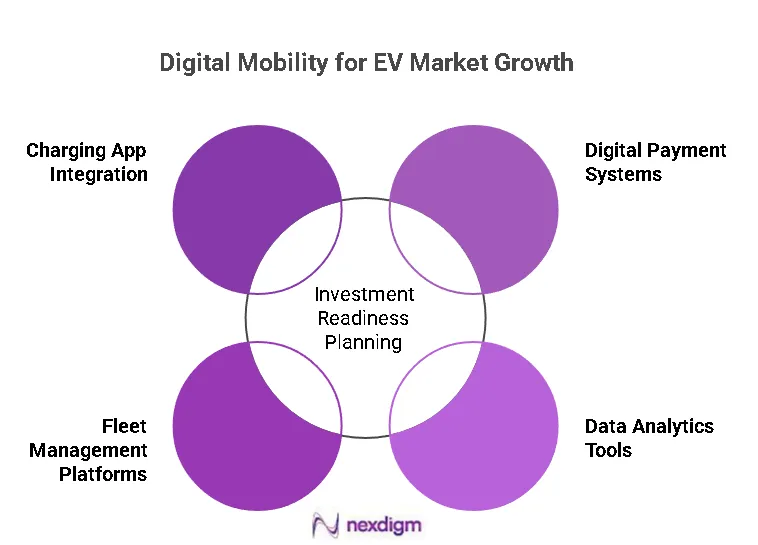
- Charging App Integration: Enables users to locate chargers, check availability, compare prices, book slots, and manage EV charging conveniently.
- Digital Payment Systems: Supports cashless charging payments, subscriptions, wallet integration, billing transparency, and smoother customer transactions.
- Fleet Management Platforms: Helps EV fleet operators monitor vehicle usage, charging schedules, battery health, route efficiency, and operating costs.
- Data Analytics Tools: Uses charging data, driver behavior, location demand, and usage trends to improve EV infrastructure planning.
Nexdigm Charging Infrastructure Feasibility Assessment for EV Expansion
Nexdigm Charging Infrastructure Feasibility Assessment for EV Expansion helps companies evaluate charging demand, location potential, power availability, customer usage patterns, investment costs, and regulatory requirements. It supports decisions on public, residential, workplace, and fleet charging networks. By identifying viable locations, partnership opportunities, and revenue models, Nexdigm helps reduce investment risks and improve EV infrastructure scalability.
How can Nexdigm assess EV charging demand in high-growth markets?
Nexdigm can assess EV charging demand by analyzing EV adoption rates, traffic density, charging behavior, residential and fleet needs, competitor networks, grid readiness, customer usage patterns, and location-level growth potential.
- Traffic and Location Analysis: Nexdigm evaluates traffic flow, parking patterns, commercial zones, highways, and residential clusters for charging station placement.
- Customer Usage Behavior: Nexdigm analyzes charging frequency, preferred charging times, dwell time, payment preferences, and convenience expectations.
- Competitor Network Review: Nexdigm benchmarks existing charging operators, station density, pricing models, service quality, and coverage gaps.
- Grid Readiness Assessment: Nexdigm reviews power availability, load capacity, utility support, and upgrade needs for reliable charging infrastructure.
Nexdigm’s case:
Nexdigm helped an EV charging infrastructure company assess demand in high-growth Indian markets before network expansion. The team analyzed 12 cities, reviewed 200 potential charging locations, mapped fleet and residential demand, and benchmarked 8 competing charging operators. Findings showed that 68% of expected demand came from fleet users and high-traffic urban zones. Based on Nexdigm’s recommendations, the company prioritized 60 high-potential sites, improved location planning, and refined its revenue model.
To take the next step, simply visit our Request a Consultation page and share your requirements with us.
Harsh Mittal
+91-8422857704