

The EV motor supply landscape is becoming increasingly competitive as electric vehicle production scales and automakers pursue greater powertrain integration. Global electric car sales exceeded 20 million in 2025, growing 20% year-on-year and representing one-quarter of new car sales. Nearly 22 million electric cars were produced globally, with China accounting for nearly 75% of production.
Within electric drive motors, Chinese suppliers are gaining significant scale. FinDreams Powertrain led China’s 2025 electric drive motor installations with 3.81 million sets and a 25.6% share, followed by Huawei Digital Power and InfiMotion. This increasingly competitive landscape makes supplier intelligence important for understanding who leads on scale, technology, efficiency, and strategic capability.
Why EV Motor Supplier Leadership Is Becoming Harder to Define
Market leadership is no longer determined by installation volumes alone. Suppliers must increasingly balance motor efficiency, power density, thermal performance, manufacturing scale, cost competitiveness, integration capabilities, and technology development. The growing use of integrated electric-drive systems and higher-voltage architectures is also changing the parameters on which suppliers compete.
For OEMs, EV motor supplier intelligence can therefore provide a broader view of competitive positioning and help distinguish volume leaders from suppliers with differentiated technical or strategic strengths.
Dimensions Should OEMs Compare Across EV Motor Suppliers
A meaningful supplier’s assessment should examine multiple dimensions rather than relying on market share as the sole indicator. These dimensions are:
- Efficiency and Technical Performance: Compare motor efficiency, power density, torque characteristics, thermal management, operating range, materials, architecture, and integration capabilities across competing suppliers.
- Production Scale and Manufacturing Capability: Assess installed capacity, production volumes, manufacturing footprint, automation, quality performance, localization, scalability, and supply-chain resilience to determine production readiness.
Together, these parameters provide a more complete view of supplier leadership. Evaluating suppliers across these dimensions helps OEMs identify partners that can support both current production requirements and long-term EV program objectives.
How Nexdigm Helps Benchmark EV Motor Supplier Competitiveness
Nexdigm combines market intelligence and supplier benchmarking to help OEMs understand competitive positioning. The assessment looks beyond market share to identify suppliers offering:
- Technical Capability: Compare motor efficiency, power density, thermal performance, architecture, materials, controls, durability, and technology maturity across competing suppliers.
- Production Scale: Assess manufacturing capacity, production volumes, plant footprint, automation, quality systems, localization, scalability, and supply-chain resilience.
- Commercial Positioning: Evaluate cost competitiveness, customer portfolios, geographic presence, partnerships, financial strength, and commercial positioning against relevant supplier peers.
- Future Readiness: Examine R&D investments, technology roadmaps, integration capabilities, strategic partnerships, and expansion plans to assess long-term suitability for evolving EV programs.
Through this approach, Nexdigm helps OEMs identify competitive EV motor suppliers by combining technical, operational, and commercial insights to support informed, future-ready sourcing decisions.
Why OEMs Turn to Nexdigm for EV Motor Supplier Intelligence
Nexdigm combines industry knowledge, market intelligence, and structured benchmarking to give OEMs a clearer view of EV motor supplier competitiveness. Our EV motor supplier intelligence goes beyond market share to evaluate technical capability, production scale, commercial positioning, and future readiness. This helps OEMs identify relevant suppliers, understand competitive gaps, assess sourcing risks, and make informed decisions aligned with specific vehicle programs, technology requirements, and evolving EV market priorities.
Strategic Applications of Nexdigm’s EV Motor Supplier Intelligence
Nexdigm’s intelligence can support OEMs across several stages of supplier evaluation and EV strategy. These stages/areas are:
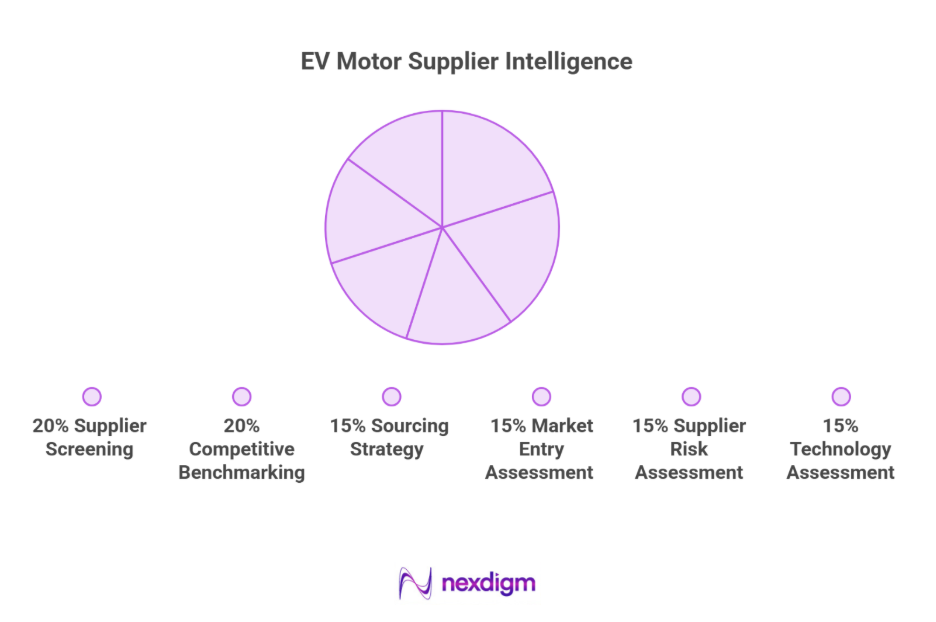
- Supplier Screening: Shortlisting relevant motor suppliers based on technical capabilities, scale, geography, cost positioning, and program fit.
- Competitive Benchmarking: Comparing suppliers across key performance and capability indicators to understand relative strengths and market positioning.
- Sourcing Strategy: Supporting supplier allocation, negotiations, localization decisions, and sourcing plans using structured market and supplier insights.
- Market Entry: Assessing supplier ecosystems, competitive intensity, and local capabilities when entering new EV markets or expanding existing operations.
- Technology Assessment: Tracking emerging motor technologies, supplier investments, R&D direction, and technology roadmaps to support future platform planning.
- Supplier Risk Assessment: Identifying potential capacity, technology, supply-chain, financial, and scalability risks that could affect long-term sourcing decisions.
As EV motor markets evolve, OEMs need more than supplier rankings to make confident sourcing decisions. Nexdigm’s EV motor supplier intelligence can help connect market developments with supplier capabilities, enabling OEMs to identify the right partners.
Nexdigm’s Case
An OEM evaluated five EV motor suppliers using Nexdigm’s intelligence framework. The assessment helped increase supplier comparison coverage by 40%, identify 8 critical capability gaps, reduce the supplier evaluation cycle by 26%, and improve visibility into sourcing opportunities by 32%. These insights supported faster shortlisting, targeted supplier discussions, and more informed sourcing decisions.
To take the next step, simply visit our Request a Consultation page and share your requirements with us.
Harsh Mittal
+91-8422857704