

The rapid shift toward higher-voltage EV architectures is increasing the importance of power electronics across the vehicle. Global electric car sales exceeded 20 million in 2025, representing one-quarter of new car sales, while the IEA expects global sales to reach around 23 million in 2026. At the same time, the first 1,000-volt EV models entered the market in 2025, with charging times below 10 minutes increasingly being announced.
These developments are raising requirements for inverters, onboard chargers, DC-DC converters, power modules, semiconductor technologies, and high-voltage components. As OEMs balance efficiency, cost, thermal performance, reliability, and supply security, mapping the EV power electronics supplier landscape can help identify vendors aligned with both current vehicle programs and future high-voltage platforms.
The Power Electronics Landscape Is Expanding
EV power electronics is evolving rapidly as higher-voltage platforms, advanced semiconductor materials, faster charging requirements, and software-driven vehicle architectures reshape the market. As electrification advances, OEMs are increasingly evaluating:
- Technology Evolution: The industry is shifting toward high-voltage architectures, advanced semiconductor technologies, and integrated power-electronics systems that improve efficiency, charging performance, and overall vehicle functionality.
- Expanding Supplier Requirements: OEMs are assessing suppliers based on technology maturity, manufacturing capabilities, integration expertise, cost competitiveness, and readiness to support next-generation EV platforms.
As power electronics become more central to EV performance, supplier selection requires a broader evaluation of both technological and operational capabilities.
Growing Complexity in EV Power Electronics Supply Chains
The power electronics ecosystem now spans inverter manufacturers, semiconductor suppliers, onboard charger providers, power-module specialists, and integrated system developers. As vehicle architectures become more centralized and software-enabled, supplier capabilities increasingly extend beyond component manufacturing to system integration, thermal management, and power optimization. Understanding how suppliers compete across technology, scale, localization, and innovation can help OEMs identify partners that align with long-term electrification strategies.
Nexdigm’s Expertise in EV Power Electronics Sector
Nexdigm brings together automotive industry knowledge, market intelligence, and supplier-level insights to help organizations navigate the evolving power-electronics ecosystem. Our perspective can help with:
- Understanding Market Shifts: Understand technology shifts, supplier movements, competitive dynamics, and emerging opportunities across the EV power-electronics value chain.
- Supplier Intelligence: Develop deeper visibility into vendor capabilities, market positioning, manufacturing strengths, technology investments, and strategic direction.
- Decision Support: Translate market and supplier insights into practical inputs for sourcing, partnerships, localization, platform planning, and strategic evaluation.
This enables organizations to move from understanding market complexity to identifying suppliers that can support both current requirements and future EV architectures.
Nexdigm’s Valuable Insights for Supplier Evaluation
Nexdigm can translate market and supplier intelligence into a clearer view of vendor suitability across the EV power-electronics value chain through EV power electronics supplier landscape analysis. This can help organizations:
- Compare Capabilities: Assess suppliers across technology, manufacturing scale, quality, cost, localization, and high-voltage expertise.
- Identify Strategic Vendors: Highlight suppliers with differentiated technologies, strong investment pipelines, scalable operations, and relevant OEM relationships.
- Spot Capability Gaps: Identify areas requiring deeper technical validation, supplier development, commercial discussions, or alternative sourcing.
- Support Sourcing Decisions: Use supplier insights to inform shortlisting, allocation, localization, partnerships, and future platform planning.
By connecting supplier intelligence with specific EV program requirements, Nexdigm can help organizations make more focused and evidence-based vendor decisions.
Nexdigm’s Analysis for Future-Ready EV Platforms
Nexdigm can help organizations assess whether power-electronics suppliers are prepared for the next generation of EV platforms. The analysis can focus on:
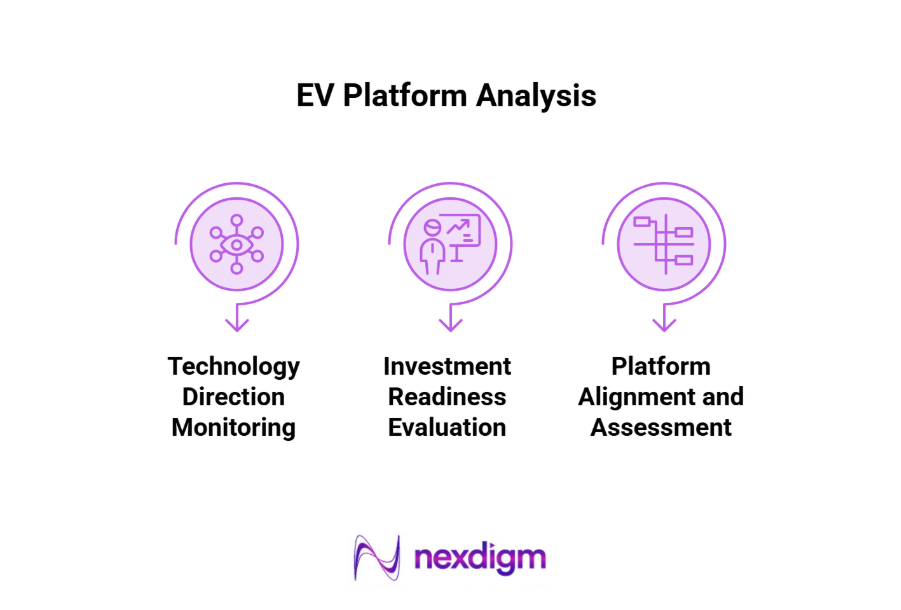
- Technology Direction: Track developments in high-voltage inverters, wide-bandgap semiconductors, integrated power electronics, thermal management, and other emerging technologies to assess supplier innovation.
- Investment Readiness: Evaluate R&D spending, manufacturing investments, capacity expansion, partnerships, and technology development plans to understand suppliers’ ability to scale with future demand.
- Platform Alignment: Assess whether supplier capabilities match future OEM requirements around voltage, efficiency, charging performance, packaging, integration, and scalability.
These insights can help organizations identify suppliers with stronger future potential while highlighting vendors that may require additional validation, development, or alternative sourcing before inclusion in next-generation programs.
Nexdigm’s Case
An EV OEM needed to identify suitable power-electronics partners for a high-voltage platform. Nexdigm assessed 18 suppliers across technology, manufacturing, commercial strength, and future readiness. The analysis enabled the OEM to prioritize 5 strategic vendors, identify 3 partnership opportunities, and focus technical diligence on suppliers with the strongest potential for next-generation platform requirements.
To take the next step, simply visit our Request a Consultation page and share your requirements with us.
Harsh Mittal
+91-8422857704