

EV price elasticity study plays a key role in forecasting consumer demand under changing price scenarios by quantifying how buyers respond to variations in electric vehicle pricing. By integrating EV pricing analysis, competitor benchmarking, and total cost of ownership insights, manufacturers can predict demand shifts more accurately.
EV price elasticity study supports data-driven EV pricing strategy decisions, improves demand forecasting accuracy, and strengthens market responsiveness in rapidly evolving electric mobility ecosystems.
EV price elasticity analysis improves demand forecasting accuracy by approximately 10–17%, enhances pricing responsiveness, and reduces forecasting error in volatile EV markets. As price sensitivity increases across consumer segments, structured EV pricing analysis enables stronger prediction of purchase behavior and more stable adoption trends in electric mobility ecosystems.
EV Pricing Strategy for Elasticity-Driven Market Insights and Positioning
EV Pricing Strategy enables automotive brands to refine electric vehicle pricing decisions by analyzing price elasticity, consumer demand behavior, and competitor benchmarks. Its key elements include:
- Dynamic Pricing Adjustment Modeling: Evaluation of real-time pricing shifts and their impact on EV demand responsiveness across market conditions.
- Income-Based Affordability Segmentation: Analyzing EV demand variations across income groups to refine pricing strategy precision.
- Incentive Impact Sensitivity Analysis: Assessing how subsidies and tax benefits alter consumer response to EV pricing changes.
- Adoption Threshold Pricing Study: Identification of critical price points that trigger significant changes in EV purchase behavior.
- Cross-Market Elasticity Comparison: Comparing price sensitivity across regions to optimize localized EV pricing strategies.
Nexdigm’s Support in Elasticity-Driven EV Pricing Strategy Development
Nexdigm’s Support in Elasticity-Driven EV Pricing Strategy enables automotive companies to design optimized electric vehicle pricing strategies using EV price elasticity analysis, demand forecasting, and competitor benchmarking. By evaluating consumer price sensitivity, battery cost impact, incentives, and total cost of ownership, Nexdigm delivers data-driven EV pricing analysis that improves market responsiveness, strengthens adoption rates, and enhances competitive positioning in dynamic e-mobility landscape.
Nexdigm’s Integrated EV Pricing Elasticity and Benchmarking Model
Nexdigm’s Integrated approach enables automotive brands to refine electric vehicle pricing strategies by combining EV price elasticity analysis, competitor benchmarking, and demand forecasting insights. Its key steps include:
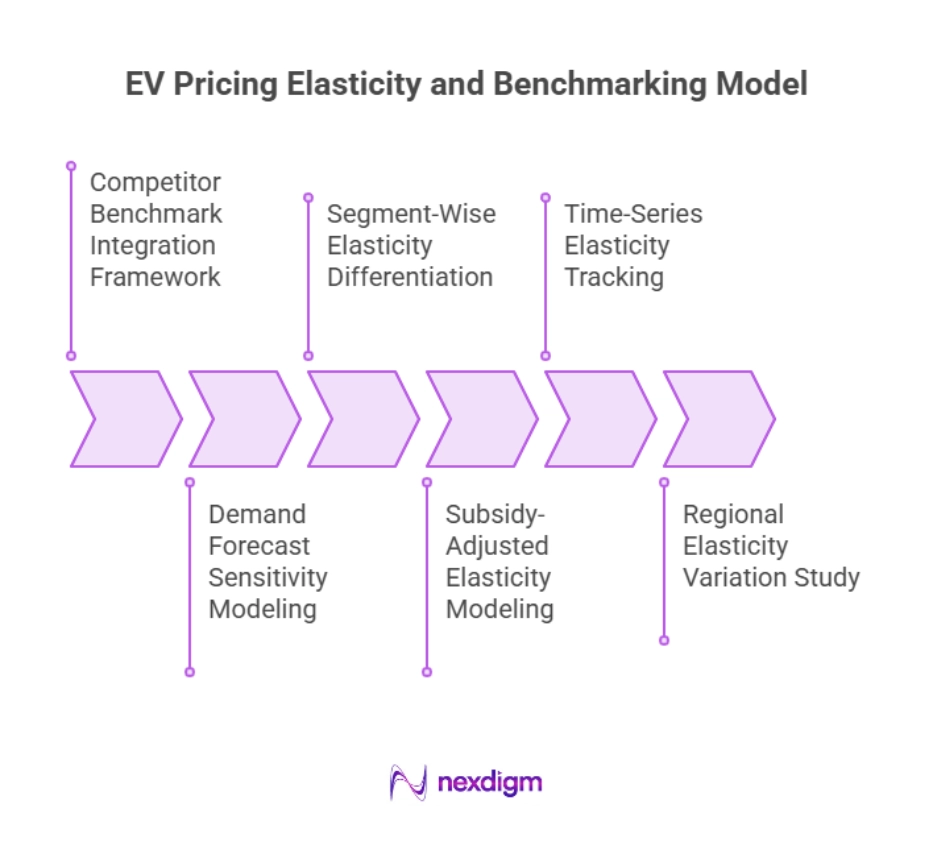
- Competitor Benchmark Integration Framework: Comparing EV pricing structures across manufacturers to identify gaps and refine positioning strategies.
- Demand Forecast Sensitivity Modeling: Evaluation of how pricing variations influence projected EV demand under different market conditions.
- Segment-Wise Elasticity Differentiation: Analyzing price sensitivity variations across entry, mid, and premium EV customer segments.
- Subsidy-Adjusted Elasticity Modeling: Incorporating government incentives into elasticity calculations to reflect true consumer response.
- Time-Series Elasticity Tracking: Monitoring how price sensitivity evolves over product lifecycle and market maturity stages.
- Regional Elasticity Variation Study: Comparing demand responsiveness across geographic markets with different economic conditions.
Nexdigm’s Case
An EV manufacturer engaged Nexdigm to optimize pricing strategy using EV price elasticity analysis and competitor benchmarking. The initiative delivered a 20% increase in sales volume, 15% improvement in pricing accuracy, 12% higher market penetration, 10% reduction in discount dependency, and improvement in demand forecasting accuracy, enhancing overall market performance.
To take the next step, simply visit our Request a Consultation page and share your requirements with us.
Harsh Mittal
+91-8422857704