

Export corridors are becoming increasingly important as manufacturers diversify production, emerging economies expand their export bases, and companies look for faster and more resilient routes to international markets.
Global merchandise exports reached $26.3 trillion in 2025, increasing by 7.2% year-on-year. Developing economies accounted for 46% of global merchandise exports, while exports from developing Asia and Oceania grew by 9%.
For exporters, logistics companies, port operators, infrastructure developers, freight forwarders, investors, and governments, the opportunity is which export corridors can support sustained cargo growth efficiently and competitively.
An Export logistics opportunity analysis helps evaluate export volumes, commodity flows, origin markets, ports, transport links, logistics costs, infrastructure capacity, and future demand. Nexdigm connects these factors to identify corridors where logistics infrastructure and services can capture emerging export opportunities.
The Diversifying Export Growth
Global export growth is no longer concentrated entirely within traditional trading powers. UNCTAD data shows that developing economies increased exports by 8.7% in 2025, while developing Asia and Oceania recorded 9% growth and developing Africa recorded 9.7%.
This creates opportunities for logistics networks connecting new manufacturing centers with international markets. Export growth can generate demand for ports, freight corridors, inland terminals, warehouses, customs facilities, and multimodal transportation.
New Export Hubs Are Emerging
Some economies are becoming important connector and assembly locations within global supply chains. UNCTAD identifies economies such as Viet Nam, Cambodia, Indonesia, and Egypt as examples of economies increasingly serving as logistical hubs or assembly points.
These markets can create new logistics opportunities as manufacturing and trade flows expand.
Nexdigm evaluates industrial activity, export growth, infrastructure, and connectivity to determine whether emerging export hubs can support sustained logistics demand.
Nexdigm’s Expertise in Mapping Export Logistics Opportunities
Export growth alone does not automatically create attractive logistics opportunities. The true potential of an export corridor depends on multiple factors. Understanding how these factors interact is critical for identifying corridors that can support sustainable trade growth and logistics investment. Experts at Nexdigm assess these factors through:
- Export Growth Assessment: Nexdigm evaluates export trends, commodity flows, and trade volumes to identify markets where increasing exports are driving demand for logistics infrastructure and services.
- Manufacturing & Industrial Analysis: The assessment examines industrial clusters, manufacturing activity, and export-oriented industries to understand the long-term cargo generation potential of a corridor.
- Logistics Economics Assessment: The analysis considers logistics costs, capacity utilization, operating efficiencies, and investment requirements to assess the commercial viability of logistics opportunities.
Leveraging its expertise in trade and logistics markets, Nexdigm develops a strategic view of export corridor attractiveness and growth potential. These insights serve as the foundation for Nexdigm’s framework, enabling organizations to identify priority corridors and strategic investment opportunities.
Nexdigm’s Export Logistics Opportunity Framework
Experts at Nexdigm utilize framework to conduct an Export logistics opportunity analysis which evaluates the major areas to help stakeholders compare export corridors and identify where connectivity, or logistics services could generate stronger opportunities. These areas are:
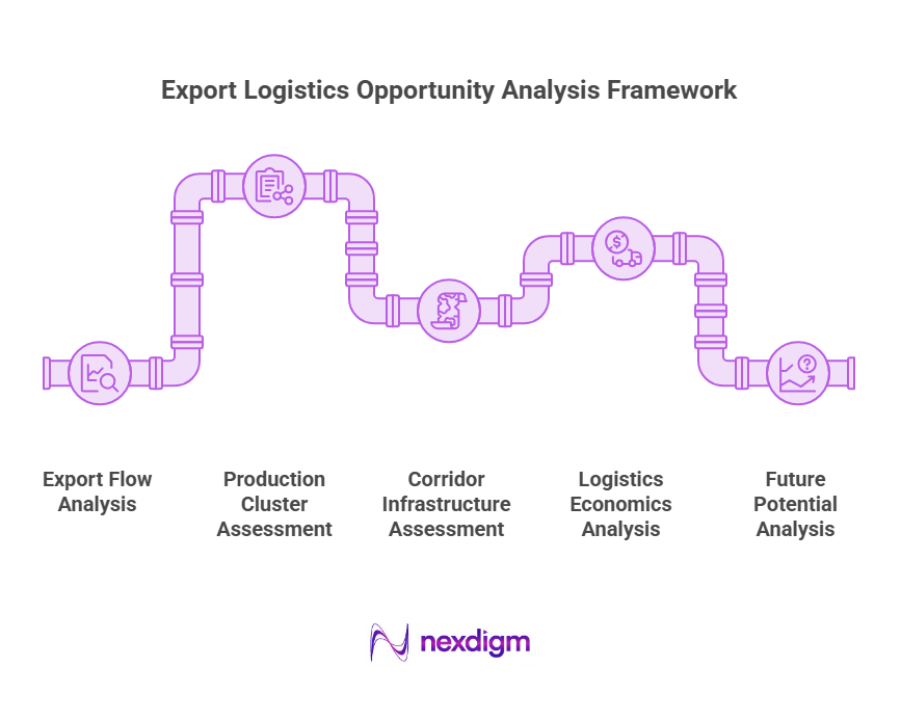
- Export Flows: Nexdigm maps export volumes, commodities, origins, destinations, and growth patterns to identify high-value corridors and changes in international cargo movement.
- Production Clusters: The assessment evaluates manufacturing centers, industrial parks, agricultural regions, and resource locations to understand where future export cargo is likely to originate.
- Corridor Infrastructure: Nexdigm assesses ports, roads, railways, airports, terminals, warehouses, and border infrastructure to identify capacity constraints affecting export movement.
- Logistics Economics: The framework compares freight costs, transit times, handling charges, customs requirements, and reliability to determine corridor competitiveness and commercial attractiveness.
- Future Potential: Nexdigm considers export forecasts, industrial investment, infrastructure pipelines, trade agreements, customer demand, and competing routes to identify corridors with stronger long-term potential.
The framework connects these areas, helping organizations identify corridors where logistics investment can support sustainable trade expansion.
Where Nexdigm Sees the Greatest Potential
Based on the findings of the Export Logistics Opportunity Framework, Nexdigm identifies the areas where export growth, infrastructure readiness, connectivity, and logistics capabilities come together to create the strongest opportunities.
The assessment helps distinguish high-potential export corridors from markets where infrastructure constraints or operational challenges may limit growth. These insights enable businesses and investors to focus on locations, logistics assets, and services that are best positioned to support future trade expansion and sustainable value creation.
Nexdigm’s Strategic Recommendations
Based on the findings of the Export Logistics Opportunity Framework, experts at Nexdigm provide strategic recommendations to help organizations capitalize on emerging export corridor opportunities and strengthen their logistics capabilities.
These recommendations focus on aligning infrastructure investments, connectivity enhancements, operational efficiency, and network expansion strategies with evolving trade flows and market demand.
By adopting a structured and forward-looking approach, organizations can improve corridor competitiveness, enhance supply chain resilience, and position themselves for sustainable export-driven growth.
Nexdigm’s Case
An exporter engaged Nexdigm to evaluate corridor costs, port connectivity, and emerging export markets. The assessment helped reduce logistics costs by 14%, improve shipment reliability by 22%, and shorten average transit times by 17%, enabling stronger export capacity and more efficient market expansion.
To take the next step, simply visit our Request a Consultation page and share your requirements with us.
Harsh Mittal
+91-8422857704