

Automation demand is best understood at the production-line level. Two factories in the same industry can have very different requirements because of differences in product variety, batch sizes, labour availability, quality standards and existing equipment. A demand forecast based on factory counts alone can therefore overstate the addressable market.
The stronger approach is to identify which manufacturing tasks remain labour-intensive, inconsistent or difficult to scale, then estimate how many production lines could justify automation.
Four Production Areas Are Driving Different Buying Requirements
- Assembly: Automation is most attractive where products have repeatable geometries, stable volumes and clearly defined assembly sequences. Complex products and frequent design changes may require flexible tooling, collaborative robots or semi-automated workstations rather than fixed automation.
- Material handling: Palletising, machine tending, internal transport and component movement can be attractive applications where repetitive work constrains throughput or creates safety concerns. The business case depends on movement frequency, travel distance, payload and integration with the wider production layout.
- Inspection: Machine vision and automated testing address repeatability, traceability and the cost of defects. Adoption is influenced by the range of defects, inspection speed, false-positive rates and the consequences of a missed fault.
- Packaging: Automated filling, labelling, case packing and palletising can improve line speed and product consistency. High product variety may require quick-change tooling and recipe management, while seasonal demand can affect the utilisation of dedicated equipment.
These applications should be modelled separately. A plant may be ready to automate packaging but lack the stable process data required for automated inspection. Another may have suitable robot applications but insufficient space or production volume to justify installation.
What Does the Latest Robot Demand Tell Us About Factory Investment?
The International Federation of Robotics reported that global industrial robot installations reached 603,000 units in 2025, up 11% year on year. Installations in metal and machinery manufacturing grew 22%, suggesting stronger automation demand beyond the traditional automotive base. Automotive and electronics each recorded 10% growth.
The pattern matters for demand forecasting because factory automation is spreading across a broader range of industrial applications. However, robot installations are not a complete measure of factory automation: they exclude much of the demand for programmable controls, sensors, machine vision, software and integration services.
A robust forecast should estimate the number of suitable production lines, the share likely to automate, the number of systems required per line and the replacement or expansion cycle. It should also account for adoption barriers such as capital constraints, downtime during installation and limited access to integration expertise.
From Production Bottlenecks to Addressable Demand
For Factory automation demand analysis, Nexdigm can segment the installed manufacturing base by application, line configuration, production volume and investment readiness. The assessment should distinguish between plants that have an identifiable automation opportunity and those that can realistically fund and implement it within the forecast period.
Customer interviews and equipment-level analysis can then test assumed adoption rates. A factory expressing interest in robotics is not equivalent to a funded project. Procurement approval, engineering validation, space availability and expected payback determine when interest becomes actual demand.
Nexdigm’s Factory Automation Demand Conversion Framework
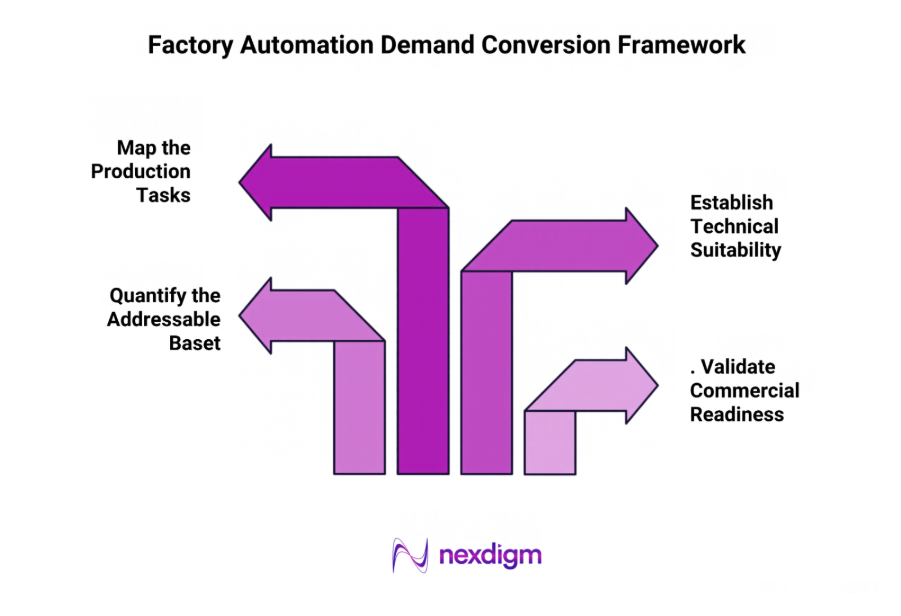
- Map the Production Tasks
Identify assembly, handling, inspection and packaging processes with measurable performance constraints. - Establish Technical Suitability
Assess repeatability, product variation, cycle time, layout, safety requirements and compatibility with existing equipment. - Quantify the Addressable Base
Estimate suitable production lines, expected automation penetration, system requirements and deployment timing. - Validate Commercial Readiness
Test budgets, payback, integration requirements, installation downtime and the likelihood of conversion into funded orders.
Nexdigm Case Study: Identifying Purchase-Ready Factory Automation Demand
Nexdigm assessed 125 production facilities across automotive components, packaged foods and industrial goods. The team mapped 310 assembly, handling, inspection and packaging lines, then screened technical suitability, capital budgets and expected payback. Eighty-four lines met the initial technical criteria, but only 39 had investment cases supporting payback within 30 months.
Nexdigm prioritised robotic handling and packaging automation for the first deployment phase, identifying a potential equipment and integration opportunity of ₹27 crore.
To take the next step, simply visit our Request a Consultation page and share your requirements with us.
Harsh Mittal
+91-8422857704