

When a factory starts missing delivery dates, the first response is often to buy more equipment. Sometimes that is the right decision. Sometimes the existing plant is losing capacity through downtime, slow changeovers, poor scheduling, or bottlenecks that a targeted operational improvement could resolve.
The distinction matters because a new production line brings more than additional output. It adds fixed costs, maintenance requirements, working-capital needs, and pressure to keep equipment utilised.
Factory Capacity Utilization: Finding the Actual Constraint
Rated capacity rarely reflects what a factory can consistently produce. The more useful measure is saleable output after downtime; quality losses, changeovers and product-mix constraints are considered.
A line may appear fully utilised while another has unused capacity. Production can also be constrained by testing, packaging, material handling, or an unreliable supplier rather than by the main manufacturing equipment.
Before approving expansion, examine:
- Machine-level utilisation, downtime, and maintenance records.
- Changeover time, rejection rates and rework.
- Actual production against planned output.
- Orders delayed or lost because of capacity constraints.
- Additional output achievable through process improvements or another shift.
This analysis establishes whether the business needs new machinery, a targeted upgrade, or a different operating model.
Factory Expansion Feasibility Analysis: Is Demand Strong Enough?
Capacity should not be added simply because the sales pipeline looks promising. Signed orders, repeat purchases, customer forecasts, and early-stage opportunities carry different levels of certainty.
The forecast should distinguish committed demand from expected and speculative sales. It should also account for customer concentration. If a single buyer is expected to absorb much of the additional output, a change in that customer’s purchasing plans could leave the new equipment underused.
Capital expenditure needs similar scrutiny. Machinery, civil works, utilities, and installation are only part of the investment. Training, commissioning, maintenance, initial quality losses, and working capital can materially affect the returns. New equipment may take months to reach its planned yield and throughput.
A credible model measures the incremental contribution generated by additional sales after these costs are included. It should show the utilisation level required to break even and the impact of delayed commissioning, lower sales, or higher project costs.
Nexdigm’s Factory Expansion Strategy: The Capacity Investment Framework
The Factory Expansion Feasibility Framework compares three practical options before capital is committed.
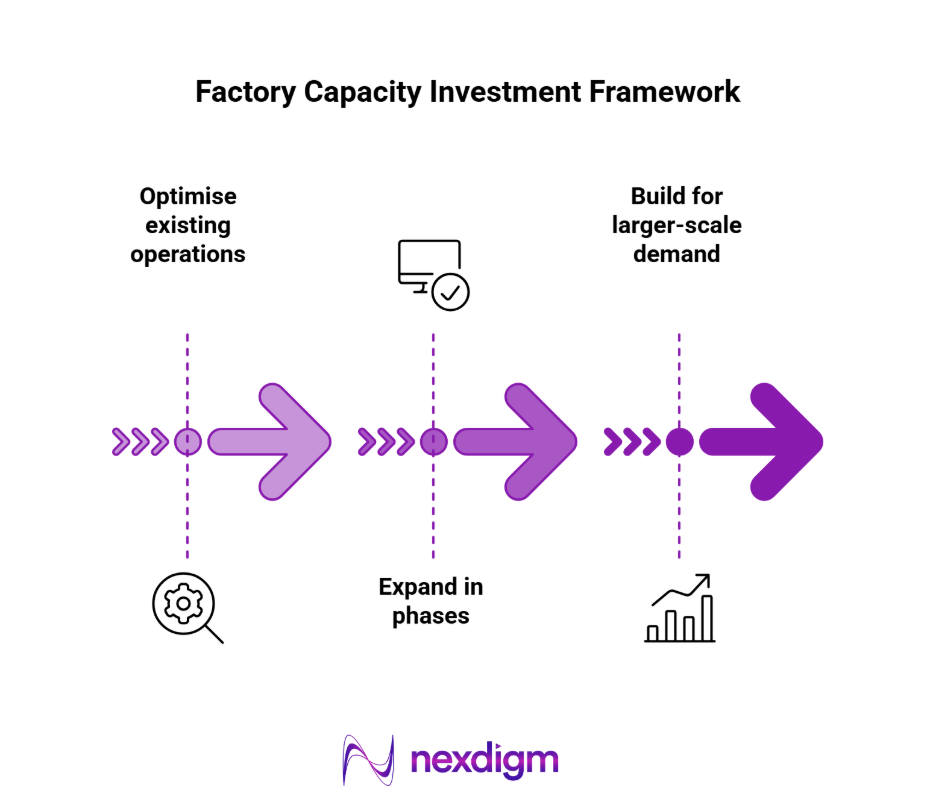
- Optimise existing operations: Reduce downtime, improve yield, shorten changeovers, or address the specific bottleneck. Estimate how much saleable output can be released without major investment.
- Expand in phases: Add equipment or shifts as demand becomes more certain. This can reduce exposure to idle capacity while preserving the option to grow.
- Build for larger-scale demand: Consider a full expansion where customer commitments, equipment lead times or economies of scale justify the upfront cost.
Each option should be evaluated against the same demand assumptions and financial measures, including payback, cash requirements, break-even utilisation and return on invested capital.
What Should a Factory Expansion Business Case Include?
A sound business case needs more than a sales forecast and a machinery quotation. It should establish that the capacity constraint is real, additional demand is credible, and the project remains viable under less favourable conditions.
The analysis should also define measurable post-investment milestones. These might include output per shift, quality performance, utilisation and contribution margin. If demand falls below an agreed threshold before the next investment stage, management should be able to defer further spending.
Nexdigm Case Study: Evaluating Incremental Capacity
Nexdigm assessed a proposed expansion for an Indian component manufacturer by reviewing 14 production stages, machine utilisation, order forecasts and capital requirements. 3 bottlenecks accounted for a disproportionate share of production delays. Targeted operational improvements were estimated to release 12% of effective capacity, supporting a phased investment rather than immediate approval of the full expansion.
To take the next step, simply visit our Request a Consultation page and share your requirements with us.
Harsh Mittal
+91-8422857704