
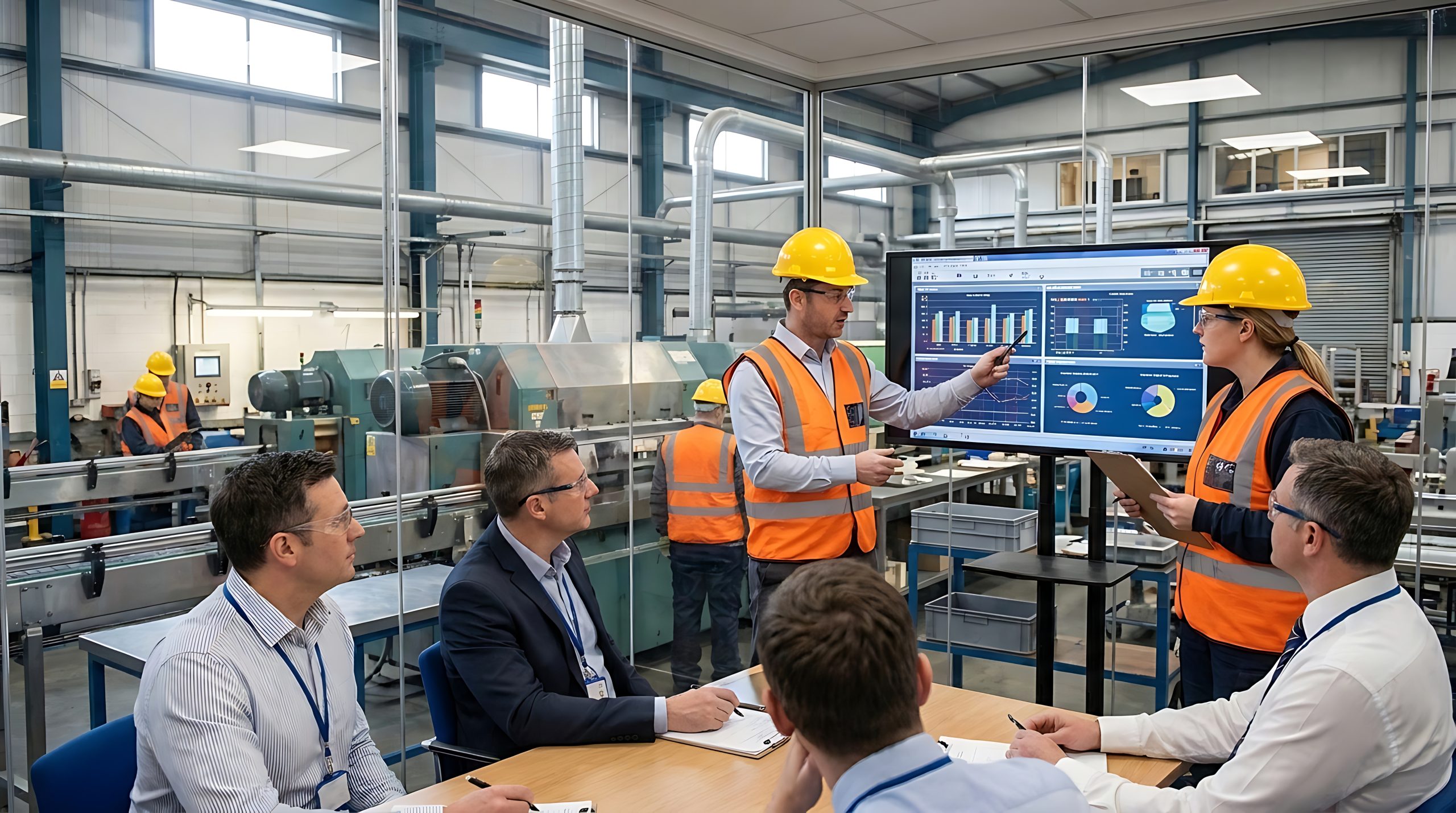
Capacity decisions become difficult when demand and production capability move at different speeds.
A growing market does not automatically require a new factory. Existing plants may have unused capacity, competitors may be expanding faster than demand, or new technology may allow more output from the same footprint. Conversely, a market with moderate headline growth can still require significant investment if utilization is already high.
Production capacity forecasting therefore has to answer two questions together: how much output the market will require, and how much of that requirement existing capacity can realistically satisfy.
Start With the Demand-Supply Gap
Hence, forecasting production capacity requires simultaneously addressing two key questions: what total output will the market demand, and to what extent can current capacity realistically satisfy that demand?
Evaluating the Demand-Supply Gap
Every capacity model relies on a fundamental formula:
Potential capacity requirement = Forecast demand − Available productive capacity
However, every element of this equation demands rigorous verification:
- Forecast Demand: Must account for end-use expansion, evolving customer requirements, export opportunities, and potential product substitution.
- Available Productive Capacity: Must factor in active facilities, realistic utilization rates, scheduled outages, debottlenecking initiatives, and public expansion plans.
Calculating this variance offers the primary signal as to whether expanding capacity is genuinely required.
The Strategic Impact of Capacity Utilization
Identical rates of demand growth can yield drastically different capacity needs across different markets depending on current operational utilization.
Utilization Changes the Investment Case
Two markets with identical demand growth can have completely different capacity requirements.
Consider steel. OECD projects global steel demand growth of only around 0.9% annually through 2030, yet global steelmaking capacity is expected to reach 745 million tonnes of excess capacity by 2028. Global utilization was around 76% in 2025 and could fall toward 74% through 2028.
The implication is important: production demand and capacity demand are not interchangeable.
Where utilization is low, additional demand may be absorbed by existing plants. Where utilization is consistently high, even moderate demand growth can create a stronger case for expansion.
Capacity Forecasting Needs a Pipeline View
- Operating capacity: What plants can produce today under realistic operating conditions.
- Committed capacity: Projects already funded, under construction, or contractually committed.
- Announced capacity: Projects publicly disclosed but not yet fully committed.
- Potential capacity requirement: The residual requirement after accounting for realistic supply additions.
This prevents a common forecasting error: treating every announced project as if it will definitely come online.
The Factory May Not Need to Be Bigger
Expansion is only one response to rising demand.
Companies may instead:
- Increase utilization
- Add shifts
- Debottleneck existing lines
- Upgrade equipment
- Improve yield
- Automate labour-intensive processes
- Outsource selected production
- Relocate production
- Build a new facility
The economically appropriate response depends on the gap between required output and existing capability.
This is particularly important in capital-intensive sectors where an unnecessary greenfield facility can create excess capacity for years.
Geography Can Distort Capacity Planning
Production capacity is also increasingly influenced by where companies want to manufacture.
UNIDO reported global manufacturing production increased 1.2% quarter on quarter in Q1 2026, while manufacturing exports increased 3.5%. Higher-technology manufacturing production rose 1.9%, with exports increasing 4.7%.
These figures suggest that capacity requirements cannot be estimated from domestic demand alone. Export opportunities, regional supply chains and technology-intensive production can materially alter the required footprint.
A country with moderate domestic demand may still support new capacity if it can become an efficient export base.
Nexdigm can support factory production demand forecasting consulting through demand modelling, capacity mapping, utilization analysis, expansion pipeline assessment, production economics and location strategy.
Nexdigm’s Capacity Requirement Model
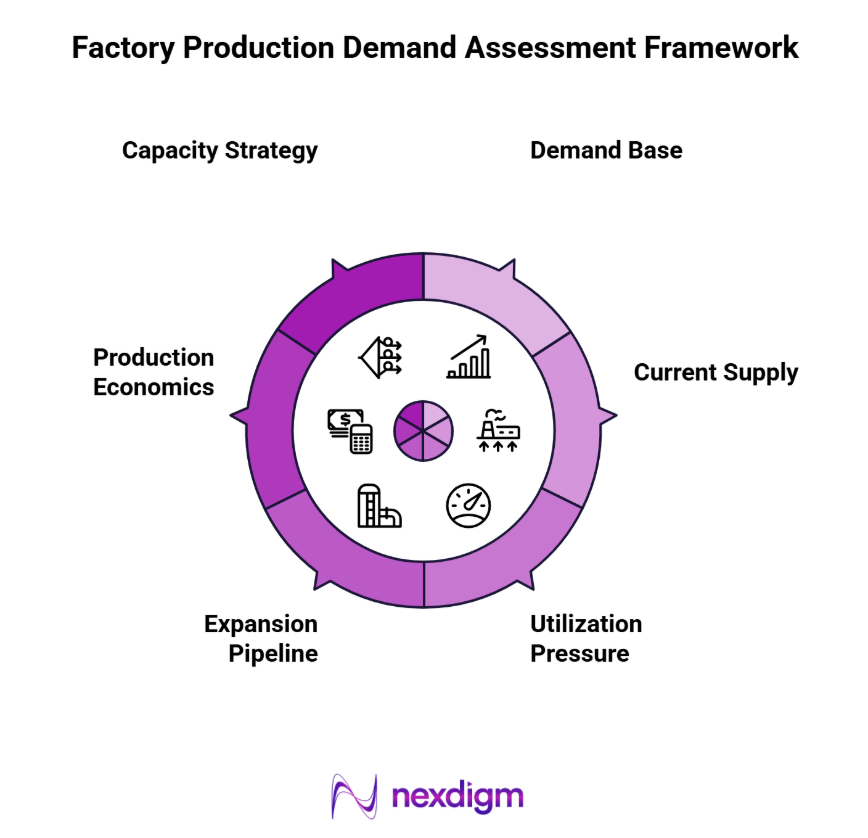
- Demand Base: Forecast consumption by product, end use, geography and customer segment.
- Current Supply: Map installed production capacity and realistic operating output.
- Utilization Pressure: Measure current and forecast utilization to identify where supply constraints may emerge.
- Expansion Pipeline: Track operating, committed, announced and potential capacity additions.
- Production Economics: Compare utilization, labour, energy, logistics, capex and operating costs across expansion options.
- Capacity Strategy: Evaluate greenfield expansion, brownfield expansion, debottlenecking, outsourcing and geographic relocation.
The resulting model can distinguish genuine capacity gaps from markets where additional investment would simply deepen oversupply.
Nexdigm Case Study: Testing the Need for New Production Capacity
Nexdigm supported a manufacturing client assessing whether demand justified additional production capacity. The analysis compared 1.2% global manufacturing growth in Q1 2026 with 3.5% export growth and OECD’s projected 745 million tonnes of excess steel capacity by 2028.
The assessment helped distinguish genuine capacity requirements from supply already available in the market, supporting a more informed expansion and utilization strategy.
To take the next step, simply visit our Request a Consultation page and share your requirements with us.
Harsh Mittal
+91-8422857704