

Factory investments extend far beyond site selection. While UNIDO reports Q1 2026 global manufacturing output up 1.2% quarter-on-quarter and high-tech manufacturing up 1.9%, growth remains uneven across sectors and regions. A viable business case requires balancing demand absorption, reliable infrastructure, competitive inputs, supply chain access, and a production model built to deliver returns at realistic operating rates.
Site Selection Begins with the Customer
The lowest-cost location is not necessarily the strongest manufacturing location.
A plant producing heavy or time-sensitive products may benefit from proximity to customers. A facility dependent on imported components may prioritize ports and supplier clusters. An energy-intensive operation may prioritize electricity cost and reliability.
The location decision should therefore begin with the product’s supply chain.
Customer concentration, inbound material flows, outbound freight, lead-time requirements, inventory strategy, and supplier density determine the practical value of a site.
Infrastructure Can Become a Production Constraint
Factory economics depend on infrastructure that may not appear in a basic land-cost comparison.
Electricity reliability can affect automated production lines. Water availability can constrain process industries. Port congestion can increase inventory requirements. Poor road connectivity can increase freight costs and delivery times.
This matters particularly as manufacturing becomes more technologically intensive.
UNIDO’s latest data shows higher-technology manufacturing growing faster than overall manufacturing in Q1 2026.
Advanced production therefore requires a site capable of supporting more sophisticated equipment, technical talent, utilities, quality systems, and digital infrastructure.
Capacity Has to Be Tied to Demand
Once a site has been shortlisted, the next question is how much factory to build.
Oversizing creates fixed-cost pressure. Undersizing can prevent the business from meeting customer demand or achieving economies of scale.
The correct capacity depends on realistic market share, contracted volumes, customer pipeline, product mix, production yield, number of shifts, and expected utilization.
A plant designed around an aggressive market-share assumption may appear highly profitable in a base case but become loss-making if customer conversion takes longer than expected.
That is why factory feasibility requires demand and capacity to be modelled together.
Output Economics Reveal the Real Investment Case
Factory profitability is ultimately determined by the relationship between selling price, variable production cost, fixed overhead, and output.
A simplified operating model is:
EBITDA = (Selling Price − Variable Cost) × Volume − Fixed Costs
As utilization increases, fixed costs are spread across more units.
This creates operating leverage, but it also creates downside risk. A factory with substantial fixed expenses can experience a sharp decline in profitability when utilization falls.
The model should therefore calculate the break-even utilization rate and test what happens at lower volumes.
Advanced Manufacturing Adds Another Layer
The capital intensity of modern manufacturing can also increase the importance of demand certainty.
SEMI forecasts global semiconductor manufacturing equipment sales to reach $165.9 billion in 2026, a 23.2% increase from 2025. Investment is being driven by AI infrastructure, leading-edge logic, advanced memory, testing, and packaging.
For these facilities, capacity decisions involve very large equipment investments and specialized infrastructure. A plant cannot be economically justified simply because the underlying industry is growing.
The question is whether the proposed facility can capture sufficient demand at the required yield, utilization, pricing, and return on capital.
The Best Site on Paper May Not Be the Best Factory Location
Location comparison should therefore include both static and dynamic variables.
Static factors include land, labour, taxes, utilities, logistics, and incentives.
Dynamic factors include wage inflation, electricity-price changes, infrastructure expansion, supplier development, customer growth, regulatory changes, and future competition.
A location with slightly higher initial costs may become more attractive if it provides stronger supplier depth and customer access. Conversely, a heavily subsidized site may lose its advantage when incentives expire or operating costs rise.
This is why factory production market feasibility research needs to evaluate the factory over its operating life, rather than treating site selection as a one-time land comparison.
Nexdigm’s Factory Production Economics Framework
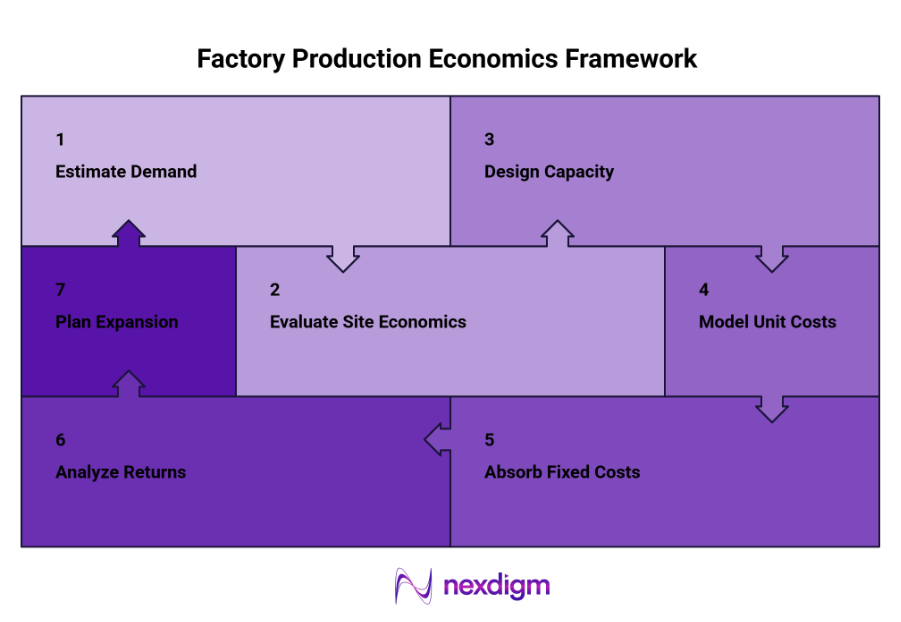
- Demand and Customer Base
Estimate addressable demand, target customers, market share, contracted volumes, and realistic sales ramp-up. - Site Economics
Compare land, labour, utilities, logistics, taxes, incentives, supplier access, and proximity to customers. - Capacity Design
Determine nameplate capacity, line configuration, shifts, product mix, expansion modules, and expected utilization. - Unit Production Cost
Model raw materials, energy, labour, maintenance, scrap, logistics, packaging, and other variable costs. - Fixed-Cost Absorption
Assess facility costs, depreciation, management, insurance, compliance, fixed maintenance, and overhead. - Return and Break-Even Analysis
Calculate break-even utilization, EBITDA, operating margin, return on capital, payback, and downside cases. - Ramp-Up and Expansion
Model commissioning, customer acquisition, workforce scaling, capacity additions, and alternative expansion paths.
Case Study: Factory Production Market Feasibility Research
UNIDO recorded 1.2% global manufacturing growth and 3.5% export growth in Q1 2026. Higher-technology manufacturing grew 1.9%, reinforcing the need to size new factories around sector-specific demand, utilization, infrastructure, and technology intensity.
To take the next step, simply visit our Request a Consultation page and share your requirements with us.
Harsh Mittal
+91-8422857704