

Farm automation does not begin with the most sophisticated machine available. It begins with the operation where automation can solve a measurable economic problem.
India is already moving toward precision agriculture, drones, sensors, robotics, IoT and AI-enabled farming. ICAR has explicitly identified automation and smart machinery as strategic areas, while its Agri-Drone programme has deployed 263 drones across 193 institutions for field demonstrations and technology adoption.
The commercial challenge is deciding which farm operations are ready to move beyond pilots.
Some Operations Have Better Automation Economics Than Others
Automation becomes easier to justify when an operation is repetitive, labour-intensive, time-sensitive and sufficiently standardised.
Spraying is one example. A drone can perform repeated applications across defined acreage without requiring the same level of manual field movement. Precision irrigation offers another opportunity because sensors can connect soil moisture conditions with irrigation decisions.
Harvesting is more complicated. The economic opportunity may be large, but field fragmentation, crop variability and machine cost make deployment harder.
The market therefore needs to be assessed operation by operation.
A Practical Readiness Test
Four questions determine whether automation has a realistic path to adoption.
- Is the labour burden significant?
Operations dependent on scarce or increasingly expensive labour have a stronger economic incentive for automation. - Is the task repetitive?
Automation works more naturally when the same action can be performed repeatedly under predictable conditions. - Can the environment be sensed?
Sensors, cameras, GPS and remote imagery make automation more feasible when crop and field conditions can be converted into machine-readable data. - Can the investment be recovered?
Even technically successful systems may fail commercially if the farmer cannot recover the cost through higher yields, lower inputs, labour savings or reduced crop losses.
The Business Model Matters as Much as the Technology
India’s fragmented farm structure creates a major constraint on individual ownership. Small and marginal holdings make expensive autonomous systems difficult to justify on a single farm. That creates several routes to adoption: custom hiring centres, FPO-led equipment pools, service companies, pay-per-acre models and technology bundled with existing machinery. The same automation technology can therefore have completely different market potential depending on how it is monetised.
Nexdigm’s Framework: From Technical Feasibility to Market Readiness
A structured farm automation market demand analysis can rank opportunities according to commercial readiness rather than technological novelty.
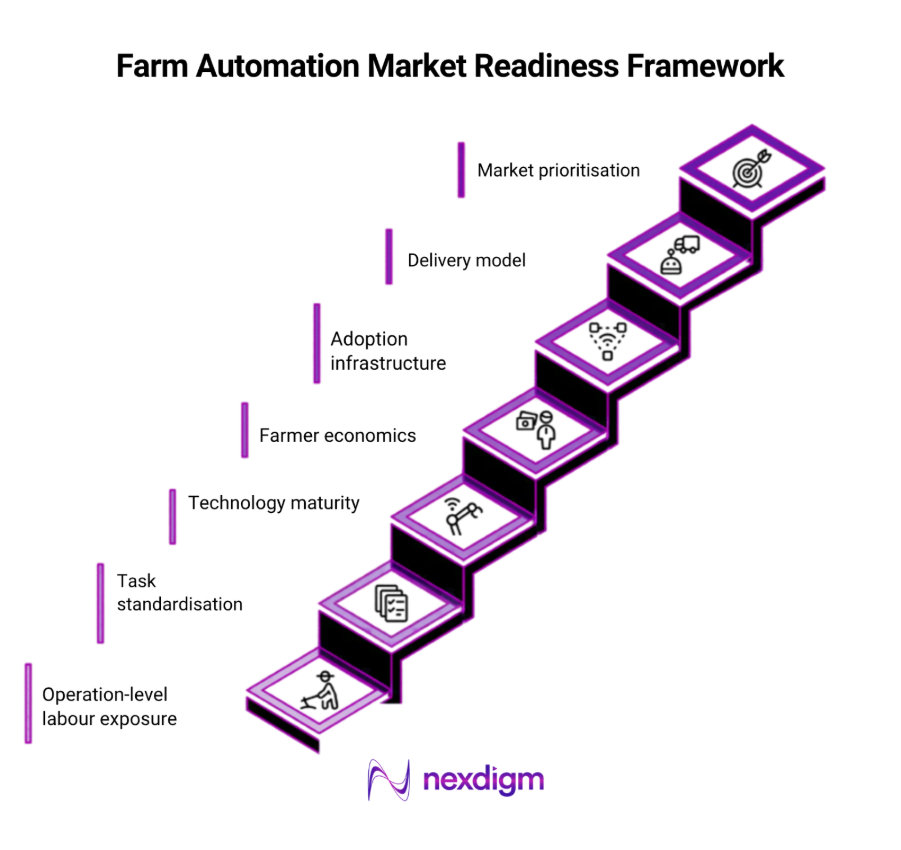
- Operation-level labour exposure
Measure labour hours, wage rates, worker availability and seasonal bottlenecks for each farm operation to identify where automation has the greatest economic leverage. - Task standardisation
Assess whether field conditions, crop geometry and operating procedures are sufficiently consistent for automation to perform reliably. - Technology maturity
Evaluate the availability, reliability and field validation of sensors, drones, robotics, computer vision and connected machinery relevant to the operation. - Farmer economics
Calculate the investment required and compare it with labour savings, yield improvement, input reduction and avoided crop losses. - Adoption infrastructure
Assess connectivity, dealer support, repair capabilities, operator training and access to financing or subsidies. - Delivery model
Test ownership, leasing, custom hiring, FPO deployment and pay-per-use models to identify the lowest-friction route to market. - Market prioritisation
Score each crop-operation-region combination by addressable acreage, economic benefit, technology readiness and adoption constraints to identify commercially actionable opportunities.
This framework allows technology providers and equipment manufacturers to distinguish between a promising technology and a scalable market.
Nexdigm’s Case Study: Prioritising Automation by Operation
An agricultural technology provider assessed 9,400 farms across five districts and screened 12 operations. Spraying, irrigation monitoring and crop scouting represented 61% of the addressable automation opportunity. A service-based deployment across 2,800 farms reduced estimated labour hours by 34%, input application costs by 17%, and average operating time per acre by 29%. The resulting three-year addressable revenue pool was estimated at ₹96 crore.
To take the next step, simply visit our Request a Consultation page and share your requirements with us.
Harsh Mittal
+91-8422857704