
Agricultural automation is moving beyond conventional machinery toward connected equipment, robotics, autonomous systems, and data-enabled farm management. However, adoption remains uneven across markets and farm sizes.
Eurostat’s 2026 analysis found that only 7% of EU farms used agricultural robotics in 2023, while approximately 18% applied some form of precision farming technology. The OECD’s 2026 research also highlights differences in adoption across countries, with advanced technologies remaining less widespread than basic digital tools.
As agribusinesses consider automation investments, identifying the right technology providers becomes increasingly important. Farm automation technology supplier analysis helps businesses assess supplier capabilities, understand technology maturity, and evaluate whether available solutions align with operational requirements and long-term business priorities.
Why Agricultural Automation Requires More Than Equipment Selection
Automation investments can involve autonomous tractors, robotic systems, automated irrigation, livestock monitoring, and digital farm management platforms. Each technology addresses different operational needs and requires specific infrastructure, workforce capabilities, and investment. Businesses must therefore assess not only what a solution can automate, but also whether it can operate reliably within existing farm conditions and deliver value at the required scale.
How Farm Scale and Infrastructure Influence Automation Adoption
The suitability of an automation solution depends on the environment in which it will operate. Farm size, crop type, terrain, connectivity, workforce skills, and existing machinery influence technology requirements and implementation complexity. Nexdigm considers these operating conditions when assessing supplier markets, helping businesses distinguish solutions suited to their immediate requirements from those capable of supporting broader automation objectives.
How Nexdigm’s Expertise Connects Farm Requirements with Automation Suppliers
Understanding farm scale and infrastructure is essential to identifying suitable automation technologies. Our expertise in market intelligence, supplier research, and competitive benchmarking helps agribusiness assess these requirements against available supplier capabilities. Through farm automation technology supplier analysis, our experts examine two important dimensions:
- Operational Requirement Assessment: Evaluate farm size, crop applications, existing machinery, and infrastructure to establish relevant technology requirements.
- Supplier Capability Alignment: Identify providers with suitable automation solutions, deployment experience, technical capabilities, and support networks.
This combination of operational understanding and supplier intelligence can be understood through a structured framework for evaluating agricultural automation providers.
Nexdigm’s Framework for Agricultural Automation Supplier Evaluation
Our experts apply a structured, four-step research framework to assess agricultural automation suppliers beyond their product portfolios:
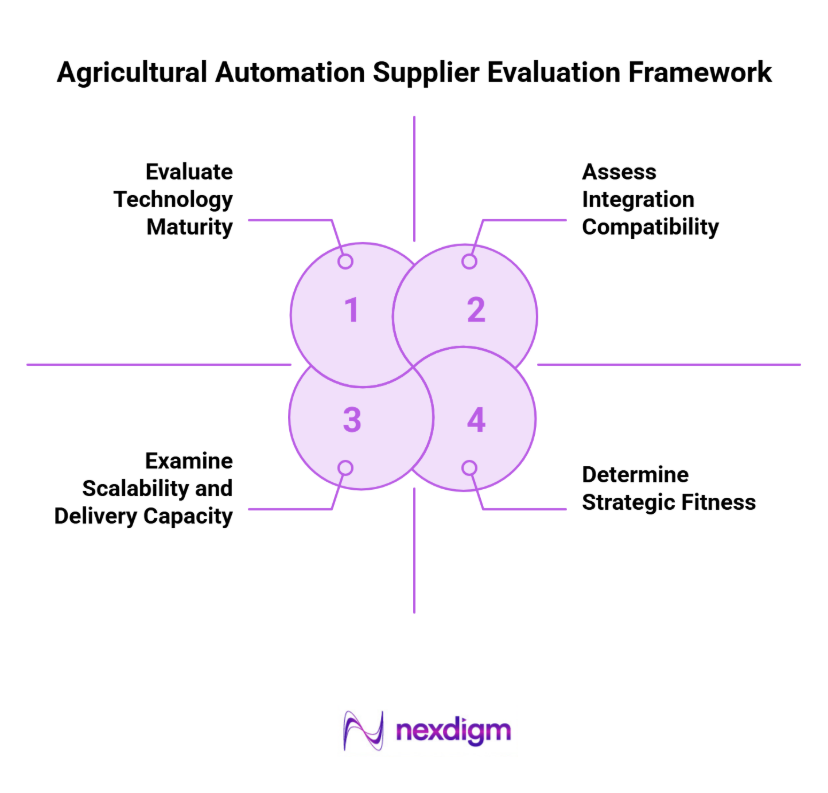
- Evaluate Technology Maturity: Examine product development stages, testing evidence, commercial deployments, and demonstrated performance across agricultural applications.
- Assess Integration Compatibility: Review interoperability with existing machinery, farm management software, sensors, and digital infrastructure.
- Examine Scalability and Delivery Capacity: Evaluate manufacturing capabilities, deployment experience, geographic coverage, and the ability to support expanding requirements.
- Determine Strategic and Commercial Fit: Compare supplier positioning, pricing models, support arrangements, innovation roadmaps, and alignment with business priorities.
By following these steps, we help businesses move from broad supplier identification to a structured assessment of technology and commercial suitability.
What Agribusinesses Gain from Nexdigm’s Evaluation Framework
Our framework provides a consistent basis for comparing agricultural automation providers and understanding their relative strengths. It helps businesses identify technology and integration gaps, distinguish commercially mature suppliers from emerging providers, assess scalability, and recognize potential sourcing constraints. These insights support more focused supplier shortlisting, informed investment planning, and technology selection aligned with operational and long-term business objectives.
Converting Nexdigm’s Framework Findings into Supplier Priorities
Our experts consolidate the four assessment dimensions into comparative supplier profiles and evaluation matrices. Our expert-led research helps agribusinesses identify technology gaps, understand differences in supplier readiness, and prioritize providers for further assessment. This gives decision-makers a clearer view of which solutions merit technical validation, commercial discussions, or consideration for future automation investments.
Nexdigm’s Case
An agricultural technology distributor sought to identify automation suppliers for precision spraying, robotic harvesting, and automated irrigation. Nexdigm assessed 25 providers across product capabilities and service networks. The analysis found that 36% had limited crop-specific solutions, while 24% lacked adequate technical support infrastructure. The distributor prioritized suppliers for further evaluation.
To take the next step, simply visit our Request a Consultation page and share your requirements with us.
Harsh Mittal
+91-8422857704