
Farm equipment markets are increasingly shaped by automation, precision agriculture, connectivity, fuel efficiency, durability, and after-sales performance. Farm equipment competitor pricing research helps manufacturers, distributors, investors, and agribusinesses compare brand prices, specifications, technology packages, financing options, warranties, and ownership costs.
With Pricing Analysis Services, businesses can identify price gaps, quantify technology premiums, optimize product tiers, and strengthen market positioning. This evidence-led approach supports informed launch decisions, competitive differentiation, margin protection, and sustainable growth across tractors, harvesters, implements, irrigation systems, and other mechanized agricultural equipment categories globally and regional customer segments.
India’s tractor market reached 1.09 million domestic sales in 2025, increasing 20% from 2024, while exports exceeded 105,000 units. This record growth highlights expanding mechanization demand and the need for technology-based benchmarking, competitive price positioning, and ownership-cost analysis across brands.
Pricing Analysis for Technology-Enabled Farm Machinery Growth
Pricing analysis helps farm machinery businesses align technology, performance, customer economics, and competitive benchmarks to establish defensible prices and strengthen market positioning. Major elements in-focus, during Pricing Analysis process are:
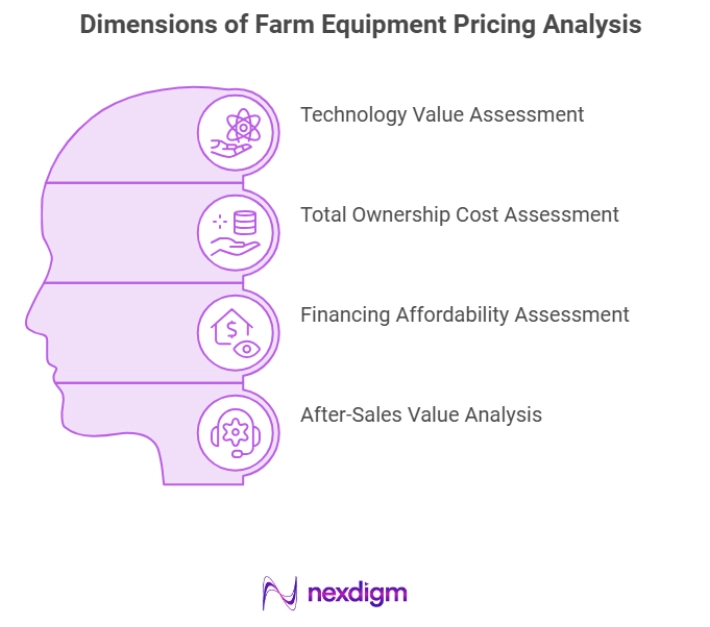
- Technology Value Assessment: Evaluates automation, telematics, precision controls, connectivity, fuel efficiency, and digital capabilities to determine how technological differentiation supports credible price premiums across machinery categories and markets.
- Total Ownership Cost: Assesses acquisition price, financing, fuel, maintenance, repairs, depreciation, and resale value to demonstrate long-term equipment economics and support informed customer purchasing decisions across markets.
- Financing Affordability Assessment: Evaluates loan terms, lease structures, repayment capacity, subsidies, and ownership budgets to align machinery prices with different buyer affordability levels and purchasing models.
- After-Sales Value Analysis: Assesses warranty coverage, maintenance responsiveness, spare-parts availability, technician networks, and uptime support to determine how service strength influences equipment pricing and brand preference.
Nexdigm’s Market-Led Pricing Support for Farm Machinery Businesses
Nexdigm’s market-led Pricing Analysis support enables farm machinery businesses to align equipment pricing with technology, performance, customer value, and competitive market dynamics. Nexdigm’s strategic engagement combines farm equipment competitor pricing research, agricultural machinery pricing analysis, equipment price benchmarking, technology-based pricing strategy, total cost of ownership analysis, competitive pricing intelligence, and pricing optimization that helps businesses to improve market positioning, protect margins, and drive sustainable commercial growth.
Nexdigm’s Strategic Pricing Model for High-Performance Farm Equipment
Nexdigm’s strategic pricing model integrates machine productivity, lifecycle economics, technology adoption, and customer affordability to allow market penetration across agricultural machinery segments. Important models used by Nexdigm’s experts here are:
- Output-Based Pricing Model: Quantifies acreage coverage, operating speed, fuel efficiency, labor savings, and crop-cycle productivity to align equipment prices with measurable farm performance gains consistently.
- Technology Modularity Model: Prices automation, sensors, telematics, guidance systems, and software packages separately, enabling configurable offers for buyers with different capability requirements and budgets effectively.
- Utilization-Based Value Model: Evaluates annual operating hours, seasonal intensity, fleet size, and equipment-sharing patterns to determine economically justified prices across customer usage profiles accurately.
- Residual Value Pricing Model: Incorporates durability, maintenance history, secondary-market demand, brand reputation, and resale potential to strengthen lifecycle economics and support premium equipment positioning credibly.
Nexdigm’s Case
Nexdigm supported a farm equipment manufacturer refining prices across high-performance machinery categories. Through productivity benchmarking, technology modularity analysis, ownership-cost modelling, and service-value assessment, the engagement improved average selling prices by 10%, increased premium-model conversion by 17%, reduced discount dependency and strengthened dealer confidence across priority regional markets.
To take the next step, simply visit our Request a Consultation page and share your requirements with us.
Harsh Mittal
+91-8422857704