

India’s farm equipment market is evolving as mechanization expands across agricultural operations. According to the Federation of Automobile Dealers Associations (FADA), tractor retail sales reached 79,285 units in October 2026, registering 3.1% year-on-year growth. The Government’s Sub-Mission on Agricultural Mechanization has also supported the distribution of 21.61 lakh machines and establishment of 27,554 Custom Hiring Centres between 2014–15 and 2025–26.
These developments reflect growing equipment access and a changing vendor landscape. For manufacturers, distributors, equipment rental businesses, and agricultural enterprises, selecting suitable vendors requires more than comparing purchase prices. Technology compatibility, equipment reliability, service infrastructure, and ownership costs influence procurement outcomes. Farm equipment sourcing research services help businesses evaluate these factors and identify suitable vendor opportunities.
What Makes Farm Equipment Vendor Evaluation Complex?
Farm equipment vendors differ in product specialization, technological capabilities, manufacturing standards, and regional service coverage. Equipment performance also varies with crop type, soil conditions, operating intensity, and farm size. Nexdigm’s industry and vendor research helps businesses examine these differences and understand how maintenance requirements, spare-parts access, warranty provisions, and ownership costs influence vendor selection and sourcing decisions.
How Nexdigm’s Experts Assess Farm Equipment Vendor Evaluation Complexities
Our experts examine farm equipment vendor evaluation complexities through a structured assessment of market conditions, supplier capabilities, and commercial considerations. Our research evaluates how differences in equipment technology, product specialization and regional service networks influence vendor suitability. By connecting these factors with application-specific requirements and ownership considerations, our farm equipment sourcing research services help businesses identify vendor capability gaps, compare sourcing alternatives, and assess opportunities to strengthen procurement decisions.
Areas Nexdigm’s Experts Examine When Evaluating Farm Equipment Vendors
Our research considers several dimensions that influence vendor suitability and equipment sourcing decisions:
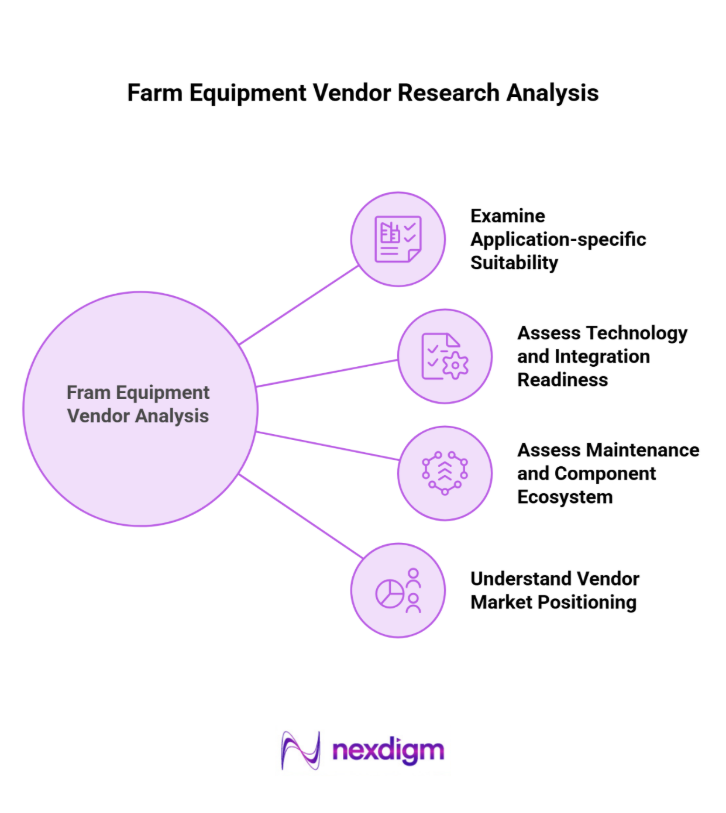
- Application-specific Equipment Suitability: Examine vendor offerings across tractors, harvesters, planters, tillage machinery, and crop-care equipment to understand their relevance to specific agricultural applications.
- Technology and Integration Readiness: Evaluate precision farming features, automation capabilities, digital interfaces, sensor integration, and compatibility with existing agricultural equipment.
- Maintenance and Component Ecosystem: Assess spare-parts availability, component sourcing arrangements, repair requirements, technical documentation, and access to maintenance support.
- Vendor Market Positioning: Understand manufacturers’ product specialization, geographic presence, distribution partnerships, customer segments, and competitive positioning across selected equipment categories.
These assessments help businesses identify vendors whose offerings align with their equipment requirements and longer-term sourcing priorities.
How Nexdigm Identifies Vendor Gaps That Influence Equipment Ownership
Beyond product comparisons, our experts examine factors that may affect the practical value of equipment procurement. Such factors are:
- Performance-to-Cost Differences: Compare equipment configurations, operating capabilities, and purchase costs to identify differences in value across vendors.
- Service Accessibility Gaps: Examine the availability of authorized dealers, trained technicians, repair facilities, and spare-parts channels across target operating regions.
- Technology Adoption Barriers: Identify limitations in equipment compatibility, digital integration, operator requirements, and technology support that may affect implementation.
- Lifecycle Cost Considerations: Review maintenance requirements, replacement components, warranty coverage, and operating expenses to understand potential long-term ownership implications.
This analysis helps organizations distinguish between equipment that meets initial purchasing requirements and vendors capable of supporting sustained operational use.
Where Nexdigm’s Research Strengthens Equipment Sourcing Strategies
Our research helps businesses translate vendor intelligence into practical sourcing priorities. By connecting equipment suitability, technology capabilities, regional availability, and ownership considerations, our experts support vendor shortlisting, sourcing diversification, and portfolio evaluation. These insights help organizations identify relevant manufacturers, assess procurement alternatives, and align equipment sourcing decisions with operational requirements, investment priorities, and long-term business objectives.
Nexdigm’s Case
An agricultural machinery rental and distribution business engaged Nexdigm to assess vendor suitability across selected Indian markets. The research evaluated 37 vendors supplying tractors, tillage equipment, planters, and harvesting machinery. The assessment found that 27% of vendors had limited equipment compatibility across different crop and landholding requirements, while 21% lacked transparent lifecycle maintenance cost information. Additionally, 14% had limited technician training and digital diagnostic support. Based on the findings, the business shortlisted 8 vendors for further technical and commercial evaluation.
To take the next step, simply visit our Request a Consultation page and share your requirements with us.
Harsh Mittal
+91-8422857704