

Farm equipment procurement is a major capital and operational decision for agricultural businesses, equipment distributors, agri-input companies and organisations supporting mechanised farming. Unlike recurring input purchases, machinery expenditure often involves large individual transactions, long replacement cycles, financing arrangements and substantial after-sales requirements.
The market is also changing as mechanisation expands across different farm sizes and agricultural regions. India’s agricultural machinery ecosystem includes tractors, power tillers, harvesters, threshers, irrigation pumps, implements, sprayers and precision farming equipment. Government support under the Sub-Mission on Agricultural Mechanization has helped expand access to machinery, including through Custom Hiring Centres and Farm Machinery Banks.
Between 2014–15 and 2025–26, the scheme supported the distribution of more than 21 lakh machines to individual farmers and the establishment of over 27,500 Custom Hiring Centres. These developments indicate a broadening equipment ecosystem, but they also create a more complex procurement landscape for organisations evaluating suppliers, product categories and regional demand.
Farm equipment spend research and analysis helps buyers understand where machinery expenditure is concentrated, how supplier prices differ and which categories offer opportunities for improved commercial terms. It also helps distinguish between equipment ownership costs and the broader expenditure associated with operating and maintaining machinery.
The Main Challenges in Farm Equipment Spend Visibility
Machinery categories have different purchasing economics
A tractor, combine harvester, irrigation pump and precision sprayer cannot be assessed using the same procurement parameters. Each category has different specifications, capacity requirements, operating conditions and maintenance needs.
Even within a category, machinery may differ by horsepower, engine capacity, working width, fuel efficiency, automation features and suitability for specific crops. These differences can create substantial price variation.
A buyer comparing equipment solely by purchase price may overlook differences in performance, operating costs and expected service life.
Regional requirements influence equipment expenditure
Machinery demand is closely connected to farm size, cropping patterns, soil conditions, irrigation access and the availability of agricultural labour. Tractor requirements in a region dominated by larger landholdings may differ from those in areas where small and fragmented farms are more common.
Harvesting equipment demand also varies according to crop type and harvesting cycles. Irrigation equipment requirements depend on water availability, field configuration and the type of irrigation system adopted.
This creates regional differences in both equipment mix and supplier competitiveness. A single national procurement benchmark may therefore provide an incomplete picture.
Purchase price does not reflect total ownership cost
Machinery expenditure continues after the initial purchase. Fuel, spare parts, maintenance, repairs, insurance, financing, transportation and operator training can significantly influence the lifetime cost of equipment.
A lower-priced machine may require more frequent servicing or have limited spare-part availability. Conversely, a higher-priced model may offer better operating efficiency or a stronger service network.
Without lifecycle cost analysis, procurement decisions can prioritise immediate savings at the expense of long-term operating economics.
Dealer networks influence the final commercial offer
Agricultural machinery manufacturers typically rely on dealers and distributors for sales, service and spare-parts support. The final price can therefore vary according to dealer margins, financing arrangements, regional incentives, bundled accessories and seasonal promotions.
Organisations purchasing across multiple locations may also encounter inconsistent quotation practices. This makes it difficult to determine whether price differences reflect genuine market conditions or variations in negotiation and purchasing processes.
Where Organisations Should Look for Better Spend Control
A meaningful equipment spend assessment should cover both direct purchases and related expenditure. Buyers need visibility into machinery specifications, supplier concentration, transaction prices, maintenance costs and regional purchasing patterns.
The analysis should pay particular attention to:
- High-value equipment categories with recurring replacement requirements.
- Price differences between comparable models and configurations.
- Dealer-level discounts, financing offers and bundled service arrangements.
- Spare-parts availability and maintenance expenditure.
- The financial case for ownership compared with hiring or leasing.
- Regional supplier coverage and after-sales service performance.
For equipment used seasonally or intermittently, the ownership model deserves particular attention. Custom Hiring Centres and shared machinery arrangements may provide an alternative to purchasing assets that remain underutilised for much of the year.
How Nexdigm Supports Farm Equipment Spend Research
Nexdigm provides market research, supplier intelligence, pricing analysis and commercial assessment to help organisations evaluate agricultural equipment markets. Research can cover manufacturer landscapes, dealer networks, product positioning, regional demand, equipment pricing and aftermarket economics.
By combining spend data with external market intelligence, organisations can identify where expenditure is concentrated and whether their procurement decisions reflect competitive market conditions.
Farm Equipment Spend Analysis Framework
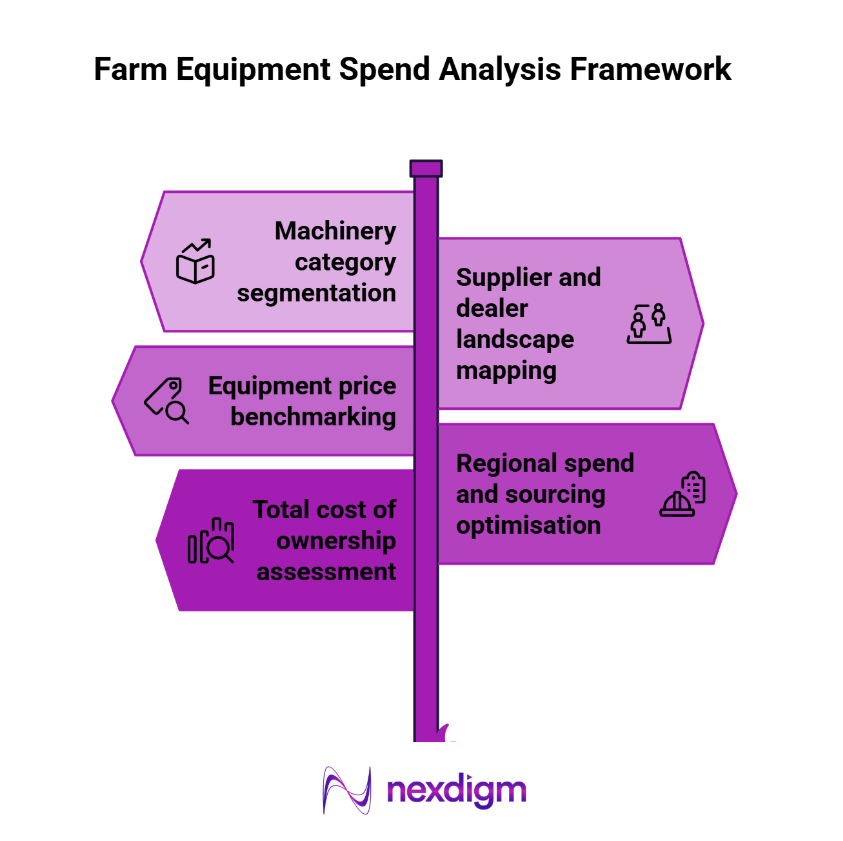
- Machinery category segmentation
Classify expenditure across tractors, harvesters, irrigation systems, tillage equipment, planting machinery, sprayers and other equipment. Separate purchases by capacity, specifications and intended application. - Supplier and dealer landscape mapping
Identify major manufacturers, authorised dealers, regional distributors and alternative suppliers. Assess geographic coverage, product availability, service capabilities and supplier concentration. - Equipment price benchmarking
Compare equivalent models and configurations across suppliers and regions. Account for horsepower, capacity, accessories, warranty coverage, financing and bundled services. - Total cost of ownership assessment
Evaluate purchase price alongside fuel consumption, maintenance, spare parts, repairs, insurance and expected operating life. Compare ownership economics with leasing or custom hiring where relevant. - Regional spend and sourcing optimisation
Map expenditure against regional machinery requirements and usage patterns. Identify opportunities for volume negotiation, supplier consolidation, improved service agreements and more efficient equipment utilisation.
Nexdigm’s Case Study: Mapping Agricultural Machinery Expenditure
Nexdigm analysed machinery expenditure across 4 equipment categories, 5 regions and 20 suppliers. The research identified 3 high-spend categories representing 68% of the assessed budget and highlighted opportunities to improve price comparability, dealer negotiations and lifecycle cost control.
To take the next step, simply visit our Request a Consultation page and share your requirements with us.
Harsh Mittal
+91-8422857704