

Agricultural input prices can vary significantly across suppliers, regions, product specifications and purchasing periods. For agribusinesses, distributors, manufacturers and large farming operations, these differences directly influence procurement budgets and production economics. Yet many organisations still compare supplier quotations using basic unit prices, without accounting for differences in product quality, concentration, delivery terms or additional costs.
A reliable benchmark should reveal more than which supplier offers the lowest quotation. It should explain why prices differ, whether those differences are justified and where procurement teams have room to negotiate. Without this understanding, buyers risk accepting market premiums that could have been avoided or pursuing discounts that compromise product suitability.
Agricultural Input Prices Follow Different Market Dynamics
Seeds, fertilizers, crop protection products and farm machinery do not share the same cost structure. Seed prices depend on variety, hybrid characteristics, treatment, certification and production cycles. Fertilizer prices are influenced by nutrient composition, raw material availability, energy costs, imports and government policy.
Crop protection products have their own pricing drivers, including active ingredient costs, formulation, concentration, manufacturing capacity and distribution margins. Machinery prices are influenced by technical specifications, components, manufacturing costs, dealer networks and financing conditions.
This makes broad price comparisons unreliable. A change in international raw material prices may affect one fertilizer category more than another, while a shortage of a particular active ingredient can create price pressure in selected agrochemical products.
Regional Price Differences Can Be Difficult to Explain
The same agricultural input may be purchased at different prices across states or districts. Transportation costs, local dealer margins, inventory availability, order quantities and regional competition all contribute to these differences.
Some variation is commercially justified. A supplier delivering to a remote agricultural cluster may incur higher logistics costs than one serving a major distribution centre. However, inconsistent purchasing arrangements can also create unnecessary premiums.
Businesses with decentralised procurement may not have a clear view of what different locations are paying for comparable products. This weakens their negotiating position and makes it difficult to identify suppliers offering genuinely competitive terms.
Product Specifications Can Distort the Benchmark
Price comparisons become unreliable when products are not technically equivalent. Fertilizers with different nutrient concentrations cannot be compared only by price per bag. Crop protection formulations may contain different active ingredient strengths, while seed products may differ in variety, treatment and quality parameters.
Equipment comparisons face similar problems. Two machines with comparable headline specifications may have different attachments, warranty coverage, service requirements and operating costs.
A useful benchmark must therefore normalise product specifications before calculating price variance. Otherwise, procurement teams may identify apparent savings that disappear once the actual product differences are considered.
Market Volatility Creates a Timing Problem
Agricultural input prices are affected by seasonal demand and changes in upstream markets. Fertilizer imports, crop production cycles, agrochemical raw material availability and machinery inventory can all influence supplier quotations.
Timing also affects negotiation leverage. Buyers purchasing during peak demand may face limited availability and fewer alternatives. Those with advance forecasts and established supplier relationships may have greater flexibility to negotiate volumes and delivery schedules.
Historical price data can help identify these patterns, but it should be interpreted alongside current market conditions. A historical average alone may not reflect changes in freight, raw material prices, currency movements or supplier capacity.
How Procurement Teams Can Turn Price Data into Negotiation Leverage
A structured farm input cost benchmarking consulting exercise should compare prices across equivalent products, suppliers, regions and purchase periods. Buyers should combine internal procurement records with market quotations and relevant cost-driver information.
The assessment should distinguish between the manufacturer’s price, distributor price and final delivered cost. It should also account for order volumes, payment terms, freight, packaging, storage and service arrangements.
Once price differences are understood, procurement teams can establish realistic negotiation targets. These may involve volume consolidation, alternative supplier qualification, regional contract reviews, specification standardisation or changes to purchasing schedules.
Nexdigm supports organisations through agricultural input benchmarking, supplier intelligence, procurement research and pricing analysis. Its research can help businesses understand market-level price variation, evaluate supplier competitiveness and identify opportunities for better commercial terms.
Farm Input Cost Benchmarking Framework
A comprehensive benchmarking exercise should cover five dimensions:
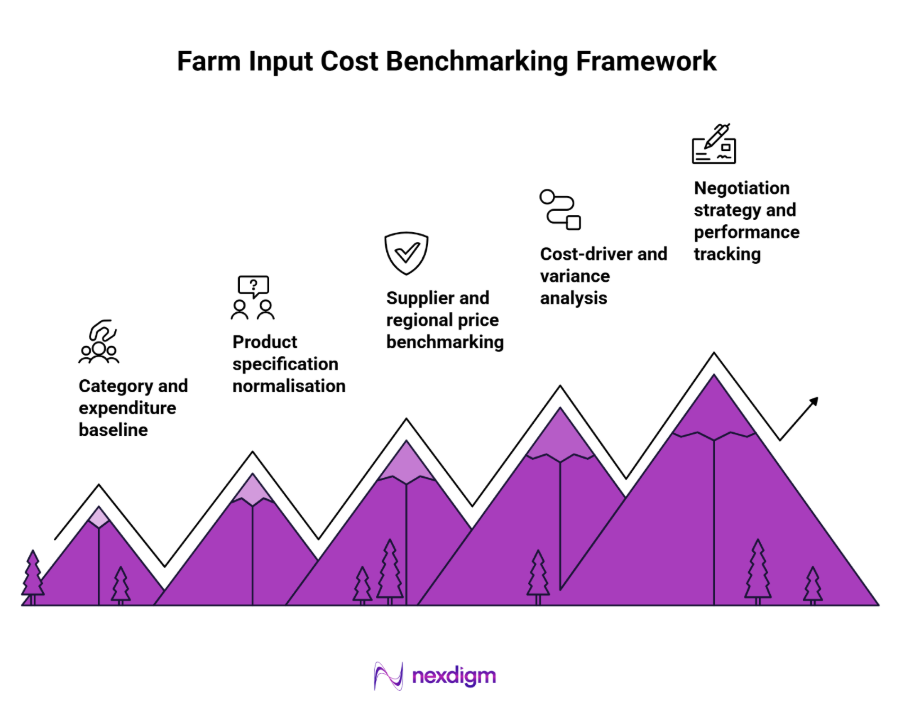
- Category and expenditure baseline: Consolidate expenditure across seeds, fertilizers, crop protection products, irrigation equipment, machinery and other relevant inputs. Segment purchases by supplier, region, product, crop and season. Identify the categories with the highest expenditure and greatest price variation.
- Product specification normalisation: Establish comparable technical specifications before evaluating prices. Account for seed variety and treatment, fertilizer nutrient content, pesticide concentration and formulation, and equipment configuration. Use appropriate comparison units such as cost per nutrient unit, treated hectare or equipment capacity.
- Supplier and regional price benchmarking: Collect quotations from manufacturers, distributors and dealers across relevant markets. Compare prices by location, order quantity, purchase period and commercial terms. Identify where regional differences reflect legitimate delivery costs and where they indicate potential pricing inefficiencies.
- Cost-driver and variance analysis: Examine raw material prices, imports, freight, energy, manufacturing costs, distribution margins, packaging and financing. Separate market-driven price movements from supplier-specific differences and internal procurement inefficiencies.
- Negotiation strategy and performance tracking: Establish category-level target prices, identify qualified alternative suppliers and prioritise negotiation opportunities. Develop volume and contract strategies while tracking actual purchase prices against the benchmark. Review realised savings separately from changes in market conditions or product specifications.
Nexdigm’s Case Study: Benchmarking Agricultural Input Prices
Nexdigm compared 37 agricultural input suppliers across 6 product categories and 8 sourcing regions, examining product specifications, regional price variance and landed costs. The research identified 10 competitive sourcing options and 6 priority negotiation opportunities.
To take the next step, simply visit our Request a Consultation page and share your requirements with us.
Harsh Mittal
+91-8422857704