

Agricultural input expenditure is rarely controlled through one procurement decision. Seeds may be purchased through authorised dealers, fertilizers through distributors, crop protection products through regional channels and machinery through separate capital expenditure processes. Each category has its own supplier market, pricing structure and buying cycle.
This fragmentation makes it difficult for agribusinesses and large farming operations to understand where money is being spent inefficiently. A lower seed price may be offset by higher treatment costs. Fertilizer discounts may be undermined by freight and inventory expenses. Machinery purchased for seasonal use may remain idle for much of the year. Cost optimisation requires a view of the entire input basket rather than isolated price negotiations.
Fragmented Procurement Reduces Visibility
When agricultural inputs are purchased by separate teams, farms or regional business units, organisations may lose the benefit of consolidated demand. Different locations can purchase similar products from different suppliers under inconsistent terms.
This creates several potential cost gaps:
- Multiple purchase orders may prevent buyers from negotiating volume-based terms.
- Different product specifications can make supplier quotations difficult to compare.
- Regional procurement may rely on a narrow set of local distributors.
- Uncoordinated buying can increase emergency purchases during peak agricultural seasons.
- Limited spend visibility can make it difficult to identify recurring price premiums.
The problem is not necessarily that every local purchase is expensive. Regional suppliers may offer better availability or lower delivery costs. The issue is that organisations often lack the data needed to distinguish efficient local sourcing from avoidable fragmentation.
Input Categories Have Different Cost Drivers
Seeds are influenced by crop variety, hybrid characteristics, certification, treatment, germination standards, packaging and availability. Fertilizer costs are linked to nutrient composition, raw material markets, imports, energy and distribution. Crop protection prices depend on active ingredients, formulation, concentration, application rates and supplier channels.
Equipment introduces a different expenditure profile. It requires capital investment, financing, maintenance, fuel, spare parts and operator support. Buying a machine may appear cheaper than hiring it, but utilisation levels determine whether ownership is financially justified.
These categories cannot be optimised using one common purchasing rule. They require different benchmarks, supplier strategies and contract structures.
External Market Conditions Can Undermine Savings Plans
Input costs are exposed to market developments beyond the buyer’s control. Fertilizer imports and raw material dependencies can influence domestic prices, while pesticide technical ingredients may be exposed to international suppliers. Seed availability is affected by crop production cycles, and machinery prices can change with manufacturing costs, financing conditions and dealer inventory.
India’s fertilizer sector illustrates the scale of this exposure. Government reporting placed the fertilizer subsidy burden at nearly ₹1.71 lakh crore in FY2024–25, while also highlighting substantial import dependence for phosphorus and potassium. Government analysis has also noted that crops use only a portion of applied nutrients, with estimated nitrogen-use efficiency of about 30–50%. This demonstrates that procurement cost and input-use efficiency are connected, even though they are separate management decisions.
A sourcing programme that focuses only on supplier discounts may therefore miss larger opportunities involving product suitability, application efficiency and inventory planning.
Seasonal Buying Can Increase Total Expenditure
Agricultural demand is concentrated around sowing, crop growth and harvesting periods. Buyers who delay planning may face limited product availability, higher freight costs and fewer supplier alternatives.
On the other hand, buying too early can increase storage, financing and deterioration risks. Seeds and crop protection products may have specific storage and shelf-life requirements, while machinery purchased for one operation may remain underutilised outside its peak season.
The right purchasing schedule depends on category-specific demand forecasts, inventory constraints and the reliability of suppliers.
How Buyers Can Optimise Farm Input Sourcing Costs
A structured farm input sourcing cost optimization programme should begin with a consolidated view of expenditure across categories, locations, suppliers and seasons. Buyers should establish comparable product specifications and calculate the total landed cost, including freight, handling, storage, financing and service requirements.
The next step is to identify opportunities by category. These may include consolidating suitable volumes, qualifying alternative suppliers, renegotiating distributor terms, standardising selected specifications, improving seasonal forecasts or shifting underutilised machinery to rental and custom-hiring models.
Savings should be measured against a defined baseline. Changes in market prices, product specifications, volumes and crop mix need to be separated from actual procurement improvements. Nexdigm supports organisations through procurement research, supplier benchmarking, category cost analysis and sourcing strategy development.
Farm Input Sourcing Cost Optimization Framework
A practical programme should move through seven stages:
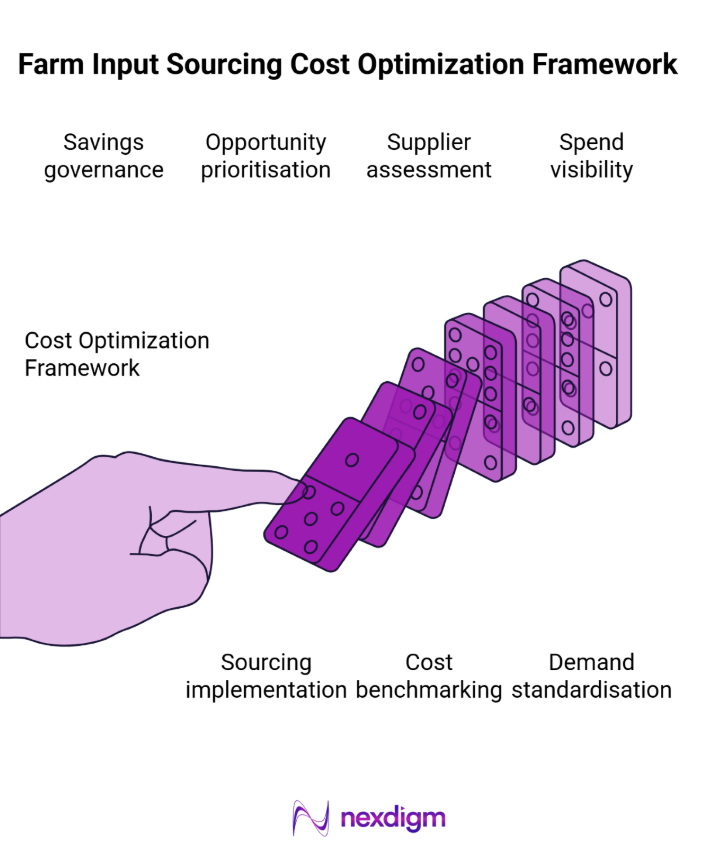
- Spend visibility and baseline creation: Consolidate purchases across seeds, fertilizers, crop protection, machinery, irrigation and other inputs. Segment expenditure by business unit, crop, region, supplier, product and season. Establish a baseline using actual invoices rather than budget estimates alone.
- Specification and demand standardisation: Identify comparable products and document essential quality requirements. Review seed variety and treatment, fertilizer nutrient composition, pesticide formulation and concentration, and machinery capacity. Separate genuine agronomic requirements from specifications that have accumulated through habit.
- Supplier and channel assessment: Map manufacturers, distributors, dealers, regional suppliers and rental providers. Assess coverage, capacity, service quality, commercial terms and dependence on intermediaries. Identify categories where alternative suppliers are available but not currently qualified.
- Total cost benchmarking: Compare purchase price alongside freight, handling, storage, financing, warranty, maintenance and application costs. Use category-appropriate measures such as cost per nutrient unit, treated hectare, operating hour or unit of equipment output.
- Opportunity identification and prioritisation: Evaluate volume consolidation, supplier rationalisation, alternative sourcing, contract renegotiation, seasonal purchasing and equipment utilisation. Rank opportunities by addressable spend, savings potential, implementation complexity and supply risk.
- Sourcing strategy and implementation: Develop category-specific negotiation plans, supplier allocation models, procurement calendars and contract requirements. Maintain regional flexibility where local suppliers offer a genuine advantage in availability or service.
- Savings tracking and governance: Monitor realised savings against the baseline, while accounting for changes in volume, market prices and product mix. Assign ownership to procurement and operating teams, and review supplier performance and cost variance regularly.
Nexdigm’s Case Study: Optimising Multi-Category Farm Input Spend
Nexdigm reviewed 5 farm input categories across 8 procurement locations, identifying specification inconsistencies, regional price gaps and underutilised equipment. The assessment prioritised 11 sourcing initiatives for negotiation, supplier qualification and purchasing consolidation.
To take the next step, simply visit our Request a Consultation page and share your requirements with us.
Harsh Mittal
+91-8422857704