
Farm input procurement is frequently treated as a series of separate purchasing decisions. Fertilizers are sourced according to nutrient requirements, seeds according to crop and variety, and crop protection products according to seasonal demand. Machinery and irrigation equipment may be purchased through entirely different supplier networks.
This category-based approach is operationally understandable, but it can prevent organisations from developing a coordinated sourcing strategy. Procurement teams may negotiate with suppliers independently, maintain overlapping vendor relationships and miss opportunities to use market intelligence across categories.
A better sourcing strategy begins with understanding the supplier markets in which the organisation operates. Buyers need to know how markets are structured, where production capacity is concentrated, which suppliers offer competitive commercial terms and what alternatives exist if current relationships become less attractive.
Farm input strategic sourcing consulting helps organisations connect supplier market research with category-level procurement decisions. It supports a shift from reactive purchasing towards a sourcing model based on commercial priorities, supplier capabilities and long-term supply requirements.
Why Conventional Farm Input Sourcing Strategies Fall Short
Category-level decisions can create fragmented supplier relationships
When each procurement category is managed independently, organisations may maintain several suppliers offering overlapping products or services.
A business purchasing fertilizers, seeds and crop protection products across multiple regions may have separate supplier lists for each location. Some relationships may be commercially necessary, while others may have continued simply because they were established in the past.
This fragmentation can increase administrative costs, weaken purchasing leverage and make it difficult to understand total supplier exposure.
Category-specific sourcing is important, but it should operate within a broader procurement strategy that considers common commercial priorities.
Supplier selection often relies on familiar vendors
Existing suppliers offer familiarity and a history of operational interaction. Buyers may know their delivery capabilities, product range and commercial practices, making them easier to work with than unfamiliar alternatives.
However, supplier familiarity does not necessarily indicate market competitiveness. New manufacturers, regional distributors or alternative sourcing channels may offer better terms or improved capabilities.
Without regular supplier market research, organisations may continue using established vendors without understanding how their position compares with the wider market.
Price-led sourcing can overlook supply and quality risks
A lower purchase price can appear attractive, particularly in categories with high annual expenditure. However, agricultural inputs must meet specific quality, technical and delivery requirements.
A cheaper fertilizer may not have the required nutrient composition. A seed supplier may lack the capacity to fulfil seasonal volumes, while a crop protection vendor may not provide adequate product documentation.
Strategic sourcing must therefore balance cost with product suitability, supplier reliability, compliance and operational continuity.
Market changes can make existing contracts less competitive
Agricultural input markets are influenced by raw material prices, international trade, transportation costs, seasonal demand and regulatory developments. These factors can change supplier economics over the course of a contract.
An agreement that was competitive when signed may become less attractive as market conditions shift. Organisations that do not monitor external pricing and supplier developments may miss opportunities to revise commercial arrangements.
Procurement decisions may not reflect long-term business priorities
A sourcing decision should support more than the immediate purchase requirement. It may also influence working capital, supplier diversification, regional expansion and operational resilience.
When procurement focuses primarily on individual transactions, these wider considerations can remain disconnected from supplier selection and contract decisions.
What a More Strategic Sourcing Model Should Address
A stronger sourcing strategy begins with category segmentation. Organisations need to distinguish between high-spend categories, operationally critical products, specialised inputs and products that are readily available from multiple suppliers.
Supplier markets should then be assessed according to their competitive structure, geographic coverage, production capacity and commercial positioning.
The strategy should also consider sourcing models suited to each category. Some inputs may benefit from consolidated manufacturer agreements, while others may require regional supplier networks to maintain delivery flexibility.
Buyers should examine:
- Total category expenditure and demand patterns.
- Supplier concentration and availability of qualified alternatives.
- Market pricing, cost drivers and commercial terms.
- Product quality, technical specifications and compliance.
- Regional logistics and seasonal supply requirements.
- Contract flexibility, inventory requirements and long-term supplier performance.
The resulting strategy should make clear which categories require competitive tendering, which suppliers should be retained as strategic partners and where additional sourcing options are needed.
How Nexdigm Supports Farm Input Strategic Sourcing
Nexdigm supports organisations through supplier market research, procurement benchmarking, category intelligence and commercial assessment. Its research can help buyers understand supplier landscapes, evaluate competitive alternatives and identify sourcing opportunities across agricultural input categories.
By connecting market intelligence with procurement priorities, organisations can develop sourcing strategies that are more commercially informed and less dependent on historical supplier relationships.
Farm Input Strategic Sourcing Framework
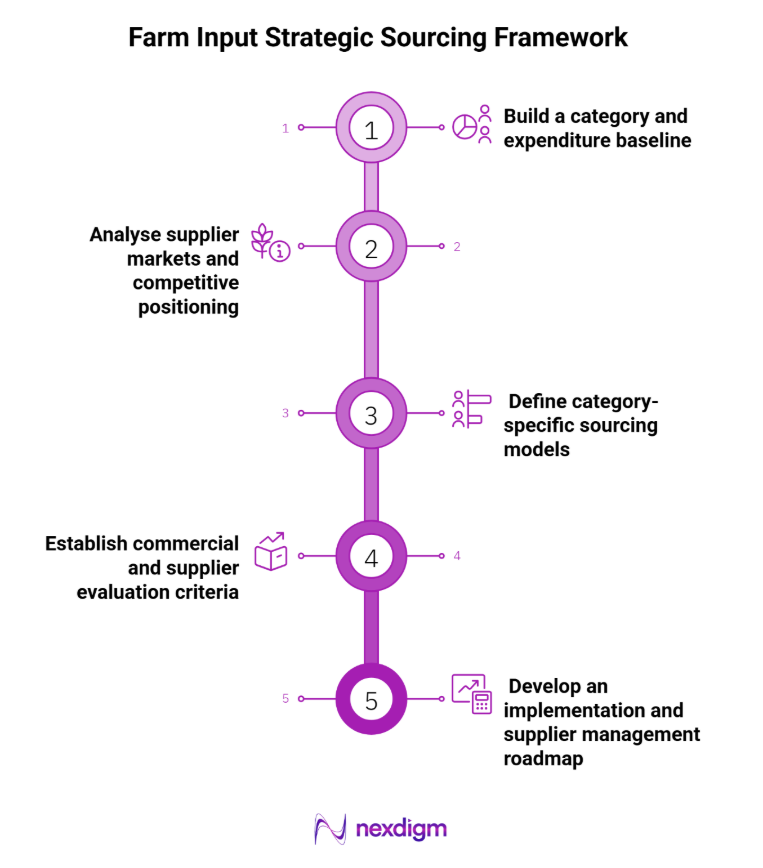
- Build a category and expenditure baseline
Map procurement across fertilizers, seeds, agrochemicals, irrigation products, machinery and other farm inputs. Examine spend concentration, purchasing volumes, regional requirements and recurring demand patterns. - Analyse supplier markets and competitive positioning
Identify manufacturers, distributors, importers and regional suppliers. Assess their market presence, production capacity, product portfolios, geographic coverage and commercial positioning. - Define category-specific sourcing models
Determine whether each category is best suited to direct manufacturer sourcing, distributor partnerships, regional procurement, consolidated contracts or a diversified supplier network. Consider demand variability and operational criticality when selecting the model. - Establish commercial and supplier evaluation criteria
Benchmark product prices, discounts, freight, credit terms and delivery commitments. Evaluate quality, compliance, technical suitability and supplier reliability using consistent criteria. - Develop an implementation and supplier management roadmap
Prioritise sourcing opportunities according to expected commercial impact, risk and implementation complexity. Define supplier qualification requirements, negotiation priorities, contract review cycles and performance monitoring responsibilities.
Nexdigm’s Case Study: Developing a Farm Input Sourcing Strategy
Nexdigm assessed 6 farm input categories, 5 sourcing regions and 23 suppliers. The research identified 4 priority sourcing opportunities and developed a category-level roadmap covering supplier diversification, commercial benchmarking and procurement consolidation.
To take the next step, simply visit our Request a Consultation page and share your requirements with us.
Harsh Mittal
+91-8422857704