

India’s agricultural input market is expanding across conventional and biological product categories, creating new considerations for procurement and supplier selection. According to the Economic Survey 2025–26, India produced approximately 1,649.26 lakh quintals of quality seeds under the Sub-Mission on Seeds and Planting Materials, supported by 6.85 lakh Seed Villages.
However, market growth and product availability do not automatically indicate supplier suitability. Businesses must evaluate product quality, production capacity, distribution reach, pricing, and service reliability. Farm input supplier evaluation services help organizations compare these factors and identify vendors that align with their operational and commercial priorities.
The Difference Between Supplier Availability and Supplier Suitability
A supplier offering the required agricultural input may not necessarily meet a business’s broader procurement expectations. Differences in product specifications, production capacity, delivery performance, geographic coverage, and pricing can influence vendor suitability. Businesses must therefore assess suppliers against consistent operational and commercial criteria rather than selecting them solely on availability or quoted prices. This helps identify potential sourcing gaps and evaluate long-term vendor compatibility.
Questions That Guide Farm Input Supplier Evaluation
A meaningful supplier assessment should connect purchasing requirements with the capabilities vendors can demonstrate. Businesses should examine three important dimensions:
- Can the Supplier Meet Operational Requirements? Assess production capacity, product consistency, inventory availability, delivery timelines, and distribution reach against expected procurement volumes.
- Does the Commercial Proposition Remain Competitive? Compare pricing structures, payment terms, logistics costs, minimum order quantities, and overall value across potential suppliers.
- Can the Supplier Support Future Requirements? Examine scalability, technical assistance, product development capabilities, and flexibility to accommodate changing agricultural and business needs.
Together, these considerations help procurement teams distinguish commercially attractive vendors from suppliers capable of supporting sustained operational requirements.
Nexdigm’s Expert-led Initiative in Farm Input Supplier Evaluation
Nexdigm’s expert-led initiative combines agricultural sector knowledge, market intelligence, and structured vendor research to help businesses assess supplier suitability. Our farm input supplier evaluation services examine product portfolios, operational capabilities, distribution networks, and commercial positioning across relevant input categories. This research-driven approach helps procurement teams compare potential vendors, identify capability gaps, and prioritize suppliers aligned with their business requirements.
How Nexdigm’s Experts Guide Farm Input Supplier Evaluation Process
Our experts follow a structured, research-led process to connect supplier capabilities with procurement requirements. The approach covers the following key stages:
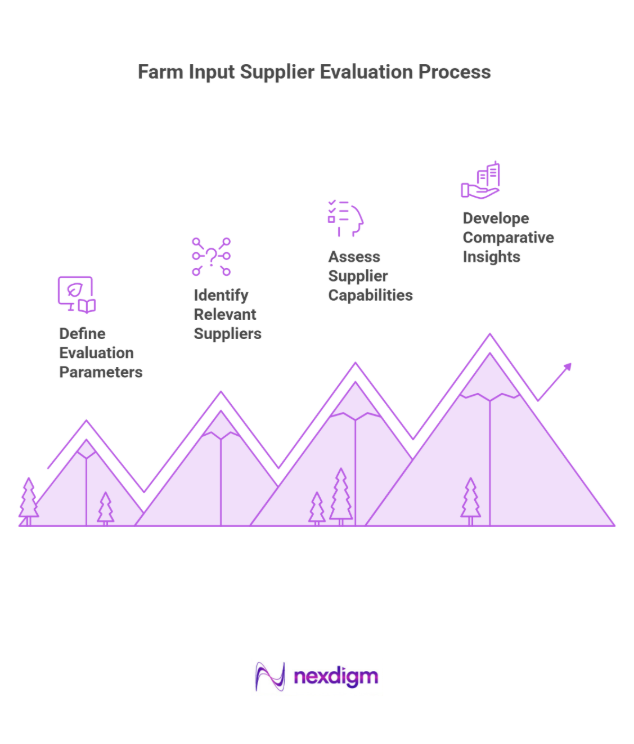
- Defining Evaluation Parameters: Establish product specifications, procurement volumes, quality expectations, target markets, and commercial requirements.
- Identifying Relevant Suppliers: Map manufacturers, distributors, and specialized vendors across fertilizers, seeds, crop protection, and biological inputs.
- Assessing Supplier Capabilities: Examine product portfolios, production capacity, quality systems, distribution reach, and commercial terms.
- Developing Comparative Insights: Consolidate supplier findings, highlight capability gaps, and prioritize vendors for further technical and commercial evaluation.
This process helps businesses build a clearer view of supplier suitability and make informed sourcing decisions.
Nexdigm’s Farm Input Supplier Evaluation Offering Business Benefits
Our structured supplier evaluation helps businesses move beyond price-led procurement and make decisions based on broader operational and commercial considerations. Our research supports this through the following key benefits:
- Improved Supplier Visibility: Identify relevant manufacturers and vendors across input categories, expanding sourcing options and reducing dependence on limited supplier networks.
- More Informed Procurement Comparisons: Evaluate product quality, production capabilities, distribution reach, and commercial terms using consistent assessment parameters.
- Early Identification of Supplier Gaps: Recognize limitations in quality documentation, production capacity, delivery performance, and technical support before finalizing vendor relationships.
- Stronger Sourcing Decisions: Prioritize suitable vendors and align procurement choices with current requirements, commercial objectives, and future business needs.
These insights help organizations develop more informed, resilient, and commercially aligned supplier networks.
Nexdigm’s Case
An agricultural inputs distributor engaged Nexdigm to evaluate potential suppliers across fertilizers, seeds, and crop protection products in three Indian markets. The assessment covered 32 suppliers and found that 28% had limited regional distribution capabilities, while 22% lacked consistent product quality documentation. Based on the findings, the distributor shortlisted 10 suppliers for further technical and commercial evaluation.
To take the next step, simply visit our Request a Consultation page and share your requirements with us.
Harsh Mittal
+91-8422857704