

India’s farm mechanization ecosystem is expanding, creating a wider procurement landscape for agricultural equipment manufacturers, distributors, and large farming enterprises. The Reserve Bank of India’s rural economy indicators recorded domestic tractor sales of 5.6 lakh units during April–September 2025–26, compared with 4.7 lakh units in the corresponding period of 2024–25.
Further, the Government’s Sub-Mission on Agricultural Mechanization has supported the distribution of 21.61 lakh machines since its inception, backed by ₹9,404.47 crore in funding. As procurement volumes and equipment choices expand, businesses need greater visibility into supplier pricing, product specifications, delivery performance, and service capabilities.
Farm machinery procurement benchmarking consulting helps organizations identify cost differences, assess vendor performance, and strengthen purchasing decisions through structured market intelligence.
Why Farm Machinery Procurement Costs Differ Across Suppliers
Farm machinery procurement costs vary because suppliers differ in manufacturing scale, component sourcing, technology, distribution networks, and service arrangements. Equipment with similar specifications may carry different prices due to brand positioning, customization, warranty coverage, and delivery terms. Businesses must therefore assess total procurement costs alongside product quality, operational suitability, and after-sales support to identify meaningful cost gaps and avoid comparisons based solely on quoted prices.
Dimensions That Shape Effective Procurement Benchmarking
A meaningful benchmarking exercise should compare suppliers across interconnected commercial and operational dimensions:
- Price and Cost Structure: Compare equipment prices, component costs, transportation charges, financing terms, warranties, and maintenance expenses to understand total ownership costs.
- Technical and Product Performance: Examine equipment specifications, fuel efficiency, durability, productivity, compatibility, and operating requirements to assess value relative to procurement expenditure.
- Delivery and Service Reliability: Evaluate delivery timelines, spare-parts availability, dealer coverage, maintenance support, and warranty responsiveness to understand supplier dependability.
Considering these dimensions together enables procurement teams to distinguish lower purchase prices from stronger overall commercial value.
Nexdigm’s Strategy to Identify Farm Machinery Cost Gaps
Our experts combine agricultural sector knowledge, supplier intelligence, and commercial research to help businesses understand procurement cost differences across machinery categories. Our farm machinery procurement benchmarking consulting focuses on:
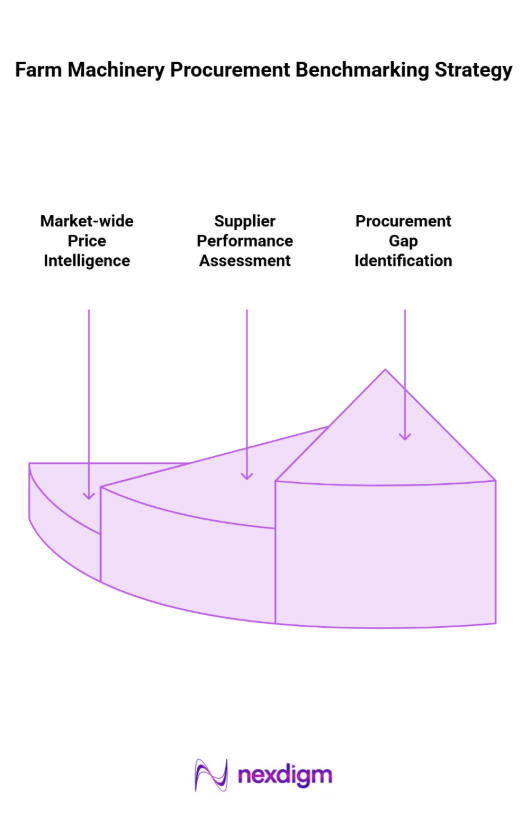
- Market-wide Price Intelligence: Compare supplier quotations, equipment configurations, pricing models, and commercial terms across selected markets to identify cost variations and potential negotiation opportunities.
- Supplier Performance Assessment: Evaluate production capabilities, product availability, delivery consistency, quality credentials, and after-sales infrastructure to understand differences in vendor performance.
- Procurement Gap Identification: Highlight pricing deviations, specification mismatches, service limitations, and sourcing inefficiencies that may influence purchasing costs and supplier selection.
This integrated assessment helps businesses understand where procurement costs originate and which supplier differences warrant further investigation.
How Nexdigm Converts Benchmarking Findings into Procurement Improvements
Our experts connect comparative supplier research with practical procurement priorities through four areas of assessment:
- Establishing Cost Benchmarks: Develop comparison parameters across equipment categories, specifications, purchase volumes, geographic markets, and commercial conditions to establish relevant cost reference points.
- Identifying Pricing Deviations: Examine differences in supplier quotations, component sourcing, customization charges, and contractual terms to identify areas requiring commercial review or negotiation.
- Evaluating Supplier Performance: Compare vendors on delivery reliability, equipment quality, warranty provisions, spare-parts access, and technical support to identify performance-related procurement risks.
- Prioritizing Procurement Alternatives: Consolidate cost and supplier findings into comparative profiles that help businesses identify suitable vendors and prioritize opportunities for procurement optimization.
Through this process, we help organizations move beyond isolated price comparisons and evaluate procurement decisions in the context of supplier performance and operational requirements.
Where Nexdigm’s Consulting Approach Supports Strategic Procurement Decisions
Our expert-led research helps businesses strengthen procurement decisions through actionable insights into supplier negotiations, vendor portfolio optimization, regional sourcing opportunities, and total ownership costs. By examining pricing differences, supplier capabilities, service coverage, and maintenance requirements, our experts help organizations identify improvement areas, optimize sourcing choices, and align procurement priorities with cost efficiency, operational reliability, and long-term business objectives.
Nexdigm’s Case
A farm equipment distributor engaged Nexdigm to benchmark procurement costs and supplier performance across selected Indian markets. The assessment covered 39 vendors supplying tractors, harvesting equipment, and agricultural implements. The research identified that 26% of suppliers showed significant pricing deviations for comparable equipment, while 23% had inconsistent delivery performance. Based on the findings, the distributor shortlisted 11 vendors for further commercial and operational evaluation.
To take the next step, simply visit our Request a Consultation page and share your requirements with us.
Harsh Mittal
+91-8422857704