

India’s agricultural productivity opportunity is visible in the gap between what many farms currently produce and what comparable production systems can achieve. But the yield gap is not simply a technology problem. It reflects farm size, water availability, input practices, mechanization access, labour constraints, and regional production conditions.
For companies serving agriculture, understanding these constraints is essential to identifying where demand for products and services can actually scale.
The yield gap is an opportunity map
Several major crops continue to show significant productivity gaps.
Cotton yields are around 437–448 kg/ha, compared with global levels of approximately 800 kg/ha. Maize yields are around 3,100–3,300 kg/ha, versus approximately 5,800 kg/ha globally. Soybean yields remain around 950–1,150 kg/ha, compared with approximately 2,800 kg/ha.
These gaps indicate potential, but the commercial opportunity differs by region because the constraint behind the gap is not always the same.
Where productivity is being lost
- Water: More than 45% of India’s net cultivated area is rainfed, exposing farmers to rainfall variability and moisture stress.
- Farm fragmentation: Average landholdings are below approximately 1.08 hectares, while small and marginal farmers account for more than 85% of holdings.
- Input imbalance: India’s NPK usage ratio is around 8.2:3.2:1, compared with the recommended ratio of approximately 4:2:1.
- Mechanization: Small holdings and fragmented plots can make ownership of large equipment economically unattractive.
- Labour: Labour shortages are increasing the value proposition of mechanized and service-based agricultural models.
Fragmentation changes the machinery business
A farmer operating a small holding does not necessarily need to own every machine required for cultivation.
This creates a different market opportunity: equipment-as-a-service.
Custom Hiring Centres and pay-per-acre models can make tractors, planters, sprayers, drones, and harvesting equipment accessible without requiring individual ownership.
The commercial question becomes one of utilisation. Equipment providers need sufficient acreage density and seasonal demand to keep assets productive.
Water and input efficiency are different markets
Productivity improvements do not come from machinery alone.
The Indo-Gangetic Plains face groundwater pressure, soil hardpan, and intensive urea use. Central rainfed regions face moisture stress and lower mechanization. Southern coastal areas contend with pest pressure, salinity, and labour requirements, while eastern alluvial regions face fragmentation and limited machinery access.
Each environment creates a different technology requirement.
A precision-irrigation solution, for example, cannot be evaluated using the same adoption assumptions as a drone-based crop-protection service.
Labour shortages are making service models more relevant
Agricultural labour availability increasingly affects planting, spraying, harvesting, and post-harvest activities.
This can accelerate adoption of shared machinery, mechanized spraying, drone services, and other pay-per-use models.
However, adoption depends on whether the service delivers measurable economic value after accounting for crop type, farm size, seasonal utilization, and local service availability.
Technology adoption depends on utilisation
The strongest agricultural technology opportunity may not necessarily be the most sophisticated product. It may be the model that fits the economics of small and fragmented farms.
Service density, equipment utilization, financing, operator availability, farmer awareness, and crop-specific economics all influence adoption.
Nexdigm’s Farm Productivity Market Assessment: From Yield Gaps to Market Opportunity
Nexdigm’s Farm productivity market assessment can map the agricultural productivity ecosystem across:
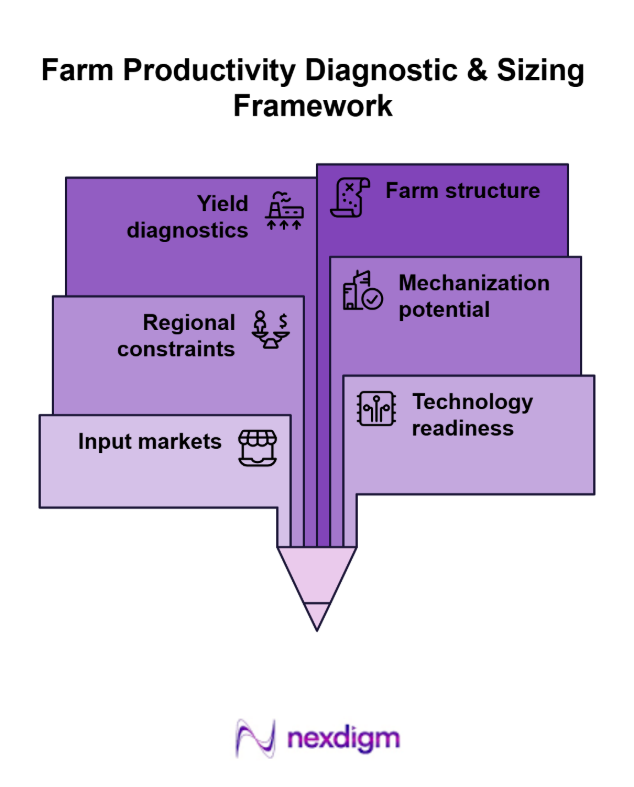
- Yield diagnostics: crop-wise and region-wise productivity gaps and their underlying causes.
- Farm structure: landholding size, fragmentation, farmer segmentation, and purchasing capacity.
- Mechanization potential: equipment penetration, custom hiring opportunities, utilization rates, and service models.
- Input markets: fertilizer, crop protection, seeds, irrigation, and precision-agriculture adoption.
- Regional constraints: water stress, labour availability, soil conditions, pest exposure, and infrastructure.
- Technology readiness: current adoption, economic payback, financing models, and distribution requirements.
This can help agricultural companies identify high-potential regions, prioritize products and services, size addressable markets, and determine which business models can overcome adoption barriers.
Nexdigm Case: Converting Small-Farm Constraints Into a Service Model
An assessment of tractor demand in Vidarbha and Marathwada found that average farm holdings of around 1.2 hectares constrained individual equipment ownership. A network of 45 village-level Custom Hiring Centres was evaluated using 35 HP tractors, planters, sprayers, and drones. The model reduced cultivation costs by 22%, pesticide application costs by 30%, and increased soybean yields by 18%.
To take the next step, simply visit our Request a Consultation page and share your requirements with us.
Harsh Mittal
+91-8422857704