

Farm supply costs are influenced by far more than the prices quoted by individual vendors. Fertilizers, seeds, crop protection products, irrigation equipment, machinery, packaging and logistics all contribute to the cost of agricultural operations. When these categories are procured independently, organisations can miss opportunities to negotiate better terms, consolidate demand or reduce avoidable expenditure.
The challenge is that cost reduction in agriculture cannot follow the same logic as a conventional low-price sourcing exercise. A cheaper fertilizer that does not meet nutrient requirements, an unreliable seed supplier or a delayed machinery delivery can create losses that exceed the initial procurement savings. The objective is to lower the total cost of supply while maintaining product quality, seasonal availability and operational continuity.
A structured farm supply procurement cost optimization exercise helps organisations identify where spending can be reduced, which supplier relationships need attention and where procurement practices are creating unnecessary costs.
Why Farm Supply Costs Remain Difficult to Control
Fragmented purchasing limits negotiating power
Agribusinesses operating across multiple locations often allow regional teams, warehouses or business units to purchase similar products independently. This can lead to different prices, payment terms and delivery conditions for comparable inputs.
The combined procurement volume may be substantial, but suppliers see several smaller orders rather than one coordinated demand base. This reduces the organisation’s ability to negotiate volume discounts, standardise contracts or secure preferential delivery arrangements.
Fragmentation also makes it difficult to identify whether price differences are justified by local market conditions or simply reflect inconsistent negotiations.
Product substitutions can create hidden costs
Agricultural inputs are not interchangeable simply because they belong to the same category. Fertilizers differ by nutrient composition, seeds by variety and genetic characteristics, and crop protection products by active ingredient and formulation.
A procurement team focused only on unit price may approve a substitute without assessing its suitability for the intended crop, soil or application conditions. The resulting impact may include higher usage requirements, lower effectiveness or additional operational expenditure.
Cost comparisons therefore need to begin with specification equivalence rather than supplier quotations.
Seasonal purchasing creates avoidable price pressure
Demand for agricultural inputs is closely connected to sowing schedules, crop cycles and regional weather conditions. When procurement begins too close to the required delivery date, organisations may have limited supplier choices and reduced negotiating leverage.
Last-minute purchasing can also increase transportation costs, create dependence on intermediaries and force buyers to accept less favourable payment or delivery terms.
Inventory planning presents a related challenge. Excess stock ties up working capital and creates storage or obsolescence risks, while insufficient inventory exposes operations to shortages during critical agricultural periods.
Logistics and supplier performance are often overlooked
The lowest quoted price does not always translate into the lowest landed cost. Freight, handling, warehousing, insurance, delivery frequency and financing costs can materially change the economics of a purchase.
Supplier reliability matters just as much. Delayed deliveries, inconsistent product quality and inadequate after-sales support can generate costs that are rarely visible in the original purchase order.
Where Cost Optimisation Opportunities Usually Exist
Organisations should examine procurement expenditure across the full supply cycle rather than concentrating only on unit-price negotiations. Several areas deserve particular attention:
- Category consolidation: Combining demand for comparable products across locations can improve purchasing leverage.
- Specification rationalisation: Reducing unnecessary variation in product specifications can simplify sourcing without compromising operational requirements.
- Supplier portfolio review: Identifying overlapping suppliers and evaluating qualified alternatives can improve competition.
- Commercial-term improvement: Discounts, payment periods, minimum order quantities and delivery conditions can affect the effective cost of procurement.
- Inventory and logistics planning: Better forecasting, delivery scheduling and stock management can reduce emergency purchases and avoidable carrying costs.
The savings potential will differ by category. Fertilizer procurement may offer opportunities through grade-level benchmarking and volume planning, while machinery purchasing may require a closer examination of lifecycle costs, maintenance and financing.
How Agribusinesses Can Reduce Costs Without Increasing Risk
The first requirement is a reliable view of procurement expenditure. Organisations need to understand which categories account for the largest share of spending, where prices vary and which suppliers receive the greatest proportion of purchasing volume.
The next step is to compare equivalent products and commercial conditions. This includes specifications, quality requirements, delivery locations, payment terms, discounts and service commitments.
Supplier alternatives should then be assessed against both cost and reliability. A new supplier may offer a lower price but lack the production capacity, geographic reach or quality systems required for dependable supply.
Nexdigm supports organisations through procurement research, supplier intelligence, category benchmarking and commercial analysis. Its research can help identify sourcing alternatives, assess supplier competitiveness and prioritise cost optimisation opportunities based on market conditions and procurement requirements.
Farm Supply Procurement Cost Optimisation Framework
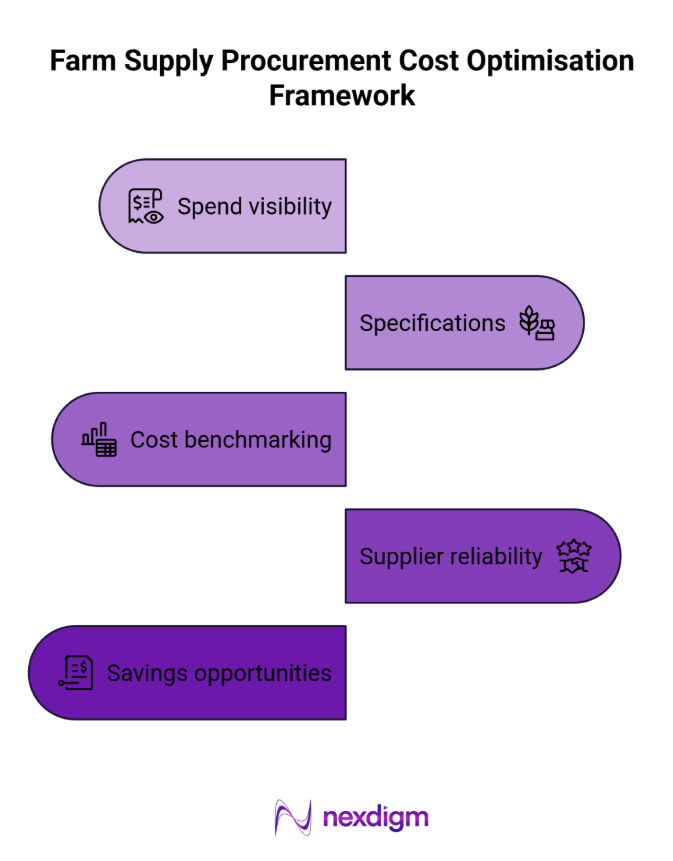
- Establish category-level spend visibility
Consolidate expenditure across fertilizers, seeds, crop protection, machinery, irrigation and other farm supplies. Identify high-spend categories, recurring purchases and differences in procurement practices across locations. - Standardise product and quality specifications
Create comparable product groups based on technical requirements, quality parameters, pack sizes and intended applications. This prevents misleading price comparisons and reduces unnecessary specification variation. - Benchmark suppliers and landed costs
Compare supplier quotations, transaction prices, freight, handling, discounts, credit periods and delivery conditions. Evaluate the total acquisition cost rather than focusing exclusively on the invoice price. - Assess supplier reliability and sourcing alternatives
Review supplier capacity, geographic coverage, quality consistency, delivery performance and financial or operational exposure. Identify qualified alternatives for categories where competition is limited or supply dependence is high. - Prioritise savings and implementation opportunities
Rank opportunities by expenditure impact, achievable savings, implementation complexity and supply risk. Assign category-level actions such as demand consolidation, contract renegotiation, supplier diversification or inventory planning.
Nexdigm’s Case Study: Reducing Farm Supply Procurement Costs
Nexdigm assessed procurement across 6 agricultural input categories, 5 regions and 22 suppliers. The analysis identified 4 priority categories for commercial renegotiation and a potential 9% cost optimisation opportunity while retaining existing quality and delivery requirements.
To take the next step, simply visit our Request a Consultation page and share your requirements with us.
Harsh Mittal
+91-8422857704