

Farm-to-market logistics networks are gaining importance as agricultural trade volumes increase and producers seek faster, more reliable access to buyers, processors, and export channels. Efficient logistics systems help reduce post-harvest losses, improve delivery timelines, protect product quality, and strengthen price realization across farm-to-consumer routes.
Companies entering this space must assess transport infrastructure, aggregation points, warehousing, cold-chain needs, regulatory conditions, and distributor partnerships. A clear market entry strategy helps evaluate operational feasibility and regional demand. A focused Farm to market logistics entry strategy supports scalable growth by aligning sourcing locations, trade corridors, storage capacity, and market access requirements.
The agriculture logistics market was valued at about USD 822.0 billion in 2025 and is expected to reach USD 1,187.8 billion by 2032, growing at 5.4% CAGR. Globally, 13.2% of food is lost after harvest and before retail, highlighting logistics and handling gaps.
Creating a Go-to-Market Roadmap for Farm-to-Market Logistics Providers
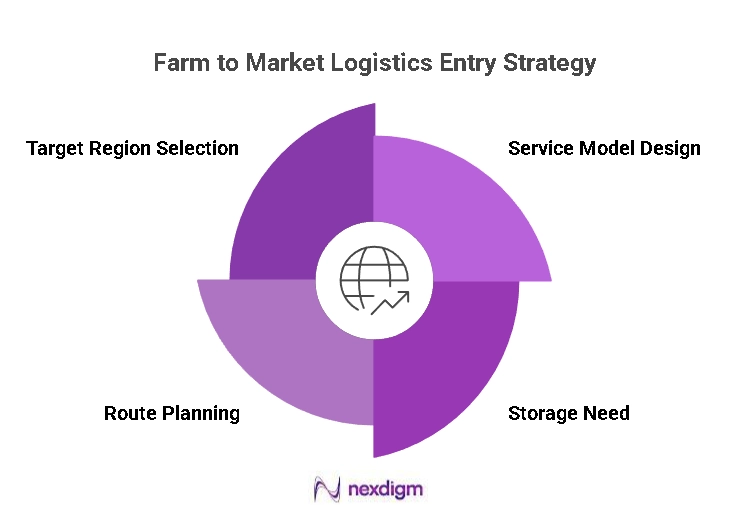
This involves defining target regions, service models, transport routes, storage needs, partner networks, pricing structures, compliance requirements, and rollout priorities for scalable agricultural logistics growth:
-
Target Region Selection
Identify regions with strong farm output, trade activity, infrastructure gaps, and demand for reliable logistics services.
-
Service Model Design
Define transport, warehousing, aggregation, cold-chain, and last-mile services based on crop type and customer needs.
-
Route Planning
Map farm clusters, collection points, processing hubs, wholesale markets, and export routes for efficient movement.
-
Storage Need Assessment
Evaluate warehouse capacity, temperature control, handling systems, and inventory requirements for different agricultural products.
Nexdigm Storage and Warehousing Capacity Review
Nexdigm can help agri-logistics providers assess warehouse availability, storage capacity, temperature-control needs, inventory handling, location suitability, and infrastructure gaps. This review supports market entry strategy by identifying storage constraints, investment priorities, operational risks, and scalable warehousing models across farm-to-market logistics networks.
Nexdigm Cold-Chain Requirement Assessment for Perishable Produce
Nexdigm can assess pre-cooling, refrigerated storage, temperature-controlled transport, handling risks, spoilage levels, infrastructure gaps, and compliance needs to support perishable produce logistics planning.
-
Pre-Cooling Assessment
Evaluate farm-level and collection-point pre-cooling needs to preserve freshness before transport or storage.
-
Refrigerated Storage Review
Assess cold room capacity, temperature zones, storage duration, and product-specific requirements for perishable produce.
-
Temperature-Controlled Transport
Review reefer vehicle availability, route duration, temperature monitoring, and delivery reliability across farm-to-market networks.
-
Handling Risk Evaluation
Identify loading, unloading, sorting, and packaging risks that may increase spoilage during produce movement.
Nexdigm’s case:
Nexdigm assisted a farm-to-market logistics provider assess cold-chain requirements for perishable produce expansion. The analysis identified 20–25% spoilage reduction potential, 18% refrigerated storage gaps, and 12–15% route-level temperature-control risks. These insights helped the company prioritize cold-room investments, evaluate reefer transport partners, improve handling practices, and build a scalable logistics entry strategy.
To take the next step, simply visit our Request a Consultation page and share your requirements with us.
Harsh Mittal
+91-8422857704