

Farmer pricing behavior strongly influences product adoption across seeds, fertilizers, crop protection, equipment, livestock inputs, and agricultural technologies. Through farmer pricing behavior analysis consulting, agribusinesses can assess affordability thresholds, willingness to pay, perceived value, seasonal cash flow, credit access, risk tolerance, and switching behavior. Integrated Pricing Analysis Services help identify how different farmer segments respond to premiums, discounts, pack sizes, financing options, and expected returns.
These insights support value-based pricing, market segmentation, product positioning, channel strategy, and adoption planning, enabling agricultural companies to improve accessibility, strengthen demand, protect margins, and achieve sustainable commercial growth across diverse regional markets and categories.
An illustrative 12% improvement in pricing accuracy can increase product adoption across agricultural categories. Pricing Analysis Services evaluate farmer affordability, willingness to pay, credit access, perceived value, and seasonal demand, helping agribusinesses strengthen conversion, price realization, profitability, and long-term penetration.
Pricing Analysis for Affordability, Value Perception, and Adoption
Pricing analysis connects farmer affordability, perceived product value, purchasing behavior, and expected returns to establish accessible prices, strengthen adoption, protect profitability, and support sustainable agricultural market growth across diverse categories. Some core benefits of it are:
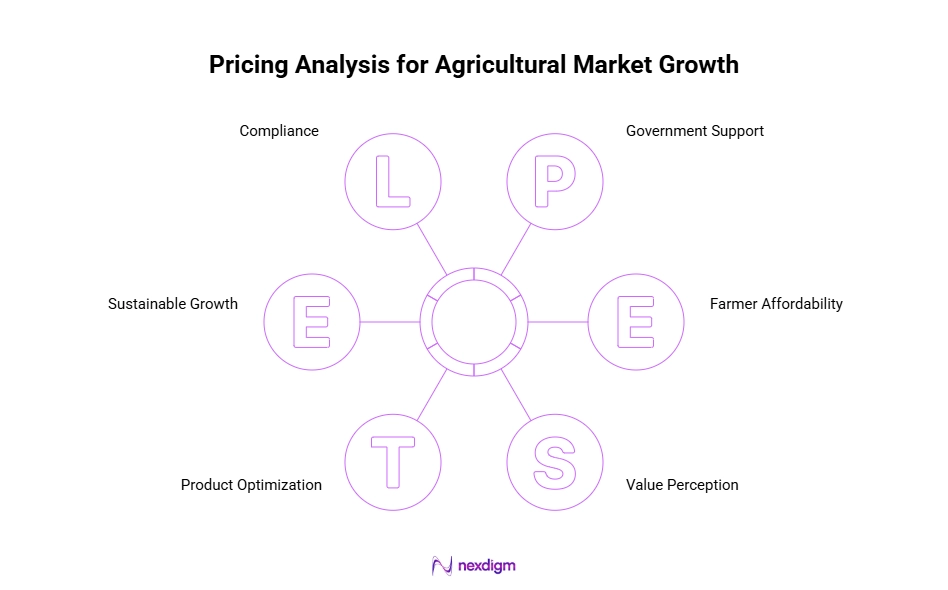
- Farmer Affordability Assessment: Evaluate farm income, seasonal cash flow, credit availability, purchasing capacity, and crop economics. Benefits include realistic price thresholds, broader accessibility, stronger demand, and reduced adoption barriers.
- Value Perception Analysis: Assess how farmers perceive product quality, performance, reliability, convenience, and expected returns. Benefits include clearer value communication, stronger purchase confidence, premium justification, and improved customer loyalty.
- Willingness-to-Pay Measurement: Analyze acceptable prices across farm sizes, regions, crops, and customer segments. Benefits include precise pricing decisions, better segmentation, improved conversion, and reduced risk of customer resistance.
- Product and Pack Optimization: Evaluate product features, formulations, pack sizes, payment options, and usage requirements. Benefits include improved affordability, flexible purchasing, stronger product relevance, and increased adoption across diverse farmer segments.
- Adoption and Pricing Performance Monitoring: Track sales, repeat purchases, customer feedback, price realization, and switching behavior. Benefits include timely pricing refinements, stronger retention, protected margins, and sustainable long-term market penetration.
Nexdigm’s Strategic Support for Agricultural Affordability and Price Optimization
Nexdigm’s Pricing Analysis Services help agribusinesses optimize affordability and pricing through farmer pricing behavior analysis, agricultural price optimization, value-based pricing, willingness-to-pay analysis, competitive pricing intelligence, and market pricing strategy. By evaluating farmer affordability, perceived product value, competitor prices, regional demand, and purchasing behavior, Nexdigm enables organizations to improve product adoption, strengthen price realization, protect margins, and achieve sustainable agricultural growth.
Nexdigm’s Affordability-Based Pricing Model for Sustainable Market Growth
Nexdigm’s affordability-based pricing model combines farmer economics, purchasing capacity, perceived value, market demand, and cost structures to improve accessibility, strengthen product adoption, protect margins, and support sustainable agricultural growth. Data Driven steps followed by Nexdigm’s experts are:
Step 1: Assess Farmer Affordability
Evaluate farm income, crop returns, seasonal cash flow, credit access, and purchasing capacity to establish realistic price thresholds across customer segments.
Step 2: Measure Perceived Product Value
Analyze expected yield gains, quality improvements, convenience, reliability, and return on investment to determine how farmers evaluate product value.
Step 3: Segment Markets and Customers
Group farmers by geography, farm size, crop type, purchasing power, and usage needs to create targeted, affordability-aligned pricing strategies.
Step 4: Model Price and Adoption Scenarios
Test alternative prices against demand, adoption, revenue, and margin outcomes to identify commercially sustainable options balancing accessibility and profitability.
Step 5: Monitor Performance and Refine
Track sales volumes, repeat purchases, price realization, customer feedback, and margin performance to refine pricing and support long-term market growth.
Nexdigm’s Case
Nexdigm helped an agribusiness implement an affordability-led pricing strategy. The initiative increased product adoption by 15%, improved price realization by 11%, and strengthened gross margins by 8%, enabling sustainable growth through balanced farmer affordability and commercial profitability.
To take the next step, simply visit our Request a Consultation page and share your requirements with us.
Harsh Mittal
+91-8422857704