

A fashion retail pricing feasibility study helps brands determine whether proposed prices match customer expectations, brand positioning, competitive realities, and margin goals before launch. Through structured Pricing Strategy Analysis, fashion retailers can evaluate willingness to pay, price sensitivity, product differentiation, channel costs, markdown risks, and regional demand.
This insight allows brands to set realistic price ranges, protect perceived value, plan promotions more effectively, and reduce dependence on assumptions. It also supports confident market entry, stronger sell-through, and sustainable profitability across collections, customer segments, sales channels, and international markets.
The global fashion industry was valued at approximately USD 1.7 trillion in 2023, while the apparel market reached about USD 1.8 trillion in 2025. At this scale, better pricing decisions can improve sell-through, limit markdown exposure, protect margins, and strengthen launch performance.
Pricing Analysis for Sustainable Fashion Retail Margins
Pricing analysis helps fashion retailers balance customer demand, brand value, product costs, promotions, and inventory risk to protect margins, improve sell-through, and support sustainable growth across markets and channels. Its major advantages are:
- Reduced Markdown Dependency: Better price planning aligns initial prices with demand and perceived value, reducing excess inventory, late-season discounting, and avoidable margin erosion across product categories and channels.
- Better Brand Positioning: Clear pricing architecture supports consistent premium, mid-market, or value positioning, helping customers understand product differences while strengthening brand perception and competitiveness across fashion segments.
- More Profitable Product Mix: Category and product-level insights reveal which styles, ranges, and price tiers generate the strongest margins, guiding assortment decisions toward more commercially valuable fashion offerings.
- Faster Response to Market Changes: Ongoing competitor, cost, and demand monitoring helps fashion retailers adjust prices quickly when trends shift, inventory builds, or customer spending patterns change across markets.
Nexdigm’s Advisory Support for Data-Driven Fashion Pricing Strategies
Nexdigm helps fashion brands and retailers make informed pricing decisions through Fashion Retail Pricing Analysis, Pricing Strategy Analysis, Fashion Pricing Feasibility Studies, and Markdown Optimization. By combining consumer insights, competitive benchmarking, price elasticity, product-level margins, inventory trends, and channel economics, Nexdigm develops data-driven fashion pricing strategies that improve sell-through, protect brand value, reduce discount dependency, strengthen profitability, and support sustainable growth across markets and sales channels.
Nexdigm’s Data-Driven Fashion Pricing Strategy Framework
Nexdigm’s framework turns customer, product, inventory, and market data into practical pricing decisions that improve sell-through, protect brand positioning, reduce markdown risk, and strengthen sustainable retail profitability. Its key steps:
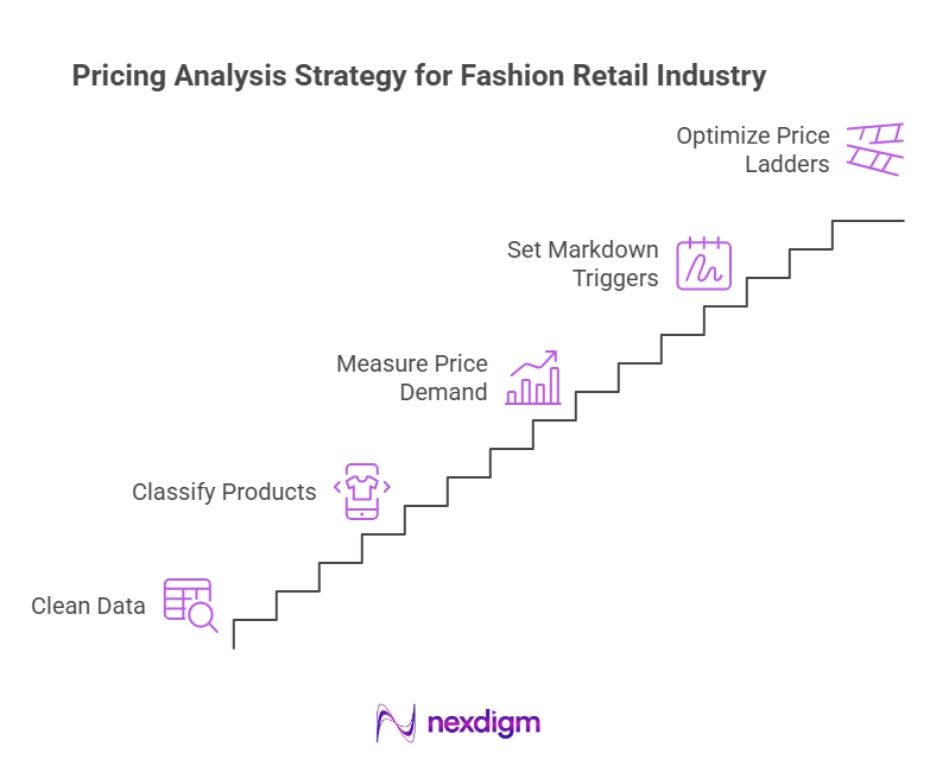
- Clean and Connect Pricing Data: Combine sales, inventory, costs, discounts, customer, and competitor data into one reliable view, enabling consistent analysis across products, collections, channels, regions, and seasons for decisions.
- Classify Products by Commercial Role: Group products as traffic drivers, margin builders, seasonal items, premium statements, or clearance risks to apply pricing rules suited to each product’s strategic purpose effectively.
- Measure Full-Price Demand Potential: Evaluate early sales velocity, customer interest, stock availability, product reviews, and channel performance to estimate which items can sustain full-price demand before promotional intervention begins.
- Set Markdown Timing Triggers: Define markdown triggers based on inventory age, remaining season length, sell-through targets, demand decline, and stock cover to reduce delayed discounting and protect margins proactively.
- Optimize Price Ladders and Product Tiers: Align entry, core, premium, and limited-edition price points to create clear customer choice, strengthen perceived value, and improve profitability across fashion categories and collections consistently.
Nexdigm’s Case
A fashion retailer engaged Nexdigm to refine pricing across seasonal collections and sales channels. The analysis increased full-price sell-through by 16%, reduced ageing inventory by 12%, improved gross margin return on inventory by 9%, and shortened markdown cycles by 18%, supporting healthier margins, faster stock movement, and stronger collection performance.
To take the next step, simply visit our Request a Consultation page and share your requirements with us.
Harsh Mittal
+91-8422857704