

Food and beverage procurement costs do not move in one direction at the same time. Agricultural inputs, processed ingredients, packaging, energy, freight, and labour respond to different market conditions. A company may face easing prices for one raw material while paying more for transportation, packaging conversion, or a supplier’s finished product.
The central challenge is to identify which costs are rising, why they are rising, and how much of the increase is commercially justified.
Read the Market Beyond Inflation
The FAO Food Price Index provides a useful view of international commodity movements. In September 2026, its overall index increased 5.8% year on year. The index was also 15.1% below its March 2022 peak, demonstrating that a market can experience renewed price pressure without returning to its previous high.
The aggregate figure hides differences between commodity groups. Cereals, vegetable oils, dairy, meat, and sugar follow distinct supply and demand patterns. Weather, harvest conditions, export restrictions, inventories, energy costs, and exchange rates can affect them differently.
For buyers, this means category-level analysis is more useful than applying a single food inflation rate across all purchases.
Separate Input Costs From Supplier Pricing
Raw-material movements do not pass through to finished products immediately or uniformly. Suppliers may hold inventory purchased at earlier prices, operate under fixed-term contracts, face higher processing costs, or have limited ability to change production schedules.
Packaging offers a similar example. Material prices may change while conversion, printing, tooling, transport, and minimum production quantities remain important cost components. A lower input price therefore does not automatically justify an equivalent reduction in the finished packaging price.
For F&B procurement cost analysis consulting, the analysis should connect external price indicators with invoice-level data, contract dates, supplier explanations, and product specifications. This makes it possible to distinguish a genuine market increase from a supplier-specific pricing change.
Where Cost Pressure Can Hide
Three patterns deserve particular attention. First, purchasing fragmentation can increase unit costs when separate locations place small orders with overlapping suppliers. Second, minimum order requirements can lower quoted prices but increase inventory and expiry exposure. Third, changes in product mix can raise total expenditure even when the price of each comparable item remains stable.
Businesses should also monitor the cost of quality failures. Rejected batches, short shelf life, damaged packaging, and emergency replacement purchases can make an apparently competitive supplier more expensive in practice.
F&B Procurement Cost Analysis Framework
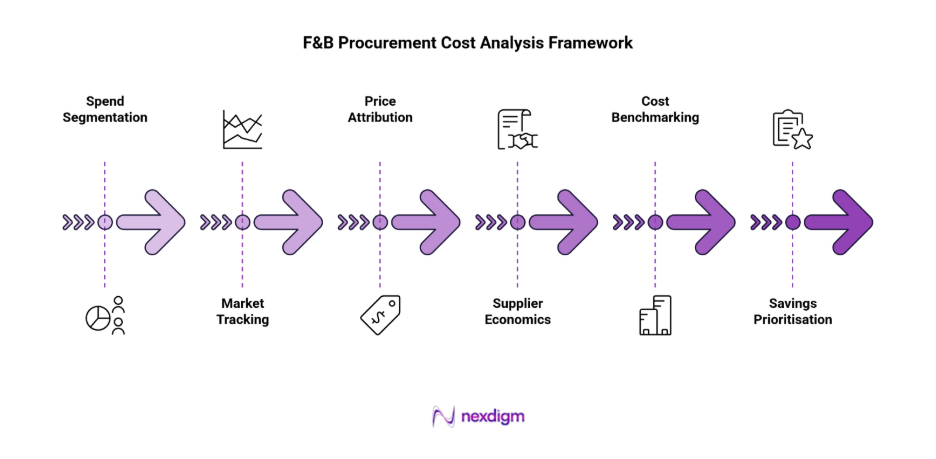
- Spend Segmentation: Break expenditure down by product, supplier, material, location, and period to identify categories responsible for the largest cost changes.
- Market Tracking: Monitor relevant commodity, freight, and input-price indicators, matching each indicator to the actual materials and contract periods involved.
- Price Attribution: Separate changes caused by market prices, purchase volumes, product mix, specifications, supplier pricing, and additional charges.
- Supplier Economics: Examine minimum orders, rebates, payment terms, delivery charges, price-validity periods, and contract escalation clauses to understand effective costs.
- Cost Benchmarking: Compare equivalent products and services across suppliers using consistent quality, delivery, and commercial assumptions.
- Savings Prioritisation: Rank opportunities by addressable spend, alternative availability, operational impact, and implementation cost, then validate results against purchasing records.
What Buyers Should Do Next
Cost analysis should support specific commercial decisions. Buyers can request a breakdown of price increases, renegotiate delivery or order terms, consolidate compatible purchases, or qualify alternative suppliers. Where the increase reflects a genuine commodity shortage, a sourcing change may be more effective than a price negotiation alone.
Nexdigm’s Case Study
A food distributor reviewing ₹28 crore in annual purchases found that price changes, freight charges, and fragmented orders were being recorded together. Separating these drivers identified three categories for negotiation and two for supplier diversification. The resulting procurement plan reduced addressable costs by 3.5% over six months while maintaining agreed quality and delivery requirements.
To take the next step, simply visit our Request a Consultation page and share your requirements with us.
Harsh Mittal
+91-8422857704