

Vendor resilience has become a commercial concern for food and beverage businesses operating across fragmented supply networks. A supplier may meet product specifications during onboarding but struggle with seasonal shortages, regulatory inspections, inconsistent production or delayed deliveries once volumes increase. These weaknesses can affect manufacturing schedules, product availability and customer commitments.
India’s food-processing sector is expanding, with its gross value added increasing from ₹1.34 lakh crore in 2014–15 to ₹2.24 lakh crore in 2023–24. Processed food exports reached approximately US$10.1 billion in 2024–25. As production and distribution networks expand, businesses become more dependent on suppliers that can maintain quality and delivery standards across larger volumes and multiple locations.
Why Vendor Risk Needs a Broader Assessment
Supplier risk is often evaluated through price, product quality and delivery history. These indicators are useful, but they do not necessarily reveal whether a vendor can sustain operations during disruption.
A supplier may have valid licences but inadequate testing infrastructure. Another may have sufficient production capacity but depend on a single raw-material source. A third may deliver consistently under normal conditions but lack contingency arrangements for equipment failure or transport interruptions.
The assessment therefore needs to examine four connected areas:
- Supply continuity: Dependence on individual farms, processors, import markets, transport routes or packaging suppliers.
- Regulatory compliance: Licensing, product standards, testing records, traceability and corrective-action procedures.
- Production capability: Installed capacity, utilisation, maintenance practices, storage conditions and ability to accommodate higher volumes.
- Delivery performance: Lead-time consistency, order fulfilment, geographic coverage and arrangements for emergency replenishment.
A vendor’s risk profile changes when these factors are considered together. High production capacity, for example, has limited value if the supplier cannot maintain compliance or transport products within their required shelf life.
What India’s Food Safety Data Reveals
The regulatory environment provides a useful indication of the importance of supplier oversight. During FY2024–25, food safety authorities analysed 170,535 food samples, of which 34,388 were found non-conforming. That represents approximately 20.2% of the samples tested.
Enforcement activity has also intensified. FSSAI’s risk-based inspection count increased from 11,904 in FY2022–23 to 26,267 in FY2024–25. The system prioritises businesses according to their risk profile, with annual inspections prescribed for identified high-risk categories.
These figures do not mean that one-fifth of all food suppliers are non-compliant. They do, however, demonstrate why vendor selection cannot depend exclusively on declarations, certificates or historical relationships. Businesses need to understand how suppliers manage quality controls and whether their operating systems can withstand scrutiny.
Where Vendor Resilience Commonly Breaks Down
- Raw-material concentration
Suppliers relying on a narrow group of agricultural producers or imported inputs may be exposed to weather conditions, regional shortages and trade restrictions. The risk is particularly relevant for ingredients with seasonal production cycles or limited alternative sources. - Inadequate production controls
Production capacity should be assessed alongside actual utilisation, equipment condition, testing frequency and process consistency. A facility operating close to its practical capacity may struggle to accommodate additional orders without affecting quality or delivery schedules. - Documentation without operational discipline
Licences, test reports and quality certifications provide important evidence, but their presence does not establish that procedures are consistently followed. Businesses should examine batch records, supplier approval systems, traceability arrangements and corrective-action histories. - Weak logistics arrangements
Temperature-sensitive products, short shelf-life ingredients and products requiring specialised handling have different delivery risks. Transport availability, route reliability, storage infrastructure and contingency arrangements need to be evaluated against the product being supplied.
A Practical Framework for Assessing Vendor Resilience
A structured F&B vendor risk assessment consulting exercise can help businesses compare suppliers across these dimensions and identify where exposure is concentrated.
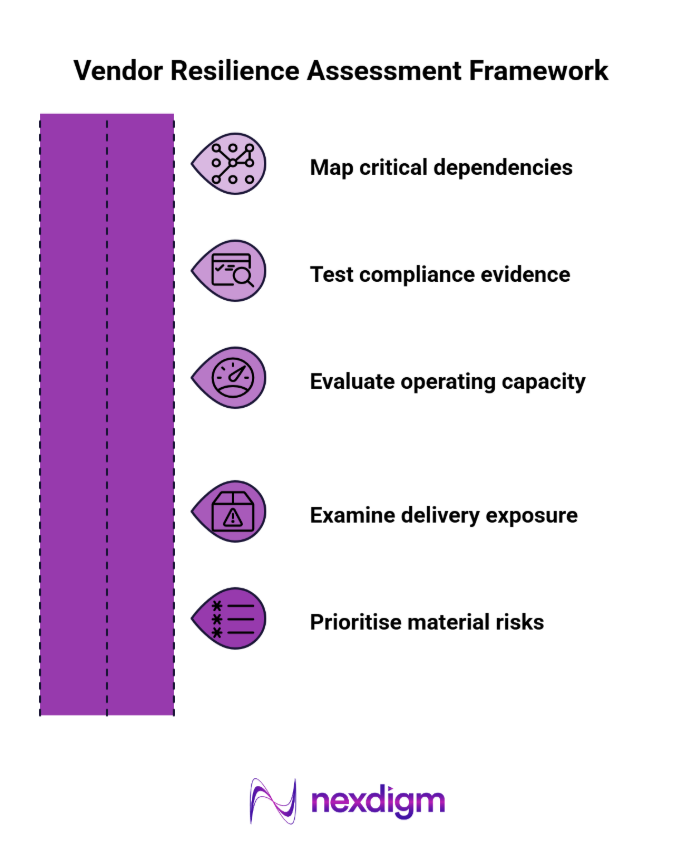
- Map critical dependencies: Identify which suppliers provide essential ingredients, packaging or services, and assess whether alternatives are available.
- Test compliance evidence: Review licences, certifications, laboratory reports, traceability records and the frequency of documented quality checks.
- Evaluate operating capacity: Compare stated capacity with actual output, utilisation, infrastructure and the ability to accommodate demand fluctuations.
- Examine delivery exposure: Assess lead times, geographic coverage, transport dependencies and performance during peak-demand periods.
- Prioritise material risks: Combine the findings into supplier risk profiles, distinguishing critical vulnerabilities from issues that can be addressed through routine monitoring.
Nexdigm’s market and industry assessment capabilities can support this process through supplier landscape mapping, competitive intelligence, sector analysis and evaluation of operating conditions across relevant markets. The objective is to help businesses understand the resilience of their supplier ecosystem and make better-informed sourcing and expansion decisions.
Nexdigm’s Case Study
A packaged food manufacturer operating across 6 states reviewed its network of 42 ingredient and packaging vendors. Nexdigm’s assessment identified 11 high-risk suppliers, including 4 with significant single-source dependencies. The client prioritised 7 alternative suppliers and reduced its exposure to critical supply disruptions by 31%.
To take the next step, simply visit our Request a Consultation page and share your requirements with us.
Harsh Mittal
+91-8422857704