

Fertilizer demand is often discussed as a function of global food production. That relationship is real, but it is incomplete.
The amount and type of fertilizer required depends on what farmers plant, how much land is cultivated, expected yields, nutrient requirements, crop prices, fertilizer affordability and local agronomic conditions.
A shift in crop mix can therefore change fertilizer demand even when total cultivated acreage remains unchanged.
IFA’s 2026–2030 Medium-Term Fertilizer Outlook explicitly models fertilizer demand through multiple scenarios, including the effects of affordability, government policies and the pace of recovery from current demand pressure.
This makes fertilizer demand forecasting a farm-economics problem as much as an agricultural production problem.
Crop Mix Changes the Nutrient Basket
Different crops consume different nutrient combinations.
Corn generally requires substantial nitrogen and also consumes significant phosphorus and potassium. Soybeans fix atmospheric nitrogen through biological processes and therefore have a different commercial fertilizer profile, with greater relevance for phosphorus and potassium. Wheat sits between these profiles, while fruits and vegetables can require more specialized, water-soluble and fertigation-compatible products.
Research illustrates the difference clearly, with corn carrying high nitrogen demand, soybeans requiring comparatively little commercial nitrogen but meaningful phosphate and potash, and specialty crops creating demand for chloride-free and water-soluble fertilizers.
This means acreage forecasting alone is insufficient.
A one-million-acre shift from soybeans to corn can increase nitrogen demand substantially even if total cropland remains unchanged.
Acreage is Only One Part of the Equation
Global agricultural land is constrained, which means future production growth increasingly depends on yield improvement.
Latin America remains an important source of agricultural expansion, particularly through Brazil’s double-cropping systems. The supplied research highlights the nutrient implications of soybean and second-crop corn systems, where repeated annual production increases nutrient removal from soils.
In North America, annual crop allocation responds to relative economics between crops. In India and China, land constraints and policy priorities place greater emphasis on nutrient efficiency and productivity.
The result is a fertilizer market where acreage, crop mix and nutrient intensity must be forecast together.
Farm Economics Determines Whether Theoretical Demand Becomes Purchases
Farmers do not purchase fertilizer simply because crops require nutrients.
They purchase when the expected economic return justifies the input.
This makes the fertilizer affordability ratio important:
Fertilizer affordability = crop revenue potential ÷ fertilizer input cost.
- When crop prices rise relative to fertilizer costs, application intensity can increase.
- When fertilizer becomes expensive while crop margins weaken, growers can delay purchases, reduce application or prioritize nutrients with the strongest expected yield response.
Nexdigm’s research identifies nitrogen as the nutrient most likely to be protected during severe margin pressure, while phosphate and potash applications can be reduced when growers rely temporarily on residual soil fertility.
IFA’s 2026 outlook similarly incorporates prolonged poor affordability conditions into its demand scenarios rather than assuming an immediate return to normal purchasing behaviour.
Why Nitrogen, Phosphate and Potash Can Move Differently
IFA’s medium-term work has previously projected faster growth in P₂O₅ and K₂O consumption than nitrogen over the medium term, reflecting differences in nutrient requirements and regional demand.
The 2026 outlook is more cautious because affordability and market conditions remain uncertain, but it continues to model nitrogen, phosphate and potash separately rather than treating fertilizer as a single product category.
A fertilizer producer may experience declining nitrogen demand in one market while phosphate or potash demand continues expanding because crop mix and soil requirements are changing.
Precision Agriculture Changes the Volume Equation
Improving nutrient-use efficiency can create another forecasting challenge.
Precision application, soil testing, fertigation and variable-rate technology can reduce unnecessary fertilizer use per hectare. That can suppress physical volume growth even while agricultural output rises.
At the same time, better nutrient management can increase adoption of higher-value specialty fertilizers, micronutrients and customized formulations.
The market can therefore move from “more tonnes per acre” toward “more value per acre.”
Forecasting fertilizer demand requires a farm-level view
The strongest demand model should ultimately connect global agricultural production with decisions made at field level.
Acreage determines how much land is available. Crop mix determines which nutrients are required. Yield targets determine application intensity. Crop prices determine affordability. Fertilizer prices determine input economics. Policy and weather influence the final decision.
That chain explains why fertilizer demand can diverge significantly from headline agricultural growth.
For producers, distributors and investors, the commercial opportunity lies in understanding where those variables are moving together and where they are creating regional or nutrient-specific demand pockets.
The Nexdigm Fertilizer Demand Model
A robust fertilizer demand analysis and forecasting exercise can be built from five interacting variables.
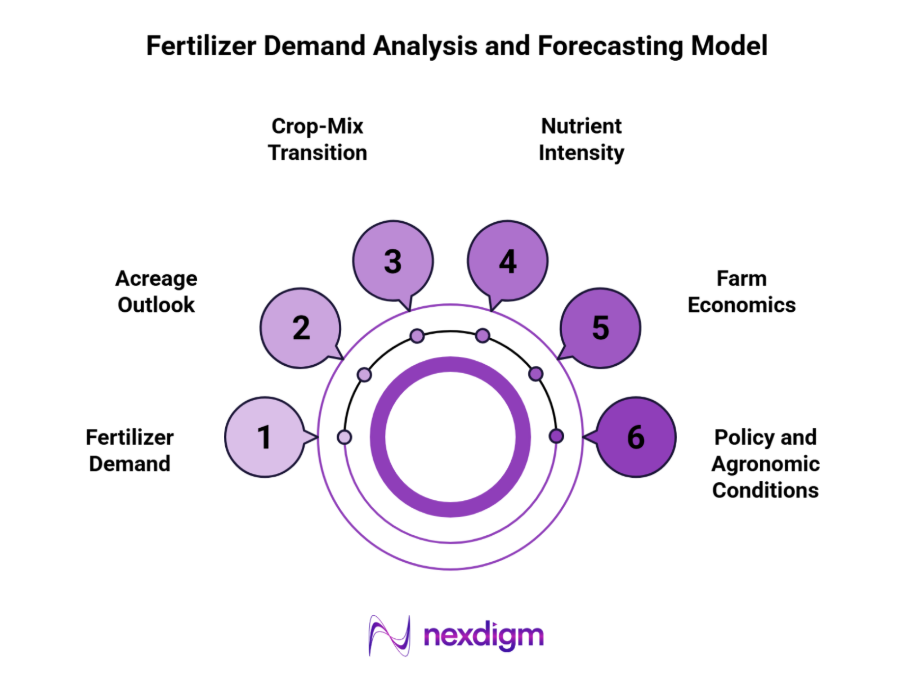
- Acreage outlook
Forecast planted area by crop, region and season. - Crop-mix transition
Model shifts between corn, soybeans, wheat, rice, specialty crops and other major crops. - Nutrient intensity
Estimate nutrient application rates per hectare and expected changes from precision agriculture, soil testing, improved varieties and nutrient-efficiency practices. - Farm economics
Track crop prices, fertilizer prices, farm margins, interest rates and input affordability. - Policy and agronomic conditions
Incorporate subsidies, fertilizer availability policies, environmental regulations, weather and local soil requirements.
This produces a nutrient-specific demand forecast rather than simply applying a growth rate to last year’s fertilizer consumption.
Nexdigm Case: Fertilizer Demand Forecast
A fertilizer producer with $1.1B revenue needed a 2030 regional forecast. Nexdigm modelled 8 crops across 6 regions, integrating acreage, nutrient intensity and crop margins, identifying 4 markets with projected nutrient demand growth above 5% annually.
To take the next step, simply visit our Request a Consultation page and share your requirements with us.
Harsh Mittal
+91-8422857704