

Building fertilizer capacity is a long-term investment decision in which plant location can influence feedstock economics, production costs, logistics, market access, and utilization. A location close to raw materials may reduce input costs, while proximity to agricultural demand can improve distribution efficiency and farmer access.
India’s fertilizer market provides a strong case for evaluating these factors together. Fertilizer consumption reached approximately 68.5 million metric tonnes in 2023–24, while the country has more than 140 million hectares of net sown area. Domestic urea capacity increased from 207.54 lakh metric tonnes per annum in 2014–15 to 283.74 LMTPA in 2023–24, with six new units contributing 76.2 LMTPA of capacity.
The Government has continued expanding domestic production: six new urea plants have added 76.2 LMTPA, while domestic urea production reached 306.67 LMT in 2024–25. For fertilizer manufacturers, investors, and agricultural-input companies, fertilizer greenfield entry strategy services can help determine where additional capacity can achieve the strongest combination of feedstock security, demand potential, infrastructure, logistics, and farmer access.
Evaluating Feedstock Availability and Supply Security
The long-term competitiveness of a fertilizer plant is closely linked to reliable access to key raw materials and inputs. Feedstock availability, sourcing economics, transportation requirements, and supply continuity can significantly influence production costs and operational performance. Manufacturers must therefore assess whether potential locations can support stable input supply while minimizing procurement and logistics risks.
Understanding Demand, Distribution, and Farmer Accessibility
Strong fertilizer demand alone does not guarantee an optimal plant location. Businesses must also evaluate agricultural activity, crop patterns, consumption intensity, distribution networks, storage infrastructure, and access to farming communities. Locations that improve connectivity to key agricultural regions can support faster market reach, lower distribution costs, and improved product availability for end users.
Nexdigm’s Expertise in Fertilizer Capacity Expansion and Market Entry Assessment
Identifying the right location for new fertilizer capacity requires a careful evaluation of feedstock access, agricultural demand, logistics infrastructure, distribution reach, and long-term operating economics. Nexdigm helps manufacturers, investors, and agricultural-input companies assess these interconnected factors through:
- Feedstock and Supply Assessment: Evaluation of raw-material availability, sourcing reliability, transportation requirements, and input economics to support sustainable and cost-effective production operations.
- Demand and Farmer Access Analysis: Assess agricultural consumption patterns, crop concentrations, regional demand drivers, and farmer accessibility to identify attractive market opportunities.
- Infrastructure and Logistics Evaluation: Analysis of transportation networks, storage facilities, utility infrastructure, distribution channels, and market connectivity to improve supply-chain efficiency.
By combining industry intelligence with commercial and operational analysis, Nexdigm helps businesses identify fertilizer-capacity locations that balance production efficiency, market access, and long-term growth objectives.
Why Assessment Matters for Fertilizer Market Expansion
The success of a fertilizer plant depends on more than production capacity alone. Decisions related to feedstock sourcing, logistics connectivity, agricultural demand, and distribution reach can significantly influence long-term utilization, operating costs, and market competitiveness. Hence, the need for assessment matters to:
- Align production facilities with regions that offer a strong balance of demand potential and distribution accessibility.
- Optimize sourcing and transportation networks to reduce feedstock, logistics, and distribution expenses over the plant lifecycle.
- Improve proximity to agricultural markets, distributors, and farming communities to strengthen product availability and customer access.
- Support capital-allocation decisions through a comprehensive evaluation of commercial, operational, and infrastructure considerations.
A structured assessment framework can help fertilizer businesses identify sites that can support efficient operations, sustainable demand fulfillment, and long-term growth.
Nexdigm’s Fertilizer Greenfield Entry Assessment Framework
Nexdigm’s fertilizer greenfield entry strategy services follow a structured framework to evaluate where new capacity can achieve the optimal balance of feedstock security, demand access, logistics efficiency, and commercial viability through the following steps:
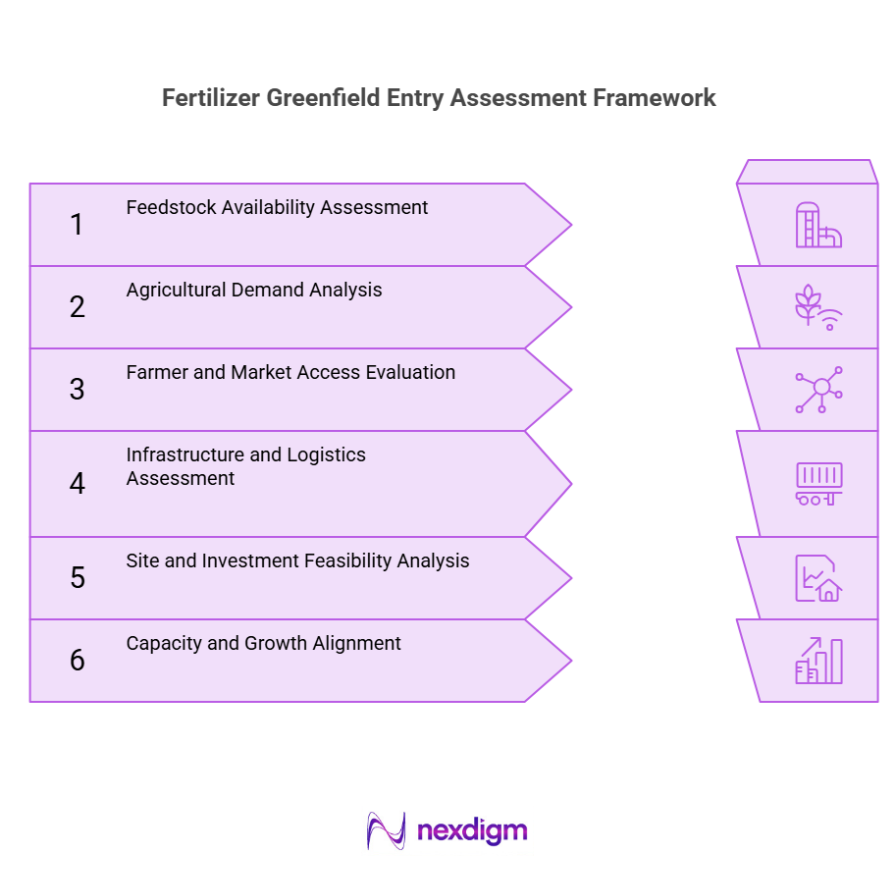
- Feedstock Availability Assessment: Evaluate access to key raw materials, sourcing economics, supply reliability, transportation requirements, and long-term feedstock security across potential locations.
- Agricultural Demand Analysis: Assess crop patterns, fertilizer consumption levels, cultivated acreage, regional demand concentrations, and future growth potential within target markets.
- Farmer and Market Access Evaluation: Analyze distribution networks, retail ecosystems, dealer reach, and proximity to agricultural hubs to understand market accessibility.
- Infrastructure and Logistics Assessment: Review transportation connectivity, storage facilities, utilities, port access, and supply-chain capabilities that influence plant operations and distribution efficiency.
- Site and Investment Feasibility Analysis: Compare location alternatives based on operating costs, infrastructure readiness, scalability, regulatory considerations, and capital requirements.
- Capacity and Growth Alignment: Assess whether proposed capacity plans align with long-term demand outlook, market expansion opportunities, and business growth objectives.
This framework helps fertilizer manufacturers, investors, and agricultural-input companies identify locations that support efficient production, strong capacity utilization, and sustainable long-term growth.
Nexdigm’s Case
Nexdigm supported a fertilizer producer requiring a regional demand forecast through 2030. Nexdigm modelled 8 crops across 6 regions, integrating acreage, nutrient intensity, and crop economics. The analysis identified 4 markets with projected nutrient-demand growth above 5% annually, providing a data-led basis for prioritizing future fertilizer-market opportunities.
To take the next step, simply visit our Request a Consultation page and share your requirements with us.
Harsh Mittal
+91-8422857704