

Fertilizer demand is often discussed at the country or nutrient level, but those views can hide where the next commercially relevant growth is forming. A national market may be growing while individual crops, regions, or nutrient categories move in very different directions.
For a fertilizer producer evaluating expansion, the more useful starting point is the farm economy. Crop acreage, yields, soil conditions, nutrient requirements and farm income determine how much fertilizer can realistically be absorbed.
Growth Is Becoming More Local
Demand potential varies considerably between cropping systems. Nitrogen remains the largest recurring requirement because of its role in vegetative growth and protein formation, while phosphorus and potassium demand is more closely influenced by crop type, soil characteristics and application cycles. Documented deficiencies in sulfur, zinc, boron and magnesium can create additional opportunities for specialty products.
This makes regional mapping important. A region with lower overall fertilizer consumption may still be attractive if it combines:
- expanding acreage in high-value crops
- persistent nutrient deficiencies
- improving irrigation or farm productivity
- increasing fertilizer application intensity
- limited availability of suitable products
The reverse can also be true. A large fertilizer market may have limited headroom where application rates are already high and established suppliers dominate the distribution network.
The Farmer Decides Whether Demand Becomes Revenue
Agronomic need is only one part of the equation. Farmers ultimately assess an input against expected crop returns and the risk of changing an established practice.
Crop prices are particularly important. When margins tighten, growers tend to protect essential applications while postponing inputs perceived as discretionary. New formulations also face a higher adoption barrier because a farmer has relatively few harvest cycles in which to test whether an unfamiliar product actually delivers the promised benefit.
Product compatibility matters as well. Granular products must work with existing spreading equipment, while liquid products need to function within established spraying or fertigation systems. Distribution and agronomic support can be equally important because retailers, cooperatives and agronomists often influence product selection.
This creates a useful distinction between agronomic potential and commercial potential. The first asks whether a nutrient is required. The second asks whether a farmer can be convinced to pay for it.
Where the Opportunity Becomes Commercially Interesting
A fertilizer growth opportunity assessment can bring these variables together by moving from broad market sizing to crop-region combinations.
For each combination, the assessment can examine:
- Crop acreage, yield and value trends
- Soil and nutrient deficiency patterns
- Current fertilizer application rates
- Farmer economics and expected ROI
- Product availability and competitive intensity
- Retailer and distributor coverage
- Adoption barriers and application practices
The purpose is to identify areas where several conditions reinforce one another. For example, a growing crop with documented micronutrient deficiencies becomes considerably more attractive when farm incomes are improving, competing products are limited and distribution infrastructure is already established.
Turning Crop Demand into Market Priorities
Nexdigm can use crop-level, regional and farmer-level analysis to separate broad fertilizer demand from addressable opportunity. The assessment can combine market sizing, agronomic data, primary research, competitor mapping and channel analysis to determine where an entrant has a realistic route to adoption.
Nexdigm’s Opportunity Prioritisation Framework
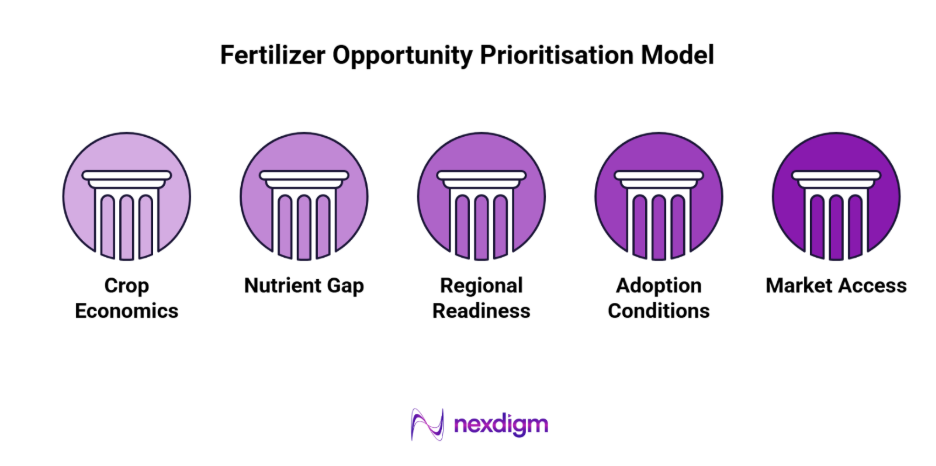
- Crop Economics
Assess acreage, yield, crop value and farmer margins to establish the economic capacity for additional fertilizer spending. - Nutrient Gap
Map soil conditions and crop-specific nutrient requirements to identify areas where incremental application has a credible agronomic basis. - Regional Readiness
Compare irrigation, cropping intensity, farm productivity and existing fertilizer usage to distinguish emerging markets from mature ones. - Adoption Conditions
Examine farmer willingness to change, product familiarity, expected ROI, application compatibility and the influence of agronomists or retailers. - Market Access
Evaluate distributor reach, competitive coverage, pricing, retailer incentives and the practical route through which the product can reach farms.
The resulting opportunity map can rank crop-region combinations rather than treating an entire country as a single market. That gives a producer a more practical basis for deciding where to enter, which products to develop and where additional primary research is justified.
Nexdigm Case: Prioritising Fertilizer Growth Markets
A fertilizer producer screened 24 crop-region combinations across 6 states. Nexdigm assessed nutrient gaps, farm economics, competitor coverage, and distribution access, narrowing the pipeline to 7 priority combinations representing an estimated $118 million addressable opportunity.
To take the next step, simply visit our Request a Consultation page and share your requirements with us.
Harsh Mittal
+91-8422857704