

Fertilizer demand begins with agronomy, but commercial success depends on much more than nutrient requirements. Farmers consider crop type, soil conditions, expected yield, product availability, price, credit and advice from trusted local sources. A fertilizer manufacturer entering a new region must understand these decisions before estimating sales.
A product may be technically suitable for a crop and still struggle to gain adoption if it is expensive, difficult to access or unfamiliar to farmers. Market entry requires a route from soil and crop needs to distribution and repeat purchase.
Fertilizer Demand Is Seasonal and Product-Specific
India’s fertilizer market combines large domestic production with significant import requirements for selected nutrients. The Fertiliser Association of India’s provisional 2024–25 statistics show that urea sales reached 38.77 million tonnes, up 8.4% from the previous year. DAP sales were 9.28 million tonnes, down 14.2%, while sales of NP/NPK fertilizers rose 28.4% to 14.21 million tonnes.
The differences matter. Aggregate fertilizer consumption can conceal shifts between products, nutrient compositions and cropping patterns. A manufacturer evaluating a new product needs to examine nutrient demand, regional crop calendars, soil conditions and the existing fertilizer mix rather than extrapolate from total sales.
Imports and production also vary by nutrient. In 2024–25, India imported 5.65 million tonnes of urea and 4.57 million tonnes of DAP, while MOP imports reached 3.54 million tonnes, according to the same FAI statistics. These figures help identify supply-chain exposure, but they do not automatically establish an opportunity for a new entrant. Pricing, subsidy arrangements, feedstock access and product approvals can influence competitiveness.
What Determines Farmer Adoption?
A farmer evaluates fertilizer through expected crop performance and the financial risk of using it. Even when a product promises better nutrient efficiency, adoption may be slow if the benefit is uncertain or takes more than one season to observe.
Market research should investigate the practical reasons farmers select or reject products:
- Crop and soil fit: Does the product address a recognised nutrient requirement for the crop and local soil conditions?
- Economics per acre: How does the cost compare with existing fertilizer practices, and what yield or quality improvement would justify the difference?
- Availability at the right time: Can distributors and retailers maintain stock ahead of the relevant sowing and application windows?
- Trust and demonstration: Do farmers, agronomists, cooperatives and local dealers have evidence of performance under comparable conditions?
- Credit and purchasing access: Can farmers obtain the product through their usual channels and within their seasonal cash-flow constraints?
A premium fertilizer may need field demonstrations and agronomic support before farmers are willing to switch. A commodity product may depend more heavily on distribution reach, price competitiveness and consistent availability. These are different go-to-market models.
Regulation, Subsidies and Distribution Shape the Opportunity
Fertilizer entry requires careful attention to the applicable regulatory and commercial structure. Product composition, quality standards, labelling, manufacturing permissions and distribution requirements must be verified for the proposed product. Subsidy arrangements can also materially affect market economics, particularly in heavily regulated fertilizer categories.
The fertilizer industry feasibility study consulting process should therefore examine demand and agronomy alongside policy, pricing and channel economics. A manufacturer needs to understand who ultimately pays, how prices are determined, whether the product qualifies for relevant schemes and what working capital is required across seasonal demand peaks.
Distribution is not a secondary consideration. Retailer margins, dealer relationships, storage, transport and the availability of agronomic guidance can determine whether a product reaches farmers consistently. An entry plan that ignores these costs may overstate the addressable market.
Fertilizer Market Entry Framework
The Fertilizer Market Entry Feasibility Framework connects agricultural demand with commercial execution.
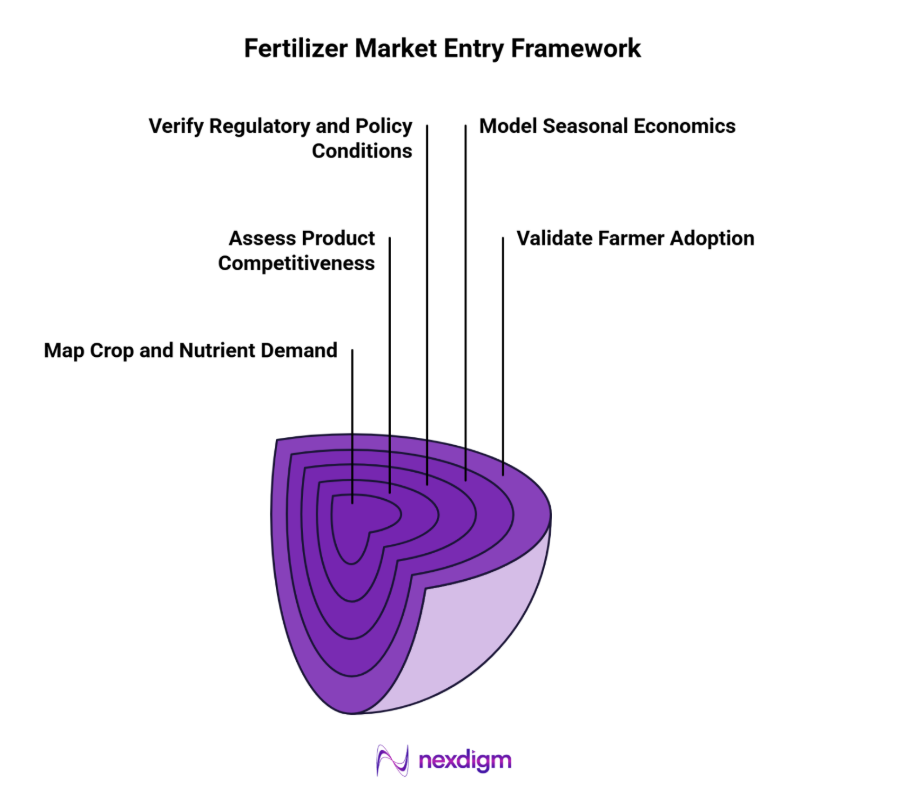
- Map Crop and Nutrient Demand: Analyse crop acreage, soil needs, nutrient use and regional application patterns.
- Assess Product Competitiveness: Compare nutrient composition, cost per acre, expected performance and existing alternatives.
- Verify Regulatory and Policy Conditions: Confirm product standards, approvals, subsidy eligibility and pricing rules.
- Model Seasonal Economics: Estimate manufacturing costs, inventory, distribution margins, working capital and demand peaks.
- Validate Farmer Adoption: Use field trials, dealer interviews and agronomic feedback to test willingness to switch and repurchase.
Nexdigm Case Study
Nexdigm assessed six fertilizer opportunities across three agricultural regions, combining crop patterns, nutrient demand, distribution coverage and product economics. Two products advanced to field validation. The entry plan prioritised regions with clearer agronomic need and established dealer access, while broader rollout depended on trial results and seasonal demand confirmation.
To take the next step, simply visit our Request a Consultation page and share your requirements with us.
Harsh Mittal
+91-8422857704