

Entering a fertilizer market can look attractive when agricultural acreage, crop production, or nutrient consumption is expanding. But a large addressable market does not automatically translate into a commercially viable entry opportunity.
Fertilizer demand is shaped by several layers of agricultural economics. Soil conditions influence nutrient requirements. Crop selection determines nutrient intensity. Acreage and yields determine the scale of application. Farm economics influence how much growers are willing to spend. Distribution, agronomic advice, product familiarity, and local availability ultimately determine whether a farmer adopts one fertilizer over another.
This makes fertilizer market feasibility different from simply estimating tonnes of nutrient consumption. A credible assessment needs to connect agronomic requirements with purchasing behaviour and commercial accessibility.
Fertilizer Demand Begins With the Crop and Soil
Nutrient demand is dictated by agricultural production systems rather than aggregate fertilizer consumption.
Crop mix determines underlying NPK and specialty nutrient requirements; cereal-heavy regions differ fundamentally from oilseed, horticulture, or plantation-led markets. Consequently, shifts in crop patterns change nutrient demand even when total acreage remains flat.
Soil dynamics, including pH, deficiencies, moisture, organic matter, and regional practices, govern nutrient uptake and product suitability. Credible market sizing must therefore anchor on crop profiles and local soil realities to ensure a new offering aligns with actual farm-level agronomic needs.
Crop Expansion Does Not Always Mean Fertilizer Expansion
Acreage and yield growth do not automatically drive higher fertilizer demand. Enhanced nutrient-use efficiency, precision management, and improved application practices often counterbalance the input requirements of higher productivity.
Crop substitution serves as a key commercial lever. Shifting toward high-value horticulture can accelerate demand for premium, differentiated formulations without expanding land use, whereas transitioning to lower-intensity crops dampen volume.
For a new entrant, the true addressable market is shaped by the interplay of cultivated area, crop economics, nutrient intensity, and on-farm practices rather than land expansion alone.
Farm Economics Determine Adoption
Agronomic suitability proves technical efficacy, but farm economics dictate adoption. Growers weigh fertilizer costs against yield gains, crop values, application expenses, and operational risk.
For premium inputs like specialty fertilizers, micronutrients, biologicals, and enhanced-efficiency products, adoption hinges on a clear return on investment. Without measurable economic gains that offset higher upfront costs, even superior technical differentiation will struggle to convert into commercial scale.
The assessment should therefore consider:
- Cost per hectare rather than only price per tonne
- Expected yield or quality improvement
- Payback period within the crop cycle
- Sensitivity to crop-price fluctuations
- Application and labour requirements
- Farmer perception of performance risk
The result is a more realistic view of willingness to pay.
Distribution Can Determine Whether Technical Demand Becomes Sales
Agronomic fit alone does not guarantee adoption if channel access and farmer guidance are lacking. Fertilizer purchasing depends heavily on existing networks of distributors, dealers, cooperatives, and agronomists, who drive product visibility and credibility.
A feasibility assessment must map decision-makers, channel concentration, and technical education requirements. While commodity fertilizers compete largely on nutrient content and price, specialty formulations demand hands-on field trials, clear application protocols, and proven economic value to overcome channel friction and build farmer trust.
Nexdigm’s Fertilizer Market Feasibility Framework
A robust fertilizer market feasibility research approach can connect agricultural demand with commercial entry through five linked assessments.
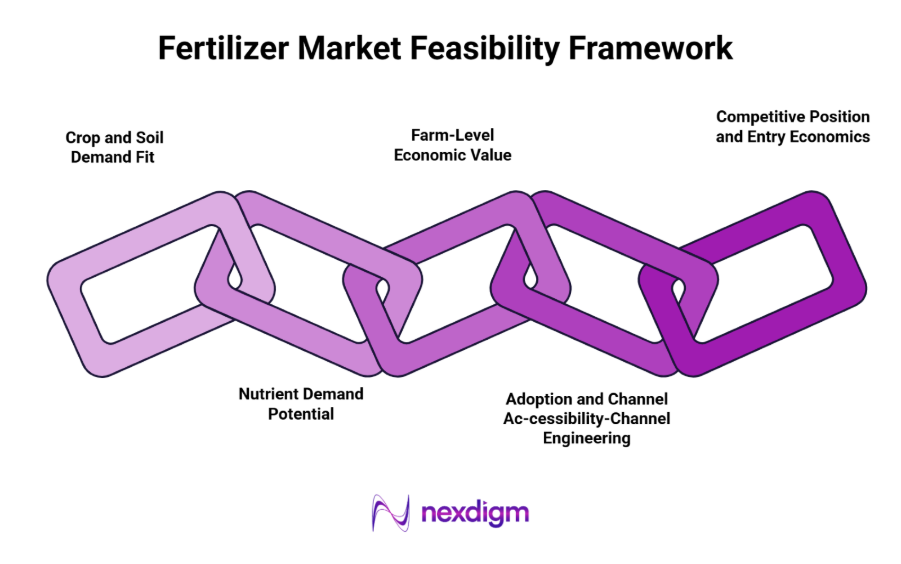
- Crop and Soil Demand Fit
Identify crops, regions, and soil conditions with genuine agronomic relevance. Nexdigm segments the market by crop mix, acreage, soil deficiencies, application rates, and farming practices to define the technically viable addressable market instead of relying on aggregate fertilizer consumption. - Nutrient Demand Potential
Translate agricultural production into nutrient requirements across NPK, secondary nutrients, and micronutrients. Combining historical consumption with crop-mix, yield, and acreage trends provides a driver-based demand forecast rather than a basic sales extrapolation. - Farm-Level Economic Value
Evaluate whether the product delivers sufficient return on investment for adoption. By comparing per-hectare costs against yield improvements, quality gains, and input savings across farm sizes and crop-price scenarios, this step determines economic viability, which is essential for higher-cost specialty formulations. - Adoption and Channel Accessibility
Assess route-to-market pathways and practical adoption barriers. Mapping distributors, retailers, cooperatives, and influencers highlights margin structures and reach, while field research reveals friction points like perceived risk, application complexity, or lack of technical support that limit real-world sales. - Competitive Position and Entry Economics
Evaluate the feasibility of building a defensible market position. Analyzing incumbent brands, pricing, subsidies, import reliance, and supply chain costs pinpoints segments where the product can achieve sustainable differentiation and outlines the required entry capital.
Together, these five points move fertilizer feasibility analysis from nutrient consumption to actual market accessibility. They connect soil and crop requirements with farm economics, purchasing behaviour, distribution, and competitive conditions.
Nexdigm Case: Fertilizer Entry Feasibility
A fertilizer producer assessed 8 crops across 6 regions. Nexdigm mapped nutrient requirements, acreage, farm economics, 4 competing product groups, and distribution coverage, identifying 3 priority markets representing $146 million in addressable annual demand.
To take the next step, simply visit our Request a Consultation page and share your requirements with us.
Harsh Mittal
+91-8422857704