

Fertilizer procurement is a significant commercial consideration for agricultural businesses, distributors, manufacturers and large-scale farming operations. Prices are influenced by international commodity markets, imported raw materials, energy costs, manufacturing capacity, government policies, logistics and seasonal demand. For buyers managing large procurement volumes, even modest price differences can translate into substantial expenditure.
However, fertilizer pricing is difficult to benchmark accurately. Products differ in nutrient composition, grade, formulation and packaging. Prices may also vary between manufacturers, distributors and regions. A procurement team comparing quotations without accounting for these differences may mistake a specification gap for a commercial advantage.
Import Dependence Exposes Buyers to External Market Movements
India’s fertilizer market has a substantial connection to international supply chains. Domestic production supports a large share of demand, but imported products and raw materials remain important for several fertilizer categories.
The Government of India’s FY 2024–25 fertilizer data illustrates this exposure. India imported 45.69 lakh metric tonnes of DAP against domestic production of 37.72 lakh metric tonnes. MOP remained entirely import-dependent, with imports of 35.41 lakh metric tonnes against demand of 22.21 lakh metric tonnes.
These figures demonstrate why international availability, freight and currency movements can influence procurement economics.
For buyers, import dependence creates uncertainty around landed prices and delivery timelines. A change in global supply conditions can affect the cost of imported products and the economics of domestic manufacturers using imported inputs.
Nutrient Prices Do Not Move in the Same Way
Urea, DAP, MOP and NPK fertilizers have different production processes, raw material requirements and market structures. Their pricing drivers are therefore not identical.
Nitrogenous fertilizers are influenced by natural gas and energy costs, while phosphatic fertilizers depend on inputs such as phosphate rock, sulphur and ammonia. Potassic fertilizer procurement is particularly exposed to international suppliers and trade conditions.
This makes category-level benchmarking essential. A buyer cannot assume that a percentage change in one fertilizer category should apply to another. Nor can a quoted price be evaluated properly without understanding the nutrient content and product specification.
Seasonal Demand Creates Negotiation and Availability Pressure
Fertilizer procurement follows agricultural seasons, with demand concentrated around major sowing periods. Manufacturers, importers and distributors must plan production, imports, inventory and distribution to meet these requirements.
The timing of a purchase can therefore affect both price and availability. Buyers entering the market close to a peak demand period may have fewer supplier alternatives, especially for products with concentrated import origins or limited regional distribution.
Inventory planning introduces another trade-off. Early procurement can improve supply certainty but increase storage and working capital costs. Delayed procurement may reduce carrying costs while increasing exposure to price movements or shortages.
Regional Price Differences Can Hide Commercial Inefficiencies
Fertilizer prices may vary across regions because of freight, handling, distribution margins, packaging and the distance between production or import points and consumption markets. Differences can also arise from supplier relationships, order quantities and credit terms.
A manufacturer supplying bulk quantities directly may offer a different commercial structure from a distributor serving smaller buyers. Comparing their quotations without adjusting for delivery terms, volume and service scope can produce misleading conclusions.
Procurement teams should also distinguish between regulated or administered price arrangements and products whose commercial prices are more directly influenced by market conditions. The applicable pricing mechanism needs to be understood before a benchmark is used in negotiations.
What Buyers Should Do to Improve Fertilizer Price Negotiations
A structured fertilizer price benchmarking research exercise should compare prices across equivalent product specifications, sourcing channels, regions and purchase periods. It should combine supplier quotations with market intelligence on raw material costs, import trends, manufacturing conditions and distribution economics.
The analysis should establish a clear baseline for each fertilizer category. This includes nutrient composition, grade, packaging, order volume, delivery location, payment terms and applicable commercial conditions. Buyers can then identify whether price differences are driven by product specifications, supplier margins, logistics or broader market movements.
A useful benchmark should also distinguish between the quoted purchase price and the total landed cost. Freight, handling, storage, financing and inventory-related expenses can change the final procurement outcome.
Nexdigm supports organisations through market pricing research, supplier benchmarking, procurement intelligence and commercial analysis, helping buyers understand price movements and identify opportunities for stronger sourcing decisions.
Fertilizer Price Benchmarking Framework
A comprehensive benchmarking exercise should include six stages:
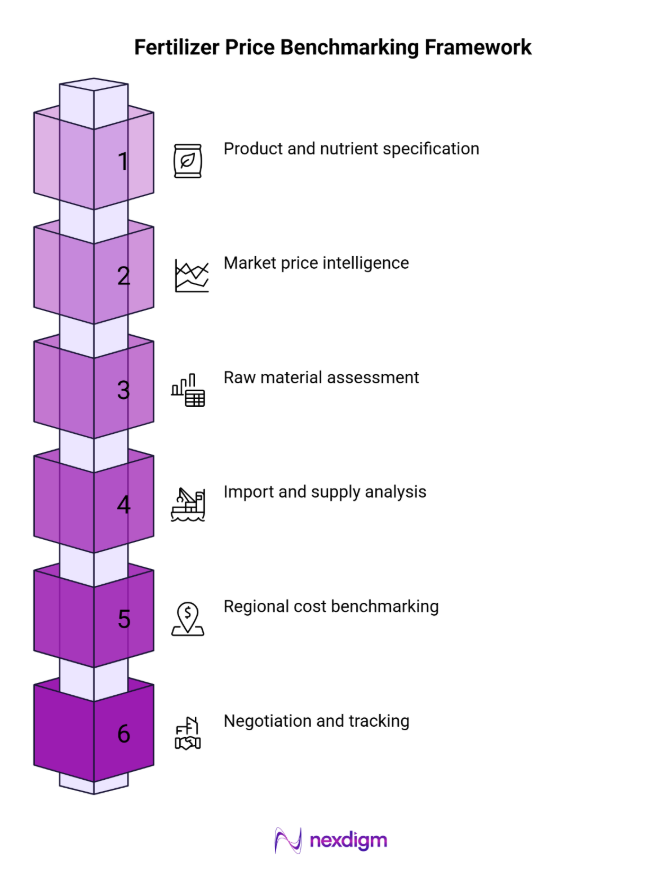
- Product and nutrient specification: Classify fertilizer requirements by category, grade, nutrient composition, formulation, packaging and intended application. Establish comparable specifications before collecting prices.
- Market price intelligence: Track manufacturer quotations, distributor prices, import benchmarks and historical price movements. Separate regulated pricing arrangements from market-linked commercial pricing.
- Raw material and cost-driver assessment: Examine the influence of natural gas, phosphate rock, sulphur, ammonia, potash, energy, manufacturing and international freight. Identify which cost components are most relevant to each fertilizer category.
- Import and supply-market analysis: Review import volumes, source-country concentration, domestic production, supplier capacity and shipping exposure. Assess how international market changes may affect availability and landed costs.
- Regional and total-cost benchmarking: Compare prices across procurement locations after accounting for freight, handling, storage, credit terms, packaging and order volumes. Identify regional variances that cannot be explained by legitimate cost differences.
- Negotiation strategy and performance tracking: Establish target price ranges, preferred supplier options, volume-based negotiation opportunities and contract review triggers. Monitor actual purchase prices against the benchmark and record realised savings over time.
Nexdigm’s Case Study: Benchmarking Fertilizer Prices and Supply Sources
Nexdigm benchmarked 27 fertilizer suppliers across 5 product categories, examining domestic and imported supply, regional pricing, raw material exposure and landed costs. The research identified 8 negotiation opportunities and 3 categories requiring closer monitoring of import dependence.
To take the next step, simply visit our Request a Consultation page and share your requirements with us.
Harsh Mittal
+91-8422857704