

Fertilizer pricing sensitivity analysis services help manufacturers and distributors understand how farmers, dealers, and regional markets respond to changing prices amid raw material, logistics, and demand volatility. Through comprehensive Pricing Analysis Services, businesses can evaluate price elasticity, affordability thresholds, purchasing behavior, competitor prices, crop economics, subsidy effects, channel margins, and seasonal demand.
These insights reveal acceptable price ranges, volume risks, margin opportunities, and customer resistance across fertilizer categories. Effective sensitivity analysis supports price optimization, scenario planning, discount design, market segmentation, and revenue forecasting, enabling fertilizer companies to protect profitability, maintain farmer accessibility, improve demand resilience, and achieve sustainable commercial growth.
An illustrative 12% improvement in fertilizer pricing accuracy can strengthen commercial performance. Pricing Analysis Services assess price elasticity, farmer affordability, competitor movements, seasonal demand, costs, and channel margins, helping businesses protect profitability, sustain volumes, improve resilience, and support long-term growth.
Pricing Analysis for Fertilizer Demand, Affordability, and Margin Stability
Fertilizer pricing analysis combines demand sensitivity, farmer affordability, input costs, competitive movements, and channel economics to maintain accessible prices, stabilize margins, protect volumes, and support resilient agricultural market growth. Some core elements in focus of it are:
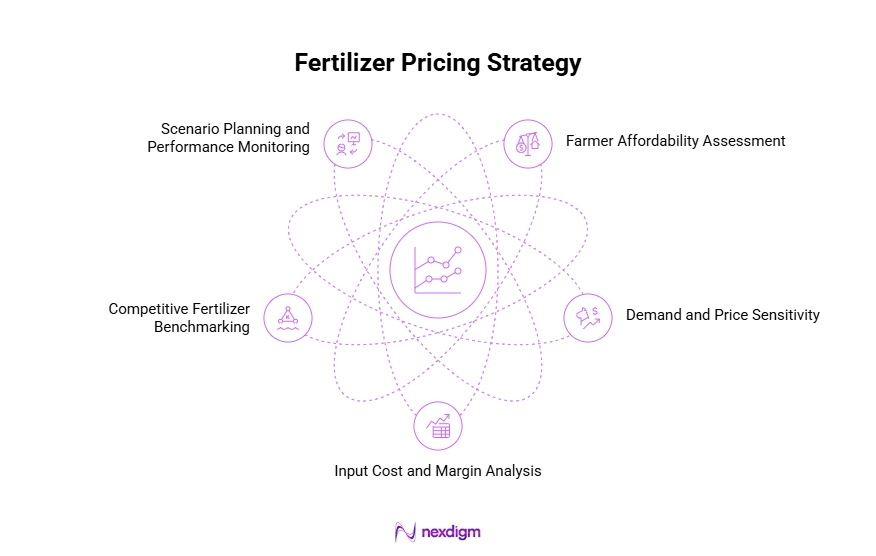
- Farmer Affordability Assessment: Evaluate farm income, crop returns, seasonal cash flow, credit access, and purchasing capacity. Elements in focus include affordability thresholds, payment flexibility, pack sizes, and adoption barriers.
- Demand and Price Sensitivity: Measure how sales volumes respond to price changes across regions, seasons, crops, and farmer segments. Elements in focus include elasticity, switching behavior, purchase timing, and volume risk.
- Input Cost and Margin Analysis: Assess raw materials, energy, manufacturing, logistics, duties, and channel expenses. Elements in focus include cost recovery, price floors, margin stability, and profitability protection.
- Competitive Fertilizer Benchmarking: Compare competitor prices, product formulations, nutrient value, promotions, discounts, and regional positioning. Elements in focus include pricing gaps, market differentiation, substitution threats, and competitive response.
- Scenario Planning and Performance Monitoring: Model alternative prices under changing costs and demand, then track realization, volumes, and margins. Elements in focus include forecast accuracy, resilience, and timely pricing adjustments.
Nexdigm’s Role in Optimizing Fertilizer Prices Amid Market Volatility
Nexdigm’s Pricing Analysis Services help fertilizer companies optimize pricing during volatile market conditions through fertilizer pricing sensitivity analysis services, price elasticity analysis, competitive pricing intelligence, market pricing strategy, farmer affordability analysis, and margin optimization. By assessing input cost fluctuations, demand shifts, competitor pricing, channel dynamics, and purchasing behavior, Nexdigm enables businesses to improve price realization, stabilize margins, sustain demand, and achieve resilient commercial growth.
Nexdigm’s Strategic Roadmap for Fertilizer Pricing Resilience
Nexdigm’s strategic roadmap combines cost intelligence, demand sensitivity, farmer affordability, competitor benchmarking, and scenario planning to build resilient fertilizer pricing, protect margins, sustain volumes, and support long-term market growth success. Data Driven types followed by Nexdigm’s experts are:
Type 1: Cost-Responsive Pricing
Prices adjust to raw materials, energy, manufacturing, logistics, duties, and currency movements, helping fertilizer businesses recover costs while maintaining stable margins.
Type 2: Demand-Sensitive Pricing
Pricing reflects seasonal demand, crop cycles, regional consumption, and purchase timing to protect sales volumes and reduce risks from changing market conditions.
Type 3: Affordability-Based Pricing
Prices align with farmer income, crop returns, credit availability, and purchasing capacity, supporting product accessibility, adoption, and balanced commercial performance.
Type 4: Competitive Benchmark Pricing
Competitor prices, formulations, nutrient value, discounts, and channel offers are compared to identify market gaps and establish differentiated, defensible price positions.
Type 5: Scenario-Based Dynamic Pricing
Alternative pricing scenarios model cost, demand, volume, revenue, and margin outcomes, enabling timely adjustments and stronger resilience during volatile market periods.
Nexdigm’s Case
Nexdigm helped a fertilizer manufacturer strengthen pricing resilience during volatile market conditions. The initiative improved price realization by 13%, reduced margin erosion by 10%, and increased sales stability by 9%, enabling stronger profitability and sustained market competitiveness.
To take the next step, simply visit our Request a Consultation page and share your requirements with us.
Harsh Mittal
+91-8422857704