

Fertilizer sourcing decisions are shaped by more than the prices offered by individual manufacturers. Buyers must consider production capacity, raw material availability, import dependence, distribution networks, product specifications and the commercial terms attached to supply agreements. These factors become particularly important for organisations purchasing large volumes across multiple fertilizer categories or operating in several agricultural markets.
India consumed approximately 705.23 lakh metric tonnes of fertilizers in 2024–25. Urea accounted for 387.92 lakh tonnes, while DAP consumption reached 96.29 lakh tonnes and NPK consumption stood at 149.72 lakh tonnes. Domestic production does not fully meet demand across several important categories. This creates a sourcing environment in which manufacturers, importers and distributors have different roles in maintaining supply availability.
For procurement teams, the central question is not simply which supplier offers the lowest price. It is which supplier markets provide the strongest combination of competitive pricing, dependable capacity, product suitability and commercial flexibility. Fertilizer strategic sourcing research services help organisations answer this question through structured market mapping, supplier assessment and category-level sourcing analysis.
Why Fertilizer Supplier Markets Require Deeper Assessment
Production capacity and raw material access vary across suppliers
Fertilizer manufacturers operate with different production capabilities and raw material dependencies. Urea production relies on natural gas, while phosphatic and potassic fertilizers are influenced by the availability of inputs such as rock phosphate, phosphoric acid, ammonia and potash.
These differences affect supplier economics and exposure to market volatility. A manufacturer with strong domestic production capabilities may offer different supply advantages from an importer dependent on international procurement and shipping schedules.
The distinction becomes important when evaluating long-term supply reliability. A supplier’s current inventory position does not necessarily reflect its ability to maintain deliveries across several procurement cycles.
Import dependence creates exposure to external markets
India relies on imports for important fertilizer products and raw materials. International commodity prices, freight availability, exchange rates and geopolitical developments can influence the cost and timing of supply.
This creates a need to assess supplier markets beyond domestic manufacturer lists. Importers with established sourcing relationships, access to multiple origins and reliable logistics arrangements may offer different commercial advantages from suppliers dependent on a narrow set of overseas sources.
Buyers that overlook these upstream dependencies may underestimate the risks associated with apparently competitive supplier offers.
Regional distribution capability affects landed cost
A supplier may have strong manufacturing capacity but limited distribution coverage in the buyer’s operating regions. Transportation distance, warehouse access, handling requirements and seasonal delivery capacity can influence the final procurement cost.
Regional distributors may offer faster availability and local market knowledge, but their pricing may include additional distribution margins. Direct manufacturer sourcing may improve price visibility while creating minimum order or logistics constraints.
The appropriate sourcing market therefore depends on both supplier capability and the buyer’s delivery requirements.
Product specifications complicate supplier comparisons
Urea, DAP, MOP, SSP and complex NPK fertilizers cannot be assessed using one common pricing benchmark. Nutrient composition, grade, physical quality, packaging and application requirements must be considered before comparing offers.
Even within the same category, suppliers may offer different grades or commercial specifications. A lower price per tonne does not necessarily represent better value if the nutrient content or quality parameters are not equivalent.
How Buyers Can Identify More Competitive Supplier Markets
Supplier market research should begin with category-level demand and product specifications. Procurement teams need to establish the volumes, grades, delivery locations and seasonal requirements that suppliers must fulfil.
The next step is to map manufacturers, importers and regional distributors according to their capabilities. This should include production capacity, sourcing origins, geographic coverage, inventory arrangements and relevant product portfolios.
Buyers should then compare supplier offers using landed cost and commercial terms rather than quoted prices alone. Payment conditions, volume commitments, freight arrangements, delivery schedules and supply guarantees can materially change the value of a sourcing option.
Nexdigm supports organisations through market research, supplier intelligence, price benchmarking and strategic sourcing analysis. Its research can help buyers evaluate fertilizer supplier markets, identify alternative sourcing channels and develop category-level procurement priorities.
Fertilizer Strategic Sourcing Research Framework
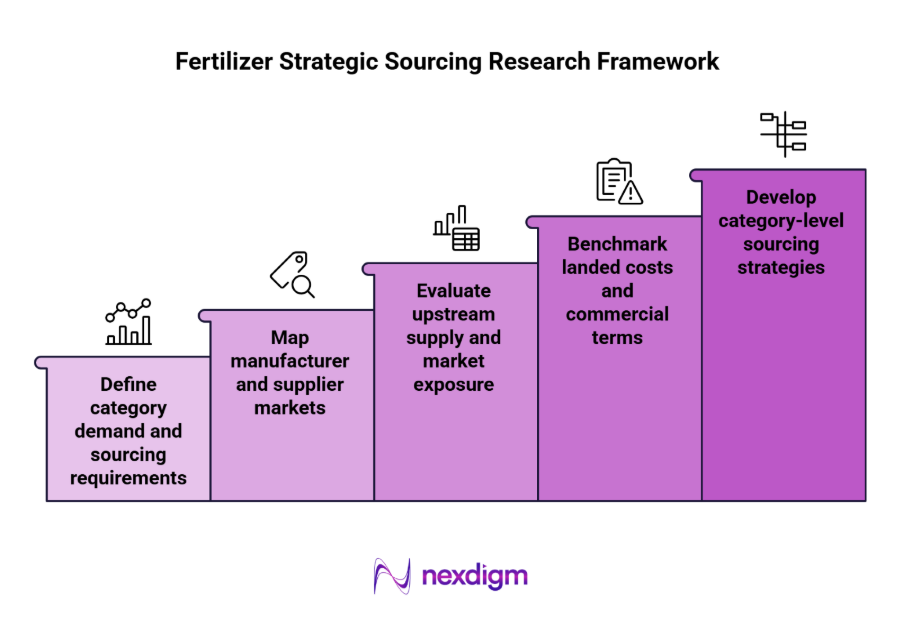
- Define category demand and sourcing requirements
Segment fertilizer requirements by product, nutrient grade, volume, delivery location and seasonal demand. Establish which categories require long-term supply arrangements and which can be sourced through shorter purchasing cycles. - Map manufacturer and supplier markets
Identify domestic manufacturers, importers, regional distributors and alternative sourcing markets. Assess production capabilities, raw material dependencies, product portfolios and geographic coverage. - Evaluate upstream supply and market exposure
Examine supplier dependence on imported inputs, international sourcing origins, logistics arrangements and production constraints. Identify categories where external market movements could affect price or availability. - Benchmark landed costs and commercial terms
Compare equivalent product specifications across suppliers. Include freight, handling, discounts, credit periods, minimum order quantities and delivery commitments when evaluating the effective cost. - Develop category-level sourcing strategies
Prioritise suppliers according to cost competitiveness, supply reliability, market exposure and commercial flexibility. Determine where direct sourcing, regional distribution partnerships, diversified imports or consolidated contracts offer the strongest procurement case.
Nexdigm’s Case Study: Mapping Fertilizer Supplier Markets
Nexdigm assessed 5 fertilizer categories across 4 sourcing regions and 19 suppliers. The research identified 3 categories with limited sourcing alternatives and developed a supplier diversification plan covering domestic manufacturers, importers and regional distribution partners.
To take the next step, simply visit our Request a Consultation page and share your requirements with us.
Harsh Mittal
+91-8422857704