

Fertilizer procurement is shaped by three connected requirements: the right nutrient composition, availability at the right time and a supply network capable of reaching agricultural markets efficiently. A supplier may have a broad product portfolio but limited distribution in a particular state. Another may offer competitive prices but depend heavily on imported raw materials or face seasonal logistics constraints.
For agribusinesses, agricultural input distributors and large institutional buyers, selecting fertilizer suppliers requires an understanding of product capabilities, manufacturing arrangements, sourcing dependencies and regional distribution. The assessment should also consider how well suppliers support changing crop nutrition requirements.
Start with the Nutrient Requirement
Fertilizer demand differs according to crop type, soil conditions, irrigation, cultivation practices and the stage of crop development. Suppliers should therefore be evaluated on their ability to provide products relevant to the intended agricultural applications.
The market includes several major categories:
- Nitrogenous fertilizers: Products such as urea that supply nitrogen for crop growth and development.
- Phosphatic fertilizers: Products such as DAP and SSP that provide phosphorus, often alongside other nutrients.
- Potassic fertilizers: Products such as MOP that supply potassium.
- Complex and NPK fertilizers: Formulations combining multiple primary nutrients in specified proportions.
- Micronutrient fertilizers: Products supplying elements such as zinc, boron, iron and other nutrients required in smaller quantities.
- Speciality and water-soluble fertilizers: Products designed for particular application methods, cultivation systems or crop requirements.
The assessment should examine nutrient composition, product specifications, packaging, application suitability and compliance with applicable quality requirements. Product breadth alone is not sufficient if the supplier cannot consistently provide the formulations required in the target markets.
Manufacturing Capacity and Raw Material Dependencies
A fertilizer supplier’s ability to meet demand depends partly on its production infrastructure and access to raw materials. Domestic manufacturing, imported intermediates and international commodity markets can all influence supply continuity and commercial pricing.
India’s fertilizer sector illustrates the importance of this assessment. According to parliamentary reporting, total fertilizer consumption reached approximately 705.23 lakh metric tonnes in 2024–25, while domestic production was approximately 517.85 lakh metric tonnes. The difference highlights the role of imports and supply chain coordination in meeting national requirements.
Procurement teams should examine whether suppliers manufacture products directly, source from third-party producers or rely on imports. They should also assess production locations, plant capacity, raw material procurement arrangements and exposure to international price movements.
Evaluating fertilizer supplier analysis for Regional Procurement
A supplier that performs well at the national level may not be equally effective in every agricultural market. Regional demand patterns, crop concentration, soil characteristics and transport infrastructure influence which suppliers can serve a particular territory efficiently.
A Fertilizer supplier analysis should examine:
- Regional product availability: Whether the supplier maintains the required fertilizer grades and quantities in relevant agricultural markets.
- Distribution infrastructure: Whether warehouses, dealers, transport arrangements and regional stock points support timely delivery.
- Crop and soil suitability: Whether the supplier offers products aligned with regional nutrient requirements and agronomic recommendations.
- Commercial competitiveness: Whether prices, credit arrangements, bulk discounts and payment terms are competitive.
- Technical support: Whether the supplier provides product guidance, application information and support for distributors or institutional buyers.
This regional approach is especially important for organisations sourcing fertilizers across multiple states or serving different crop segments. A supplier with strong distribution in irrigated cereal markets may not offer the same reach in horticultural or plantation crop clusters.
Availability and Seasonal Supply Planning
Fertilizer requirements fluctuate across Kharif and Rabi seasons. Procurement teams must coordinate purchases with crop calendars, government allocation processes, dealer inventory and transportation schedules.
Government reporting in July 2026 indicated that India’s total fertilizer requirement for 2025–26 was assessed at 677.18 lakh metric tonnes, compared with 649.43 lakh metric tonnes in 2024–25. The increase illustrates why advance demand estimation and supply coordination remain important.
Supplier evaluation should therefore examine historical fulfilment, lead times, stock visibility, replenishment practices and the ability to respond to unexpected regional demand. It should also consider the availability of alternative supply arrangements if production or imports are disrupted.
Quality, Compliance and Product Integrity
Fertilizer quality affects both crop nutrition and commercial reliability. Buyers should verify nutrient declarations, applicable product standards, batch records, packaging and labelling. Suppliers should be able to provide relevant testing and compliance documentation.
For speciality and micronutrient products, formulation consistency and technical specifications deserve particular attention. Organisations should also assess how suppliers manage product complaints, non-conforming batches and replacement requests.
The evaluation should distinguish between suppliers that simply distribute products and those with the technical and quality infrastructure needed to support more demanding procurement requirements.
How Nexdigm Supports Fertilizer Supplier Research
Nexdigm supports agribusinesses through supplier intelligence, market research, regional demand assessment and procurement benchmarking. Its research can help clients map fertilizer manufacturers and distributors, compare product portfolios, assess supply dependencies and evaluate commercial opportunities across regional markets.
Agribusiness Fertilizer Sourcing Framework
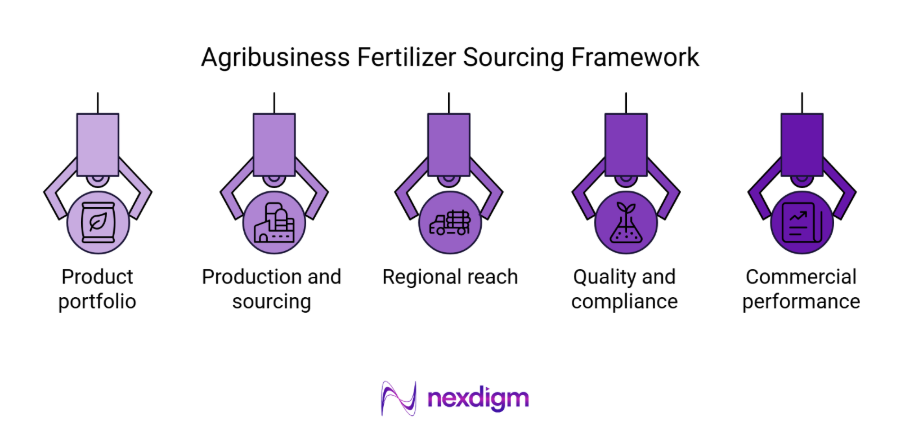
- Product portfolio: Compare nutrient categories, formulations, specifications and crop relevance.
- Production and sourcing: Assess manufacturing capacity, raw material dependencies and import exposure.
- Regional reach: Evaluate warehouses, distribution networks, stock availability and delivery performance.
- Quality and compliance: Review product testing, nutrient declarations, documentation and complaint management.
- Commercial performance: Compare pricing, credit terms, supply commitments and technical support.
Nexdigm’s Case Study: Assessing Fertilizer Supplier Capabilities
Nexdigm evaluated 15 fertilizer suppliers across six product categories, assessed regional availability in 10 agricultural markets and reviewed 28 commercial and operational indicators. The research shortlisted 4 suppliers for further evaluation.
To take the next step, simply visit our Request a Consultation page and share your requirements with us.
Harsh Mittal
+91-8422857704